OUR EUROPEAN LETTER

4%

Pacific Press Publishing Company · Mountain View, California · Aug 30, 1905

FromSigns of the Times, Vol. 31, No. 35.

Read the full edition
OUR EUROPEAN LETTER.

Religio-political Debates in France.

THE reading of M. Briand's report on the government bill for the separation of church and state, on March 4, was the opening of a brilliant debate on the subject which has lasted four entire months. The first month was taken up by the general discussion, in which the principles and merits of the bill were discussed.
M. Briand himself, M. Jaurès, the Socialist leader, and M. Ribot, all three in favor of the separation, tho' not believers in Christianity, spoke eloquently on the poetic beauties and the practical usefulness of religion. These speeches were made during Lent, and a Catholic speaker said that during that week the French tribune rivalled with the pulpit of Notre Dame Cathedral in exalting the benefits of religion. Possibly these orations were intended to sweeten a debate which had in it many elements of discord and bitterness.
Every standpoint was represented—agnostic, deist, atheist, Protestant, moderate Catholic and rank Papist. The assembly looked more like a theological council than like a political arena.

A Catholic Prediction.

M. Benoist, a Catholic, depicted the conflicts which he thought would be kindled by the measure proposed; he repeated the words of an Italian politician: "You will have an armed church in a disarmed state," and he predicted that in ten years the French Government would go to Canossa, as did Bismark, who, M. Benoist affirmed, regretted afterward that he had not had, like France, a concordat with Rome. "You have one," M. Benoist added, "and because you know not how to use it, you tear it to pieces."
Count Bonf de Castellane, a fervent Catholic, followed with a passionate speech, saying that what was intended was not the separation of the church from the state, but the destruction of the church by the state.
M. Grousseau, another Catholic, considered the withdrawal of state money from the priesthood as a robbery, and he compared the proposed separation with a divorce, with this difference, that here the abhorred wife would stay in the house and raise up no end of troubles which could all be avoided, he said, by keeping up the marriage relation.

A Socialist View.

Lewaes, a socialist, answered him by stating that the régime of the concordat had been one of ceaseless quarrel between the state and the church. He spoke of papal persecutions; he referred to a great religious revival in 1797, when the Catholic Church was severed from all connection with the French Convention; and he also recalled an interesting movement in 1830 on the part of some distinguished prelates toward the separation of church and state.

Protestant Opinion.

Eugene Réveilland, a Protestant deputy, spoke at length. He began by showing that Paganism at Rome or Athens knew no other doctrine than the union of the state with religion. Christ introduced a new teaching when He said, "My kingdom is not of this world," and the apostolic church was founded on that principle. Constantine brought back the pagan system, and papal supremacy was the outgrowth of this apostasy. But true church democracy survived among the small associations known as the Waldenses, the Albigenses, and the Paulicians. It existed in germ in the great Reformation. Unrecognized by Calvin, it was formulated by John Milton, and fully brought out, two hundred years later, by the United States of America.
Edmond de Pressensé, late French senator, was quoted as saying: "What is there on the United States' statute book about this whole question of church and state? - A blank page. Nothing but that, but all of that."
Then the speaker referred to Vinet, the eloquent Swiss writer on religious liberty, who wrote: "If you ask us, What will become of the church if abandoned by the state? we shall answer simply, Let her become what she can; let her follow her destiny; let her live if she may; let her die if she must. . . . If she can not exist by herself, she is not the truth. . . . If she is of God, it hath been given unto her, as unto Christ, 'to have life in herself,' let her show that; that is her first duty; that is the undeniable proof of her divine origin."

Liberty for All.

M. Bienenu-Martin, minister of cults, followed, stating that this measure was not intended or likely—as clericals declare—to open up an era of violence against the Catholic Church, but simply the necessary conclusion of the principles of liberty of conscience and worship, a liberty which, by the way, the Church of Rome has never accepted except for herself alone.
Maurice Allard, an atheist, had hoped, on the contrary, that the forthcoming law would break the Romish "block" into a thousand scattered fragments unable to unite, and thus effectively fetter the church which, as also Christianity and even the belief in the Creator, is inimical to all progress and civilization.
A few speakers answered him and still took sides, and the general discussion was concluded April 11.
In our next letter we hope to bring out some interesting gems of thought from the discussions proper.
Jean Vuilleumier.
Gland, Switzerland.
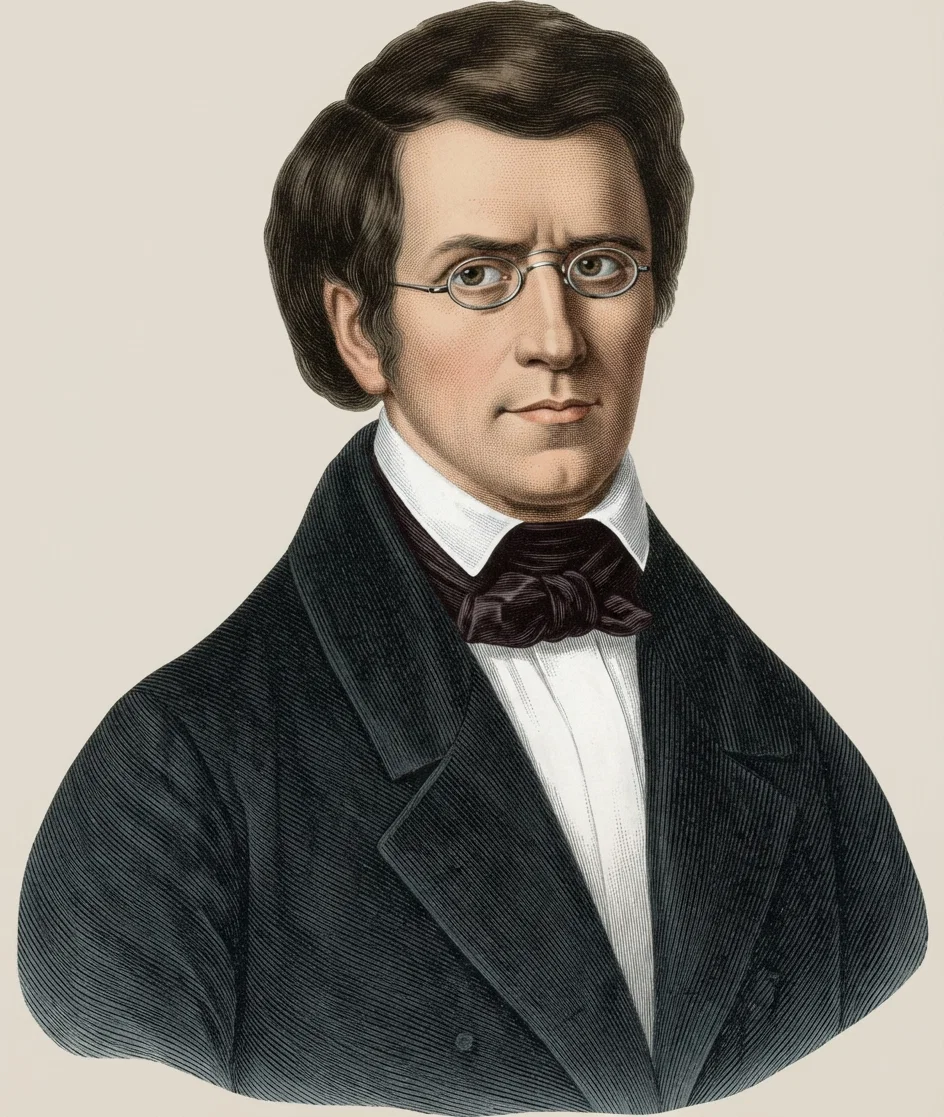
M. Vinet, of Switzerland, an Advocate of Religious Liberty.