Our Letter from Athens

4%

Pacific Press Publishing Company · Mountain View, California · Dec 9, 1908

FromSigns of the Times, Vol. 35, No. 19.

Read the full edition

Our Letter from Athens

By Prof. Warren E. Howell

I.—Notes on the Balkan Situation.

PERHAPS the readers of your excellent journal would be interested in a few news notes on that most unique international drama — not to say comedy or farce because of its gravity — that is being enacted just across the border from our little kingdom of ancient renown, as also in some observations and impressions made at close range. Not that the writer presumes to speak exhaustively on an inexhaustible subject, nor even ably on a question of such far-reaching and weighty import, but in the hope that he may add a little stimulus to serious thinking upon a situation that is just now eliciting universal interest from historical and political considerations, and which should above all occupy our attention from prophetical viewpoint. The unprecedented means for the rapid transit of news nowadays, makes known the main facts of a situation a few hours after the incidents occur, yet there often remain certain aspects and impressions perceived by one standing in the very shadow of passing events, that are not so readily discerned from afar; such aspects and impressions have given the impetus to this letter.
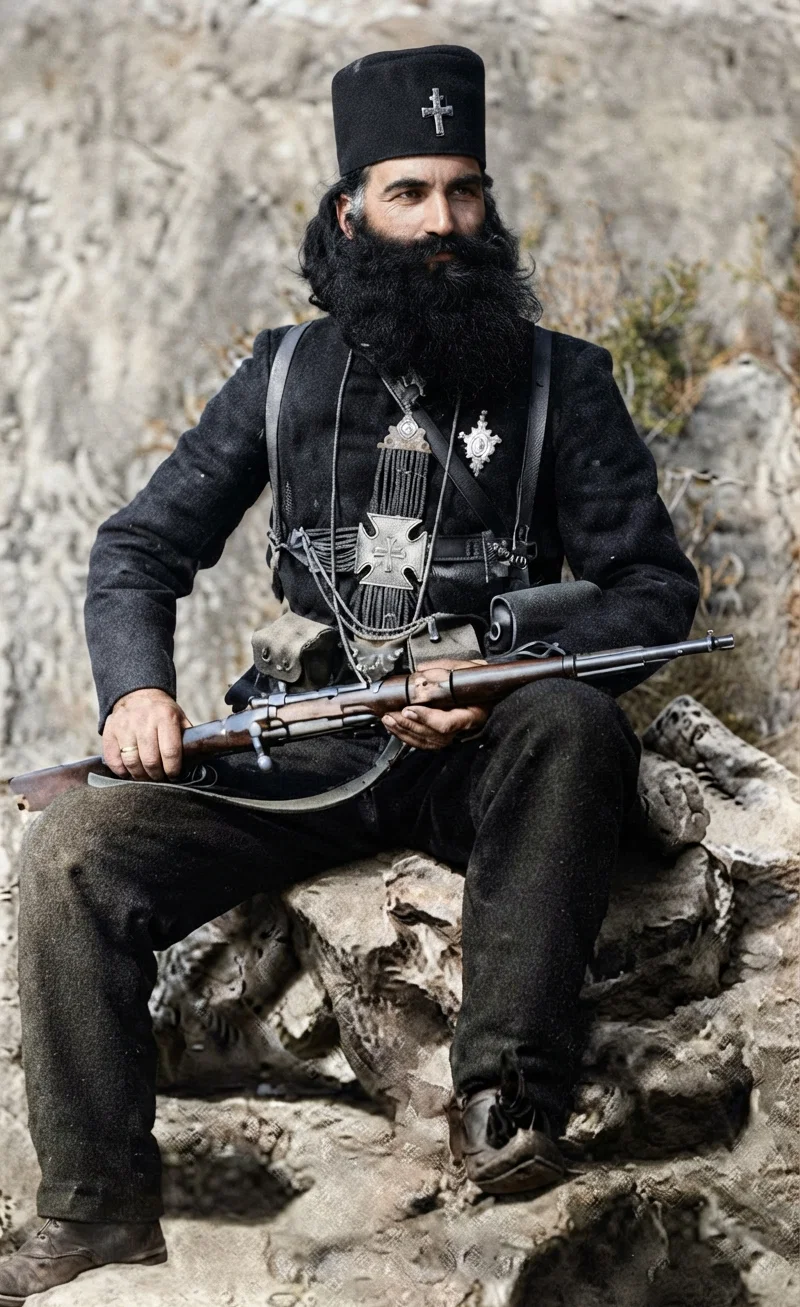
A priest to the rescue as leader of a Greek band in Macedonia.
As is well known to all, European Turkey has long been a bone of contention among the great powers, a veritable storm-center, from which have issued repeatedly wars and rumors of war. The partial integrity and the unstable independence of Ottoman rule in Europe has been preserved thus far only by the conflicting political ambitions of the greater nations of Europe, any one of which, if given a free hand, could doubtless drive the Turk into Asia and seize upon the coveted prize — Constantinople and the Bosporus with its outlets.
Chief among these ambitious rivals is Russia, so constituted by the logic of her geographical position. With no open seaboard for her commerce in time of peace, and with her fleet bottled up in inland seas in time of hostilities, it has long been a persistent policy of Russia to extend the limits of her vast land-locked territory in some direction to the sea. Preferable above all to her is the exit through the Bosporus and the Dardanelles, with the occupation of Constantinople as a natural stronghold to secure the permanent possession of this important thorofare. Almost within grasp of the coveted prize in the Russo-Turkish war of 1877, her movements in this direction were repressed by the interference of other European powers, tho not without some substantial gain to herself in the extension of her southern boundary to the Danube.
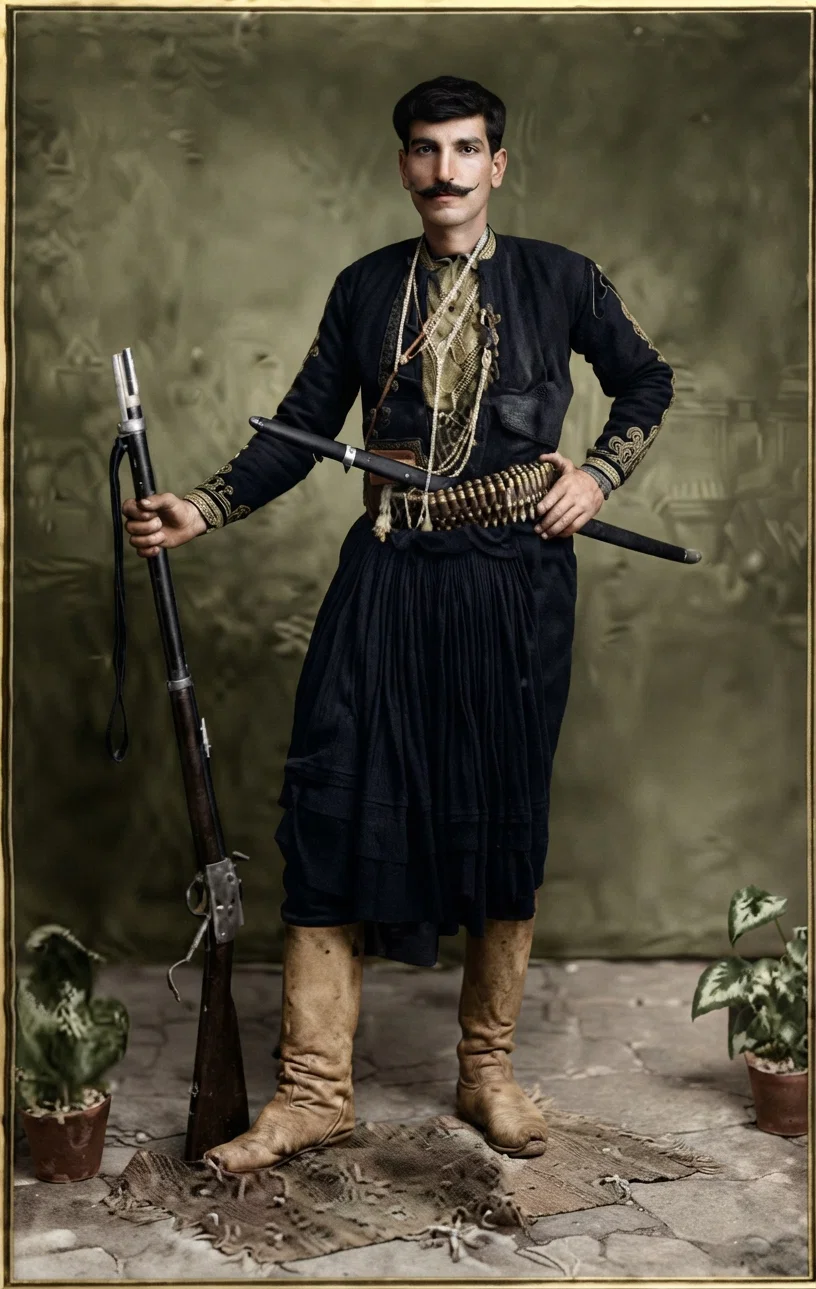
A Cretan leader of a Greek band in Macedonia.
During the “armed peace” that has been maintained in Europe since that time, the sultan of Turkey still holding his dominion by sufferance, Russia has been employed in seeking an outlet in the middle and far East. In the middle East she has unremittingly pursued the policy outlined by Peter the Great to “accelerate as much as possible the decay of Persia” and “to penetrate to the Persian Gulf.” She has been so far successful as to gain a monopoly of trade in northern Persia, to secure the right of constructing railroads over it, and to engineer heavy loans to Persia, secured upon the customs.
In her advances toward the Pacific, Russia has been effectually checked by the victories of Japan, aided by the diplomatic support of England. Consequently the danger to Indiafrom a Russian invasion of China has been removed. Thus profiting by the Anglo-Japanese agreement in the far East, England has sought to reach similar advantages in the middle East by a new and revised agreement with Japan by which the latter, in return for benefits received from British cooperation in the war with Russia, has agreed to assist England in holding Russia back in the middle East.
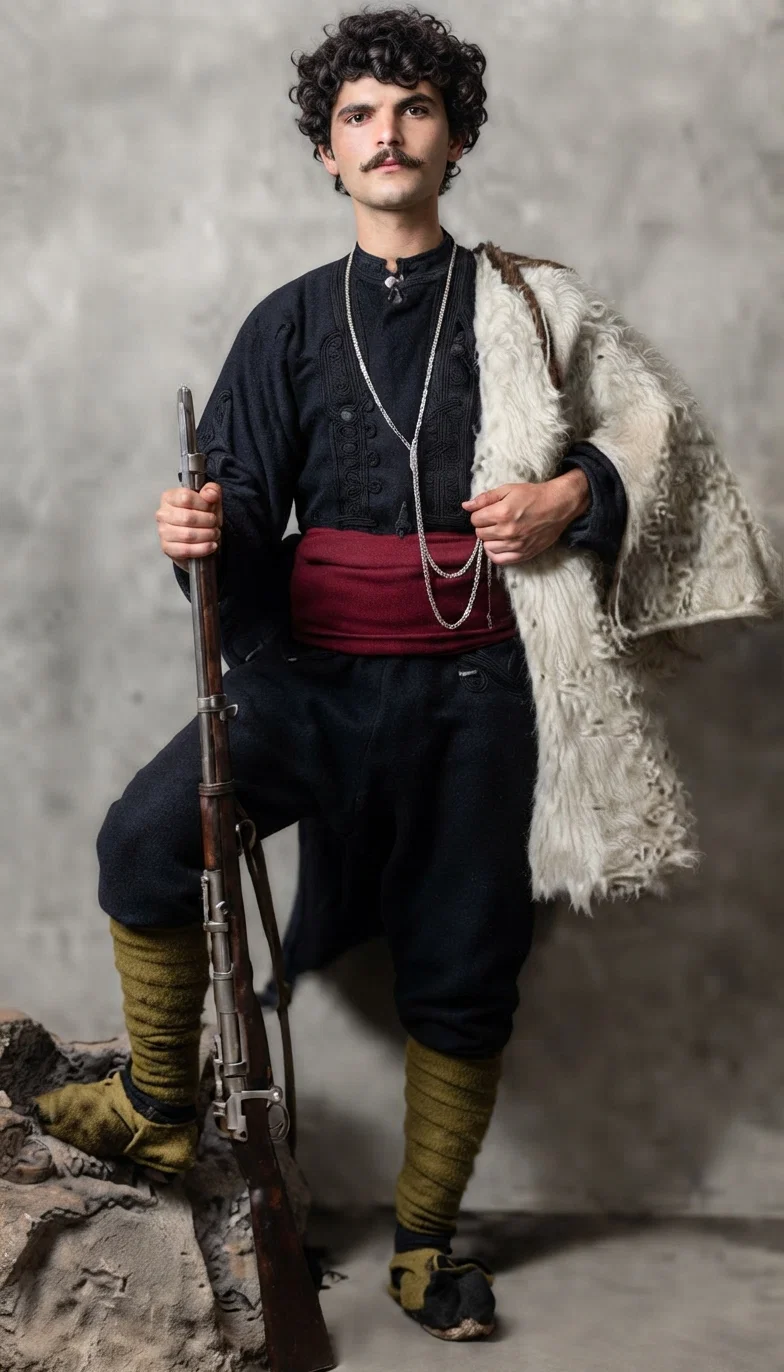
A typical young Macedonian warrior.
This further damming of the waters of Russian expansion has logically and inevitably concentrated Russian activity once more upon the near East. The sultan once again sits unsteady upon his throne. And yet again European diplomacy may be called into drastic action for the adjustment of Balkan affairs.
Meanwhile a new feature has appeared in the complicated tangle. While the attention of Russia and England was being diverted to the far and middle East, Germany has been assiduously cultivating friendly relations with the Sublime Porte, to aid in her scheme of securing an overland route to Asia, the permanent success and usefulness of which depend upon the preserving of the status quo in the Balkan Peninsula; for should Russia make advances on Constantinople, Germany's line of communication with Asia would be cut in the middle. But the maintenance of such a route by Germany would be a parallel and a rival to England's water route by way of the Suez Canal, and would be a menace to the trade if not to the political status of India.
So that we now hear of an Anglo-Russian agreement, adjusting some differences on the Persian situation satisfactory to England, and giving promise of some friendly cooperation with Russia's designs on Turkey. This apparent cooperation takes the form of encouraging Bulgaria to continue and increase her incursions into Macedonia against the Macedonian Greeks, who, in turn, with the assistance of their countrymen from Greece proper and from Crete, make vigorous counter-movements against the Bulgarians, thus creating such a state of internal dissension, bloodshed, and anarchy, as to justify the intervention of Christian Russia and Christian England, in behalf of Christian Bulgarians and Christian Greeks, against the infidel Turk, on the pretext that the latter can not or does not quell these serious disturbances within his realm.
But like most of these political alliances, whatever agreement does exist between Russia and England in regard to the near East can serve their mutual interests for only a certain length of time. For while England's policy seemingly is to create a larger Bulgaria by the annexation of Macedonia, to the end that she may have Bulgarian assistance in defeating Germany's or Russia's project, on the other hand, it has become almost a proverb that "if you prick a Bulgarian, you will find a Russian," by which situation Russia hopes to annex greater Bulgaria to her own dominion, or at least to so cement their relations, that she may thus pave a solid way toward Constantinople.
No sooner did the Anglo-Russian agreement become known than the sultan made haste to grant Germany an extension of 510 miles for the Bagdad Railway, and to call from Berlin to Constantinople one of his most trusted and able advisers. "If this means anything," says a close student of Balkan affairs, "it means that the Porte is contemplating with increased anxiety the possibility of another Russo-Turkish war."
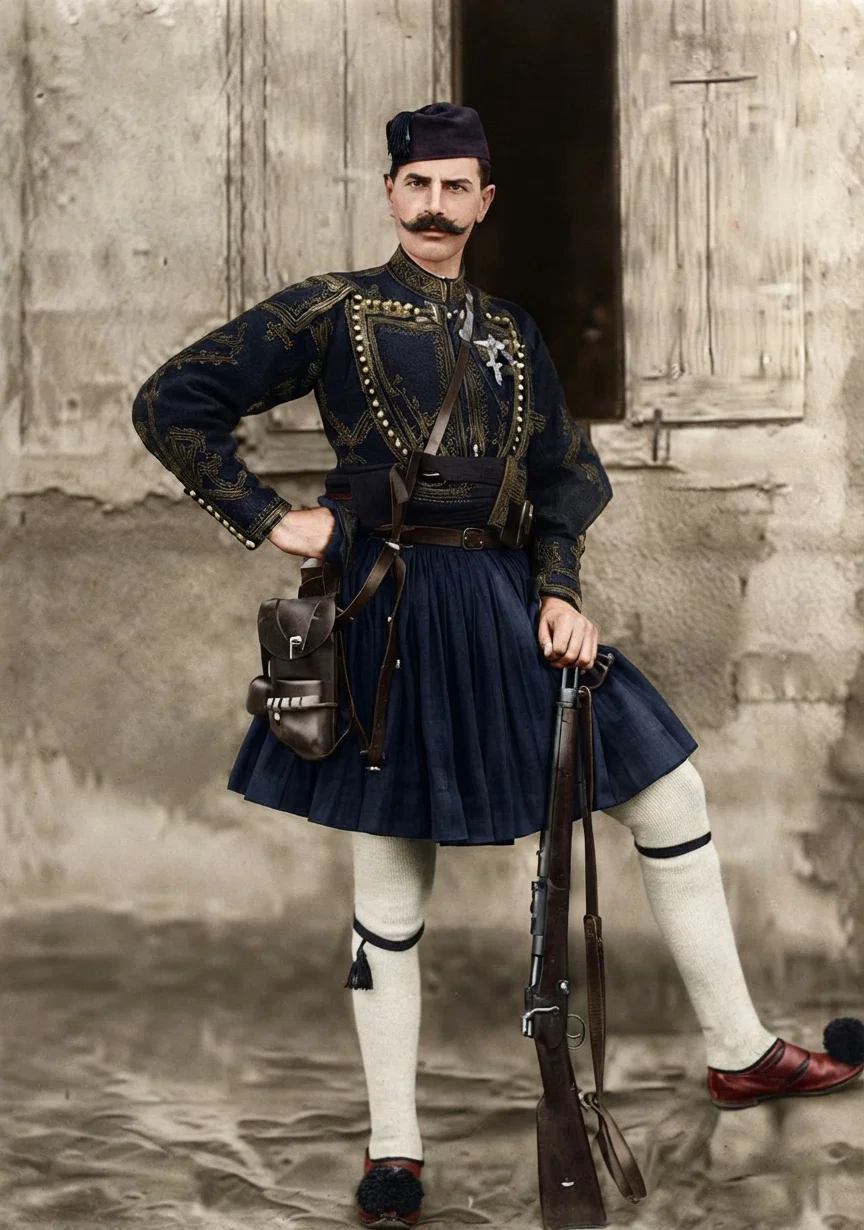
Paul Melas. Member of a wealthy and prominent Greek family of Athens, who went to Macedonia as captain of a Greek band to fight Bulgarians. He was shot by Turkish soldiers, whose informer was a Bulgarian, on the night of Oct. 13, 1904. He raised his own company of warriors, and fitted it out at his own expense, that he might aid in protecting his oppressed countrymen in Macedonia. He is now a national hero, and all but worshiped in every peasant's cot.
It has doubtless been observed by readers of the current news, that not long ago King Edward visited Czar Nicholas at the Russian port of Reval; that prior to this event the President of France visited England; and that a little later President Fallieres went on a visit to Russia. On the other hand, Germany is drawing closer to Austria, and Italy recently announced officially her determination to remain faithful to the Triple Alliance (Germany-Austria-Italy). A London writer of note says: "Every government in Europe has been plunged into a state of nervous excitement, and the whole political atmosphere of the Continent is heavily charged with electricity. No one knows what may happen at any moment, and the slightest incident might easily have far-reaching consequences."
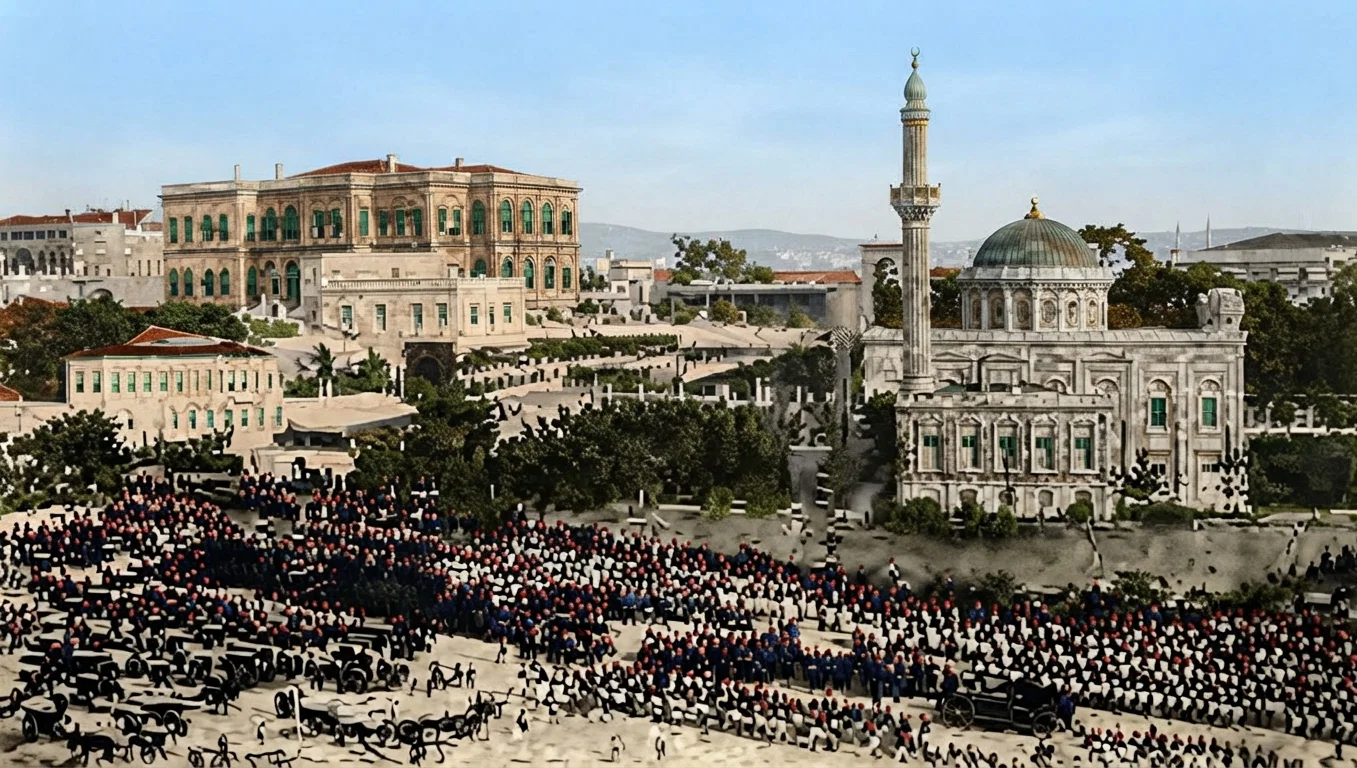
The Yildiz or Palace of the Sultan.
In full accord with the statement that "no one knows what may happen at any moment," is that notable event of latest date which came as a surprise if not a shock to the world — the granting of a constitution to the Ottoman Empire by His Majesty Sultan Abdul Hamid. The occasion for this almost incredible movement was the pressure brought to bear by the progressive element among the Turks themselves. As is characteristic of the oriental temperament, a frenzy of enthusiasm and ecstatic demonstrations prevails at the capital city, at Salonica, Monastiri, and other leading towns. Turks, Greeks, Bulgarians, and what not, are embracing one another in public places, and weeping upon one another's necks with the wildest joy over their newly acquired rights of freedom of speech, freedom of the press, right to public trial, the promised abolition of secret detective service for political reasons, and the right of representation in the law-making body to be formed immediately. The pacification of racial feuds would seem complete. Bulgarian and Greek bands are coming down from the mountains and publicly laying down their arms. Political prisoners are being set free from their dungeons by the hundred as a result of the proclamation of general amnesty. The sultan is all but deified by the torrents of congratulations, felicitations, tears, prostrations, pledges of loyalty, and assurances of love, that are pouring in upon the Yildiz every hour.
Thus a new topic for discussion is projected into diplomatic and student circles. What will be England's attitude now? What course will Russia pursue? What motives have actuated the sultan? Will he keep his word to put the constitution into effect at once? What phase will the Eastern Question now assume? We read:
"It may, however, be found that Russian and German interests are not incompatible. Instead of frustrating Russia's advances upon Constantinople, [Germany] may prefer to see Austria make simultaneous advances upon Salonica. Should this prove to be the case, THE RIVALRY OF THE POWERS, WHICH HAS HITHERTO BEEN SO IMPORTANT A FACTOR IN PRESERVING THE INTEGRITY OF THE TURKISH EMPIRE, WILL LARGELY DISAPPEAR, AND ITS OWN RESOURCES ALONE WILL SAVE IT FROM ULTIMATE ABSORPTION." [Capitals mine.]
The student of the Bible also knows that the Gospel will be preached to every nation, kindred, tongue, and people, and that the providence in the removal of the strict censorship of speech and of the press that has been so long in force in Turkey, opens the way for the proclamation of the Gospel in the full blaze of its glorious truth.
But, Mr. Editor, events are taking place so rapidly over in this part of the world, and my letter has already become so long, that, lest my news items grow too stale, Imust send this budget along, and defer an account of this intensely interesting "New-Turkey" movement to my next. The Greek papers are following closely and in full detail the development of affairs in Turkey, and their columns are filled with matter of so fascinating a nature, that perhaps with their help, I can in my next more fully realize the purpose of this letter, to relate some instructive incidents and to make some observations at close range, that may add a little stimulus to the thinking of the thoughtful.
Athens, Aug. 1, 1908.