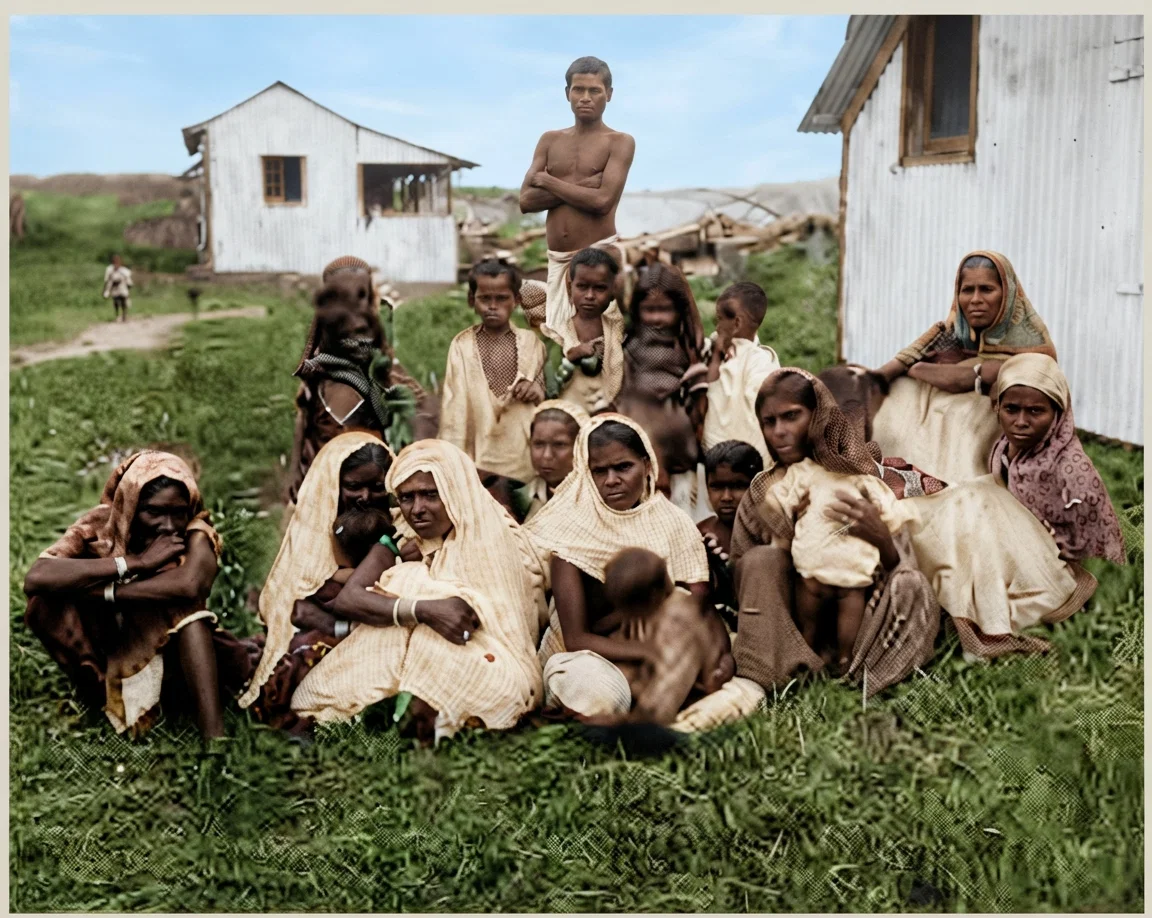
IN all the West Indies there is not a more needy or more neglected work than missionary effort in behalf of the East Indian immigrants, who are yearly brought out by the ship-load from the various parts of India, and destined to labor upon the sugar and coco estates of the West Indian planter.
For many years the present system of "indentured labor," as it is called, has been in vogue in several of the West Indian Islands, especially in Trinidad and Grenada, as also in British Guiana and to some extent in Jamaica.
The term of service is five years, and during that time the "immigrant" is in nowise free. He (and she also, for the women as well as the men labor by the thousand in the fields) is "indentured" or "bound out" to serve, and can not even leave the estate lands except he has a written "pass," signed by the estate manager. If he be found straying without this pass, he is subject to arrest and imprisonment at hard labor.
The stress of hard times, famine, etc., at home in India, is what induces so many of them to leave their own land and come to these far-off islands. The immigration agent in the various Indian ports is ever ready with his story of an easy life, plenty abounding, and riches easily acquired in the isles beyond the sea, and thus through deceit is able to beguile very many who afterwards would gladly shrink from the galling yoke were it possible. It is not possible, however; and, as a result, some lose heart altogether, and commit suicide, rather than endure the disgrace. Many of these persons have come from good families in the home land.
Their home life upon the estates can scarcely be called by that name, each family having perhaps one or two rooms where they eat and sleep, with a sort of gallery, sometimes, in front where cooking may be done. In order that they may wash their clothing they must seek out some running stream or muddy hole in a gully, and there with a flat stone or piece of board do their best to make themselves clean and respectable.
At the end of their five years of service they are free—either to return home at government expense, or to remain in the colony, in which case they receive a small grant of money from the government. A few each year do return, but the great majority remain and take up government lands which they can obtain for about $10.00 per acre. Upon this land they plant coco, sugar-cane, provisions, etc., on their own account. By dint of hard work and careful economy, some may make themselves in a few years independent.
Unlike many of their native West Indian neighbors, who are lazy, shiftless, and improvident, they are an energetic, hard-working people, and are fast taking up all available lands, until it is said that within a few years, at the present rate, all such lands will have been taken up.
In religion they are chiefly Hindus, with a good sprinkling of Mohammedans, and a few professed Christians, the fruit of the labors of the Canadian Presbyterian missionaries who have been operating here for some years.
They have among them many denominational schools, supported in large measure by government grants. They are quick to learn and are filling many lucrative government positions at the present time.
It seems to me that we ought to be doing much more for this people than we are doing. They number three hundred thousand in these colonies and many thousands of these are absolutely free and settled upon the land which has become their permanent home. Something has been done in a small way for those who have already been Christianized, but for those who are still in heathenism we have done practically nothing. Something could and would be done if we had the men, and the means to support them. We need an American laborer to learn the language, lead out in the work, and assist our native brethren in carrying it on. Without this help there is little hope of accomplishing much.
A Group of East Indians and their Homes on the Estates.
Our conference at the present time does not know how to man the field as already opened, and to take up this new work, which by all means ought to be taken up at once, means that we must have another American worker and money to support him.
Shall we have them? Shall this work for these three hundred thousand precious souls be undertaken at once, or must we still delay while souls are perishing? The answer rests with those who read these words.
If God impresses your heart to help in this important work, write at once to the Mission Board or to Elder D. E. Wellman, 31 Dundonald St., Port of Spain, Trinidad, B. W. I., stating what you will do.
And above all else, brethren, pray for the work and workers in this field.