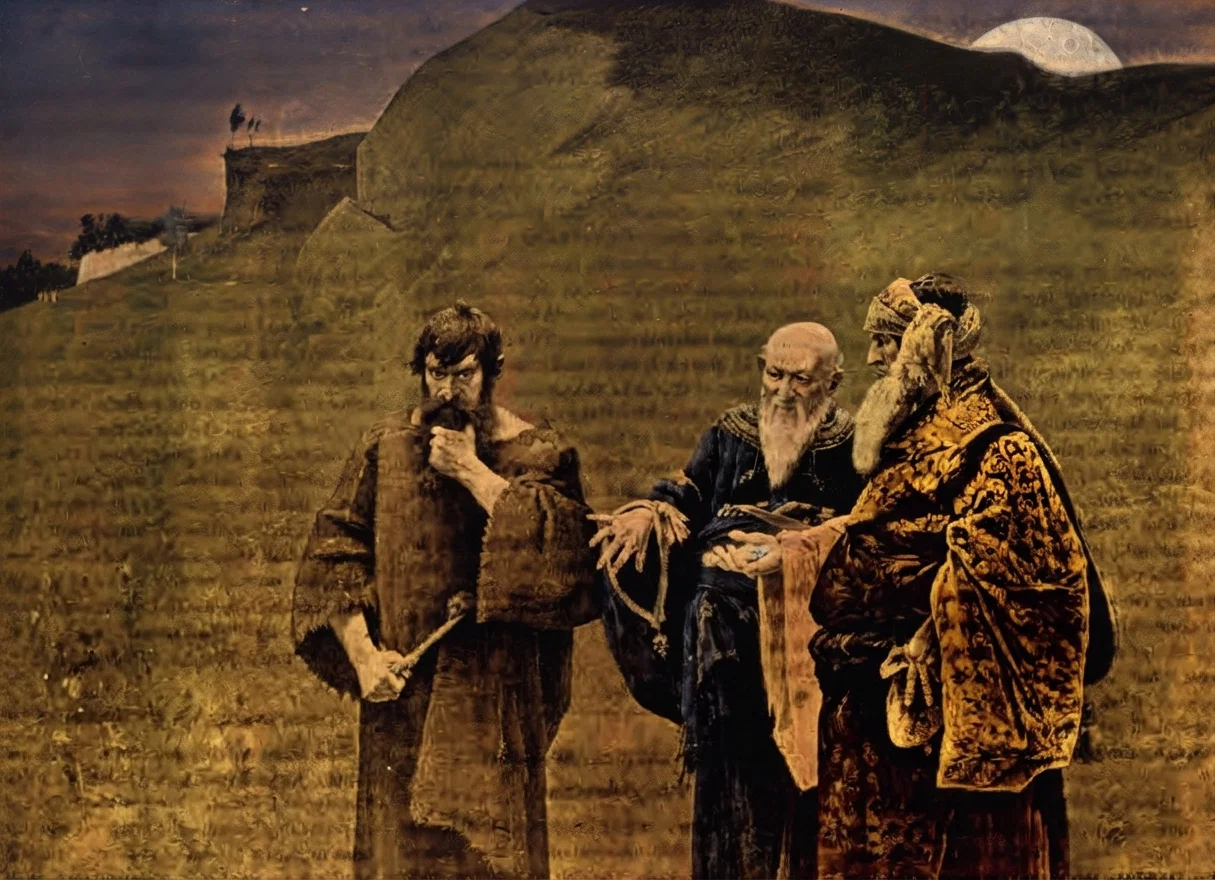
THE BETRAYAL OF JESUS

8%

Pacific Press Publishing Company · MOUNTAIN VIEW, CALIFORNIA · Feb 14, 1906

FromSigns of the Times, Vol. 32, No. 7.

Read the full edition

THE BETRAYAL OF JESUS.

JUDAS ISCARIOT was one of the fortunate twelve who were given the golden opportunity of being chosen companions of the Messiah during His earthly ministry. Such an opportunity for a three years' education, such a position of honor, such a means of forming character after a perfect model through unerring precept and example, never had fallen to the lot of man since the fall of Adam. But Judas did not appreciate it, only as it appeared to him to be an opportunity for self-aggrandizement, for selfish gain. All the light that was thrown upon his pathway, and all the experience of personal association with the divine Son of God, did not change his covetous heart. He was not born again, and therefore could not enter into the spirit of the divine life. He lacked the faith that enables one to stand when a testing crisis arises—in the hour of trial, in the moment of temptation.
BECAUSE Judas had accepted Jesus as the Messiah on the strength of outward evidence rather than by faith, his heart was not engaged in the work of salvation. Therefore he was susceptible to the temptation of the adversary, who well knew his weakest characteristic. Satan, having wrought up the Jewish council to the point of being ready to take the desperate responsibility of putting Jesus to death at all hazard, found it easy to work upon the avarice of Judas and cause him to furnish the opportunity. The resurrection of Lazarus had aroused the Jewish leaders to a pitch of desperation, and "both the chief priests and the Pharisees had given a commandment, that, if any man knew where He were, he should show it, that they might take Him."
“THE MOMENT OF TEMPTATION.”
JUDAS had been offended by the reproof of the Master at the supper in Simon's house in Bethany, only a few days before the Passover. The reproof came when Judas criticized as wasteful the act of Mary in anointing the feet of Jesus with costly ointment. This offense, added to his natural covetousness, caused him to take advantage of the opportunity to betray his Lord for money. Covetousness and sensitiveness at reproof are two characteristics which, if not restrained by overcoming grace, will lead one to almost any degree of viciousness. It is not surprising that Judas could go to the extreme of even selling his divine Master for a paltry sum, when we reflect that all the time of his association with the perfect One he was simply a "thief," taking advantage of the trust reposed in him, and making of it an opportunity for mercenary gain. Surely the human heart "is deceitful above all things, and desperately wicked; who can know it?"
YET Judas was not an exceptionally-wicked man. On the contrary his outward conduct was such as to completely deceive his fellow disciples. To all outward appearance he was as worthy as any of them; only the Master knew his heart. And his general behavior was such that even He could consistently retain him in the company, giving him every encouragement to yield to the inward appeals of the Spirit of truth. In the case of Judas' experience and fall, every individual has a lesson, a warning. The natural heart can not serve God. "It is not subject to the law of God, neither indeed can be." "Ye must be born again." To take advantage of a fellow man, to deny the necessities of life to a needybrother, to withhold what is due to God's treasury—any rejection of the Spirit of Christ, is to deny the Lord as verily as did Judas.
THE betrayal of Christ by Judas led to His crucifixion, and the betrayal of His cause by apostasy to-day involves the same principle. The backslider, or the shirker (which is the same thing), virtually indorses the act of Judas. Even in human law he would be deemed an "accessory after the fact." So without repentance, such an one must eventually go with Judas, "to his own place." "For it is impossible for those who were once enlightened, and have tasted of the heavenly gift, and were made partakers of the Holy Ghost, and have tasted the good Word of God, and the powers of the world to come, if they shall fall away, to renew them again unto repentance; seeing they crucify to themselves the Son of God afresh, and put Him to an open shame." Heb. 6:4-6.
THE betrayal of Christ was not confined to Judas. The church of which Jesus was a member, in which He had been reared, and to which He came to minister directly, gave special encouragment to the base act by soliciting the apprehension of the Saviour, and paying Judas a price for his part in the arrest. And this official part in the wicked transaction was officially emphasized at the crucifixion, when the rulers assumed the responsibility for the deed by publicly crying, "His blood be on us, and on our children."
SO THE church in after times, even to our own day, by ignoring the commandments of God, and preventing the ordinances established by Christ have taught their millions to depart from the faith, and encouraged them in turning His faithful ones over to the governments of the world for the suffering of death. Millions have been put to death in the name of Christ when in fact He was being persecuted in the person of His saints. Not only did the contemporaries of Christ suffer on this principle, but they foretold its workings unto the end. Looking forward to such scenes, Peter gives this encouraging word: "Beloved, think it not strange concerning the fiery trial which is to try you, as tho some strange thing happened unto you; but rejoice, inasmuch as ye are partakers of Christ's sufferings; that, when His glory shall be revealed, ye may be glad also with exceeding joy."
WHEN Judas yielded to the spirit of covetousness and avarice, he gave himself over to the spirit that most actuates the world, the spirit instilled into the world by the arch traitor whose rebellion arose from his encouragement of a desire for pre-eminence. It is the most dangerous, because the most infatuating, spirit that the professed disciple of Christ can foster; for it knows no limit. It is a spirit that soon sears the conscience and whose appetite can not be satisfied. Ananias and Sapphira were victims of this terrible disposition. The Spirit of the Lord told the prophet Ezekiel of those who were led by this principle, saying, "They sit before thee as My people, and they hear thy words, but they will not do them; for with their mouth they show much love, but their heart goeth after their covetousness." For this reason the spirit gives us this counsel:
"Let your conversation be without covetousness; and be content with such things as ye have; for He hath said, I will never leave thee, nor forsake thee."
IN the betrayal and execution of Christ we have a striking illustration of the effect of church and state union. The Satanic device reached its climax in the crucifixion by the world of Him who came to save the world, and in the cruel deed's being done at the instigation of the church, whose tool was a traitorous disciple actuated by a covetous heart, inspired by Satanic cunning. Here is an illustration in a nutshell of the whole church and state principle. In all ages as the church departed from the commandments of God, the resort has been to the traditions of men. And as the Spirit could not enforce that which was antagonistic to God's law, they must be enforced by the authority and power of men. The highest human authority and power being the state, the apostate church must depend upon it for the execution of her corporeal punishments. The church could not put Christ to death, even after her spy had given information concerning Him and her council had condemned Him; so the state was appealed to, and the cruel purpose was carried out.
WHEN the Christian church apostatized to the extent of uniting with the state, the same process was adopted. So to-day, as the professed churches of Christ feel the pressure of their spiritual poverty, they are attempting to keep up an appearance of righteousness by combined appeals to the state to put in force the so-called reforms suggested by the ministry. But, as in the past, the result must prove the persecution of Christ in the person of His people who shall stand by "the commandments of God, and the faith of Jesus." In all such professed Christian proceeding, the only rule that the true Christian can follow is to "render therefore unto Caesar the things that are Caesar's; and unto God the things that are God's." And the thing that God requires of every one is allegiance to His Word as the supreme authority, loyalty to Christ Jesus as our leader and example. To fail thus to follow Him is to betray Him.