INTERESTING things are taking place in the country of Luther. Between 1872 and 1880, a movement, similar to that now going on in France, was being carried through with an iron hand by the "iron chancellor," Bismarck. In order to stem the inroads of Romanism, a series of laws called the "May Laws" was passed by the Reichstag. Most of the Catholic orders, if not all, were expelled from the country, and the free expansion of Catholicism was checked by many legal difficulties.
In the heat of the debates in the Reichstag, Bismarck used to say that he was not "going to Canossa," making allusion to King Henry IV., of the days of Hildebrand. Not long after that, however, Bismarck did go to Canossa. He made terms with the Papacy, and caused the "May Laws" to be partially abrogated. The reason of this backward movement was that the "Center," or Catholic, party in the Reichstag was fiercely opposed to the government's military plans, and could only be brought to terms by order of the pope. Bismarck secured this result at the price mentioned.
The "Center" thus learned to appreciate its power, and has been making use of it ever since, by offering its help to the government when in difficulty, and receiving pay for each service rendered, in the form of favors for the Catholic Church.
Herr von Bülow, the present prime minister, has thought it proper to follow the example of his famous predecessor, and makes the "Center" his first and last resort when he has a scheme to carry through, making, in return, almost any concession to the Catholic party. This policy has been enthusiastically adopted by the emperor, who has repeatedly gone to Rome to visit the pope, and whose last visit was, as many remember, a very pompous affair.
The Emperor No Longer Master.
But it now happens that the "Center's" influence has grown to such proportions that neither Herr von Bülow nor William II. is master of the situation any more. Not only have the religious orders re-entered Germany, but, some months ago, after a long struggle, the "Center" succeeded in obtaining the repeal of a famous paragraph in the "May Laws," which forbade the entrance of the Jesuits into Germany. And now the "fathers" are again making Germany their field of operations.
In some of the public schools, the ceremonies of the Catholic Church have been made compulsory. A Catholic theological school has been opened at Strasburg, and generously endowed by the government, a thing which is not done for Protestant seminaries and theological schools. A Protestant minister was imprisoned for preaching against purgatory, while a Catholic bishop was allowed to curse a cemetery in which a Protestant had been buried. Any slanderous libel may be preached or printed against the lives of the Reformers, while books, tracts, and papers touching on the character of the "beast," or of "Babylon," are apt to be taken up and their circulation restricted, or even forbidden.
A Law Against Religious Liberty.
In 1900, the "Center" presented to the Reichstag a bill called, "A National Law Concerning the Freedom of Religious Practise;" also entitled, "Toleration Bill." The first part of the bill was adopted, while the second part, meeting with too great opposition, was withdrawn by the "Center" party itself, and kept for better days.
Think of it! the Catholic party, in the year of grace 1900 favoring the country of Luther with a law on religious liberty! Is not this a strange sign of the times? But let us look at this wonderful law:
Article I., of Part First, reads as follows: "Every citizen, living within the limits of the kingdom, shall be entirely free to profess his religion, to join any [[FIGURE]] religious body, and to perform his home or public religious duties."
Attention is called to the fact that, while Prussia, Saxony, Bavaria, Baden, and Württemberg grant "perfect freedom of conscience and belief," or "freedom of thought and conscience," and that since 1849 this new "Toleration Bill" knows only "freedom of religious profession" (bekenntnis). Why?—Because the Church of Rome denies "freedom of thought and conscience," and is satisfied with outward profession, since worshiping in spirit implies freedom of thought.
Article II. says, among other things, "After completing its 12th year, a child shall be free to choose his religious profession."
This is rather an early age for a child to be allowed to be snatched away from parental teaching and influence in religious matters. In France, in 1681, a law was passed which granted children seven years of age the right to pass over to the Catholic faith, while the reverse was forbidden even to grown people.
The Reformation Ruled Out.
That is the law with which the German nation is scourged since 1900. And now here is Part Second of the same, for the re-introduction of which the time seems to have come, since it is again before the Reichstag:
Article IX. "Religious bodies which are recognized by one of the states of the confederacy, shall enjoy, within the limits of the kingdom, the free and public performance (ausübung) of their cult."
Part First of this remarkable law completely ignores freedom of conscience. Part Second grants "freedom" in the "performance" of "cult," and that only to "recognized religious bodies!" Wonderful, is it not? Under such a law, Luther and the Reformation would never have had a chance. This all seems like a dream, and one wonders whether Protestantism is dead in Germany.
A section of the same article grants "recognized bodies" the right of erecting churches, provided with belfrys and bells, without first obtaining any license from the state or city council.
Article X. claims the right for the above bodies of communicating with their religious chiefs without hindrance. By-laws and regulations of said bodies shall be binding, without any special authorization from state authorities.
Article XI. claims for the above bodies the untrammeled right of employing foreign agents for performing spiritual duties.
Article XII. grants "recognized bodies" full freedom of performing baptism, religious marriage, and burial.
Article XIII. claims liberty of carrying on "missions" (or special revival services).
Article XIV. claims full liberty for orders, societies, and clubs belonging to "recognized bodies" to organize and carry on their work.
Limitation of Religious Liberty.
Thus it is seen that the simplest liberties are claimed only for such "bodies" as are "recognized" by the state. Wide-awake German Protestants see in the provisions of this law a door open for introducing Catholic processions on the streets—which are already a fact in the Rhenish provinces—an unlimited number of monks and nuns, and no end of Catholic churches, schools, and monasteries. In a word, they see in this law the entering wedge of papal supremacy in Germany. Hence, they endeavor to fight its passage with all their might.
It must be granted that these Catholic laws on liberty have a twofold aim: (1) Conquering complete liberty of action for the hierarchy in Germany; (2) closing the door to all new religious bodies which might come up to call out of sleep the old Lutheran churches, now petrified by rationalism, higher criticism, and worldliness.
Full liberty for Roman Catholicism is not what Germany need fear most. Her greatest danger lies in scientific unbelief in the Word of God—unbelief7in which German theologians have been the leaders in the Protestant world for a hundred years. This nefarious teaching has sown a crop of spiritual death, from which Rome is now ready to reap a harvest.
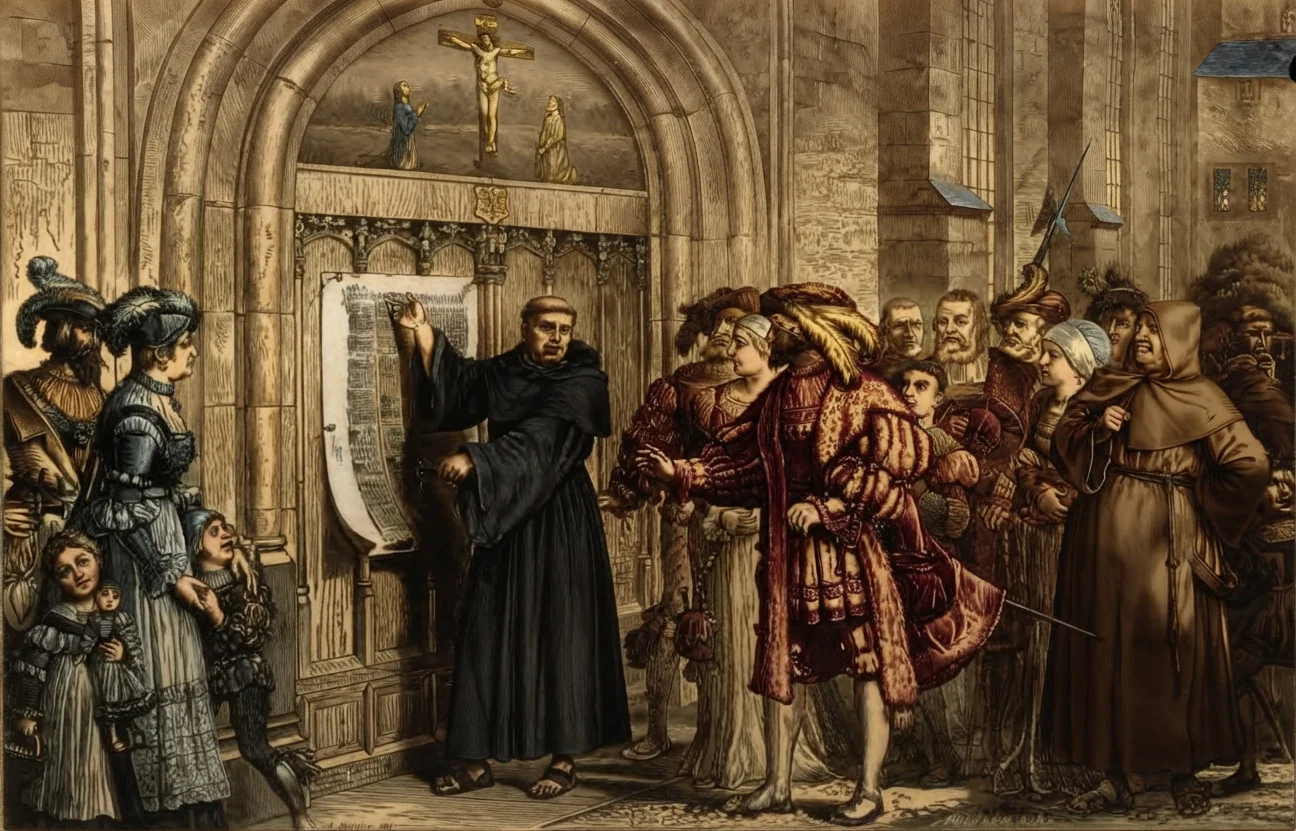
Luther Nailing Up His Famous Theses on the Door of Wittenberg Chapel.