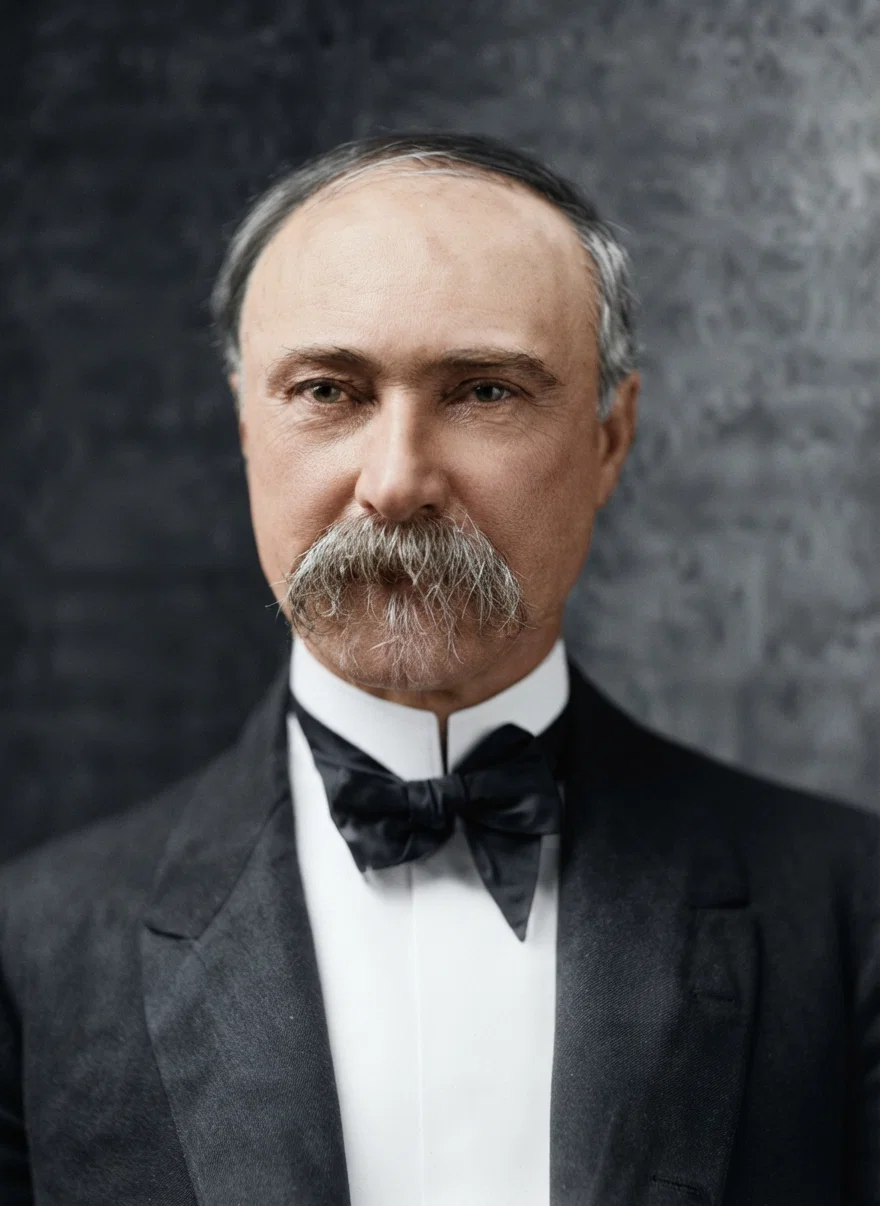
IN his address, "Our Country," delivered to the Christian Endeavor Convention at Seattle, Vice-President Fairbanks said:
"American institutions depend more upon the influences and teachings of the great Christian churches than upon all other influences combined and many times multiplied. THIS IS AND IS TO BE A CHRISTIAN NATION. Its destiny is to be governed by Christian people. Our fathers walked by Christian faith, and we are guided by that same faith. We are carrying it into business and POLITICS, and the more we put into both, the nobler will be our ideals and the more thoroly we will be inspired by that spirit of righteousness and justice which tends to the welfare of the home, the exaltation of the community, and the glory of the State. . . .
"The great Christian churches are doing more than cabinets to usher in an era of peace on earth, good-will to men; not an era which tends to the degeneracy of American manhood and of our national character. . . .
"The Christian Endeavor Society is essentially practical. It puts its theories to the actual test. That is one of the things I like about it. It is a powerful, aggressive agency for good in every avenue of our social life. It is a vast army making for better citizenship. Its influence is always to be found upon the side of those forces which have been and which are purifying our civic affairs. It is especially forceful in cultivating a spirit of good-will among nations. Such an institution is a blessing to every country in which it is to be found. All honor and success to this great society in the United States, yes, all honor and success to it thruout the world."
Speaking of "The Democracy of Christian Endeavor," Rev. L. S. Hall, of St. Paul, said: "We must emphasize the need of a closer affiliation of society members, and then closer union between the society and the church. This, I believe, will result in the Christian Endeavor organization having much to do in uniting all the different churches."
Mr. Fairbanks says that "Christian Endeavor is a powerful, aggressive agency," and a "vast army making for better citizenship." Rev. Mr. Hall thinks it will bring together the differing churches of our land. At the great Inter-Church Conference in New York City, 1905, Rev. Chas. Dickey, a prominent delegate, said: "I trust that one of the practical results of this conference will be the organization of a force that lawbreakers and lawmakers will respect and heed when great questions of morals are involved. . . . Rulers may ignore sects, but they will respect the church. This federation will compel an audience, and it will speak with power if it will put aside its differences and make its agreement its argument."
It will be remembered that Professor Wells, speaking of the probable future influence and work of Christian Endeavor in civic affairs, at the Seattle Convention, said: "It will not be long, either, before the Christian Endeavor Patriots' League will widen out irresistibly from local to national interests. . . . I hope that the response at this convention will inaugurate the League with an impetus that will be felt all over our land. And for the greatest efficiency we need the enthusiasm and weight of large numbers."
Putting these and various other statements of like tenor together,—not at all for the sake of criticism, but that questions of fact and an issue of vital importance may be rightly understood, and that just the proper conclusions may be arrived at,—it must be obvious to every candid mind that Christian Endeavor Society will link its forces with, and lend its influence to, every other confederated power purposing to secure such a change in the fundamentals of the structural government that CHRISTIAN CITIZENSHIP will be essential to one's right to participate in the affairs of the government, and that "CHRIST AND THE CHURCH" shall be recognized by the CIVIL POWER. Of this there can be no misunderstanding.
C. W. Fairbanks, Vice-President of the United States.
And herein lies the danger, the influence, and the power of great organizations, a power that "lawmakers will respect and heed," a power that no incumbent of public office or political aspirant will dare to refuse to treat with and respect, dare to seek to thwart its purposes. And herein lies the danger of the repetition of the history of Rome, the danger in the attempt "to make men good by law," the danger of crossing the pathway and denying the right of individual sovereignty in MATTERS RELIGIOUS, the danger of relighting the fires of RELIGIOUS PERSECUTION!
And in this connection, realizing the truth of Vice-President Fairbanks' prediction that Christian Endeavor will soon prove to be a mighty force in civic affairs, and an army powerful in the battle for Christian Citizenship, is it not both proper and timely to inquire as to what is genuine Christian Endeavor; as to what is GOOD CITIZENSHIP; as to the nature of Christian Patriotism and the need of Patriotic Leagues? Of the thousand and one questions that may arise, these only need to be considered; for the good of Christian Endeavor Society itself; for the good of the reader; for the good of the writer.
What is genuine Christian endeavor? The Bible, and the Bible alone, must give the answer and settle the question.
Into a great world of iniquity, Jesus Christ sent, as sheep among wolves, a little band of humble, trusting disciples, carrying a message of the merciful forgiveness of sins; a message that brought hope to the despairing, joy to the sorrowing, relief to the distressed, peace to the perplexed; a message whose power was that of the WORD OF GOD alone—a power that had lightened the heavens that the simple shepherds might see the angelic host; a power that had filled the stable and the manger with an infinite presence, while the wise men of the East gazed upon the incarnate Child; a power that had stilled the raging tempest on the sea of Galilee with the simple voice of command; a power that had healed the sick, cleansed the leper, opened the eyes of the blind, and raised the dead; a power that after all these dead centuries of the past reflects more brilliantly than ever the glory of the Cross of Christ!
"Go, . . . and preach the Gospel to every creature" is the sole command of the Master of sea and land. Never once did He ask for the aid of the civil power nor the helping hand of the magistracy. Rather did the Nazarene and His lowly followers find the civil power and the magistrates and the governors of the Roman Empire that filled the world, set against them and their right to promulgate the glorious, Gospel of freedom from sin and unrighteousness.
He who was the world's Redeemer refused to wear the royal diadem and to become this world's king (John 18: 36). In healing the servant of the high priest and replacing the ear which Peter had cut off with the keen edge of a sword of steel, our Lord absolutely repudiated the right to use force and the power of the temporal; and in a sentence He annihilated the national idea and the doctrine that Roman institutions and integrity must be held sacred, Roman laws upon the subject of religion reverently received and obeyed without question. "Render therefore unto Cæsar the things which are Cæsar's; and unto God the things that are God's."
Thus the Author of government and of right citizenship eternally divorced the forces and powers of the respective spheres of civil and divine government. The apostle Paul—the very chiefest of the apostles—never once asked the aid of the civil power. In very fact, he disclaimed any right to use any other than the power of the Gospel—the dynamite of God (Rom. 1: 16). He purposed to alone "make known Christ" and "the power of an endless life," the "mystery of God." His was the Gospel of "forgiveness;" and not the "ENFORCEMENT OF LAW."
The story of the Philippian dungeon, its quaking walls and breaking bolts and bars, is for all time sufficient proof that the power used by the apostles of God was the supernatural power, and that was all-sufficient. Not one intimation, or a single sentence about the ENFORCEMENT OF LAW and CHRISTIAN CITIZENSHIP in the State! 'Twas always and ever, forgiveness of sin, the transgression of a law, "spiritual," "holy, and just, and good," and a CITIZENSHIP IN HEAVEN.
There is no greater object-lesson on record, showing that the Gospel is not concerned in, and can not be applied to, the question of the enforcement of law, than the story of striking interest found in the eighth chapter of John. Hard-hearted Pharisees bring a forlorn and wretched woman, charged with the violation of the seventh commandment, to Christ. They demand the enforcement of law. "Now Moses in the law commanded us, that such should be stoned; but what sayest Thou!"11Marvelously did Jesus meet the issue.
Stooping, He wrote upon the ground the history of their sins. "He that is without sin among you, let him first cast a stone at her." One by one, the woman's accusers departed. When Jesus lifted Himself up, and found no accuser—"Neither do I condemn thee; go, and sin no more." Ah, truly, "Never man spake like this Man." No enforcement of law here. No, only forgiveness and freedom—freedom to choose the darkness or the light. No grand jury indictment, no trial by jury, no inexorable sentence of the court. MERCY AND FORGIVENESS! "Go, and sin no more."
The Gospel, then, is "the power of God;" it provides forgiveness of sin and imparts righteousness and purity of life. It is for that, and that alone. It—the Gospel—can have "no part or parcel," directly, in the civic affairs of men. This truth was clearly discerned by Martin Luther, declared by the princes at the Diet of Spires; reaffirmed by the famous Presbytery of Hanover; enlarged upon in that memorable document, the U. S. Senate report of 1829; recognized by Washington, Jefferson, Madison, Lincoln, and Grant; and provided for in the American Magna Charta—the Constitution of the United States.
In refusing to arbitrate the misunderstanding between brethren (Luke 12: 14), Christ positively refused the office of a magistrate. To "persuade" and "beseech" is the work of the true ambassador of Christ; his soul-winning force is the power of love, and not the love of power.
Christian Endeavor Society frankly admits, like other great organizations whose object is to make the CIVIL bend to the influence and behest of the RELIGIOUS, that with the BALLOT-BOX and AT THE POLLS must the victory be sought and won. In this they greatly err. And in the light of the foregoing, as concerning true Christian endeavor, Christian Patriotism, Christian Leagues, Christian Citizenship, they need not be considered, for all these have no place, and rightly should receive no consideration in civil government.
"There is no argument in favor of establishing the Christian religion but may be pleaded with equal propriety for establishing the tenets of Mohammed by those who believe the Alcoran." Macaulay has well said: "The whole history of the Christian religion shows that she is in far greater danger of being corrupted by the ALLIANCE OF POWER than by being crushed by its opposition." And Dr. Schaff writes: "Secular power has proved a Satanic gift to the church, and ecclesiastical power has proved an engine of tyranny in the State." The church, and church societies, in order to successfully carry on the work of God, have no need, and should not require, the aid of the civil power. It is the aid and the POWER OF THE HOLY SPIRIT that is needed, and that alone.
It is not to be denied that Christian Endeavor Society means well; and in the society there are many good, conscientious, God-fearing men and women zealously determined to carry the triumphs of the Cross to the farthest corners of earth. Yet it seems to the writer that the Christian Endeavor Society is trying to do the right thing in the wrong way. Would to God that Christian Endeavor might reconsider, RECONSIDER; and if it find the "gateway of politics" the wrong avenue thru which "to bring the kingdom of God upon earth," retrace its steps, and confine its earnest efforts to THE LEGITIMATE SPHERE OF THE SPIRITUAL. And by appeal to the INDIVIDUAL instead of to GOVERNMENT—secure the much-coveted and desired transformation "of the nations." 'Tis the only way consistent with the divine plan—a plan fraught with amazing grace and abounding love. "Neither is there salvation in any other; for there is no other name under heaven given among men, whereby we must be saved,"—the name of Jesus Christ of Nazareth.
According to the Seattle "Post Intelligencer," the Twenty-third International Convention of Christian Endeavor Society "made a profound impression upon the people of Seattle." With the increasing years, and with increasing strength and influence, Christian Endeavor will yet make a "profound impression" upon the American people—and, perhaps, the people of the WHOLE WORLD.
The next International Convention of this truly great organization will be at St. Paul, Minn., in 1909; the Fourth World's Christian Endeavor Convention at Agra, India, in 1910.