FROM the China Mail, published at Hongkong, we get some particulars of the murderous affair at Lienchan. From this account it would seem that the uprising was the result of the American boycott agitation, rather than an anti-Christian feeling. This is assumed from the fact that no native Christians were attacked by the mobs that looted and burned the mission buildings, and murdered some of the attachés. The Mail says:
On the morning of the massacre, October 28, Dr. Machle, when on his way from his residence to the men's hospital, passed a temple, near to which a temporary bamboo structure had been erected, where a la hsiu was in progress. At his request three old men followed him to his hospital, and he talked with them about their having erected the bamboo structure on mission property.
He called their attention to the fact that they would be justly offended if he should build a chapel on their land, and told them that he could not consent to their erecting a structure for their worship on mission property. Several persons standing by spoke up and said: "The foreigner is talking justice. That is right."
The elders then told Dr. Machle that the last performance and the feast were to occur that evening, that the structure would be removed the next day, and so the matter was pleasantly arranged.
The entire conversation occupied about ten, or at the most fifteen, minutes, and the elders were turning away apparently perfectly satisfied.
Armed Roughs.
Just then a crowd of younger men, a rough looking set, one of them with a drawn revolver, several armed with Chinese pikes, carrying poles, etc., rushed up, and, as Dr. Machle entered the hospital, one of them struck him on the shoulder. Then stones were thrown, one of which, glancing from a window, hit Dr. Machle in the forehead, but, as its force was spent it inflicted no injury. The elders remonstrated with the crowd and they dispersed.
A little later Dr. Machle saw another crowd around a guard boat on which Dr. Chestnut had taken refuge. That crowd was temporarily dispersed. A message was then sent to the officials.
Dr. Machle went on back to his house, a "seven-minute walk" from the hospital, supposing that there was no longer any special danger of trouble at the hospital. Not long after he got to the house, however, two persons came from the women's hospital, which was located near the men's hospital, saying that the crowd were looting the hospital, had taken everything of value, and one of the persons who brought the report had been seriously injured.
Misleading Assurances.
While Dr. Machle was dressing his wound, a Chinese official came. A little later other officials came, the highest civil and military magistrate in the district.
They came without arms, and the soldiers who came with them were without arms. The officials assured the missionaries that they need not fear any further trouble, that all would soon be quiet.
In a few minutes, however, the women's hospital was reported to be on fire. In quick succession, the other buildings down near the river were set on fire, the women's school, the men's hospital, the church, the native pastor's residence, and theological students' dormitory.
Still, the officials all remained up on the hill and assured the missionaries that they need not fear, that the crowd would certainly not come up on the hill where the mission residences were located.
The burning of the buildings near the river occupied a surprisingly little time, scarcely more than an hour, and about twelve o'clock the crowd was seen starting toward the residences. About that time the officials suggested to Dr. Machle that all missionaries get into a boat and go to the yamen, across the river in the city. But no boat was prepared. The party went down to the river and a ferry-boat that had started from the opposite shore stopped in the middle of the stream, the boatman, pretending for awhile to be coming to one shore, finally returned to the other shore.
Then the men who were pretending to guide the missionaries suggested that they go to the temple, adjoining which was a cave. But they soon found that the temple-keeper was unfriendly; then they thought to flee into the country, but the mob was too close after them. So they took refuge in the cave. Here they had a rough experience, being scattered and trying to hide in various ways. Dr. Machle sunk himself in water, with only his eyes protruding, where he remained for several hours. A Miss Patterson was hid in a well with a very small opening, but wider at the bottom. The searchers looked in the well by the light of their torches, but failed to notice her. Mrs. Machle could not get through the small aperture.
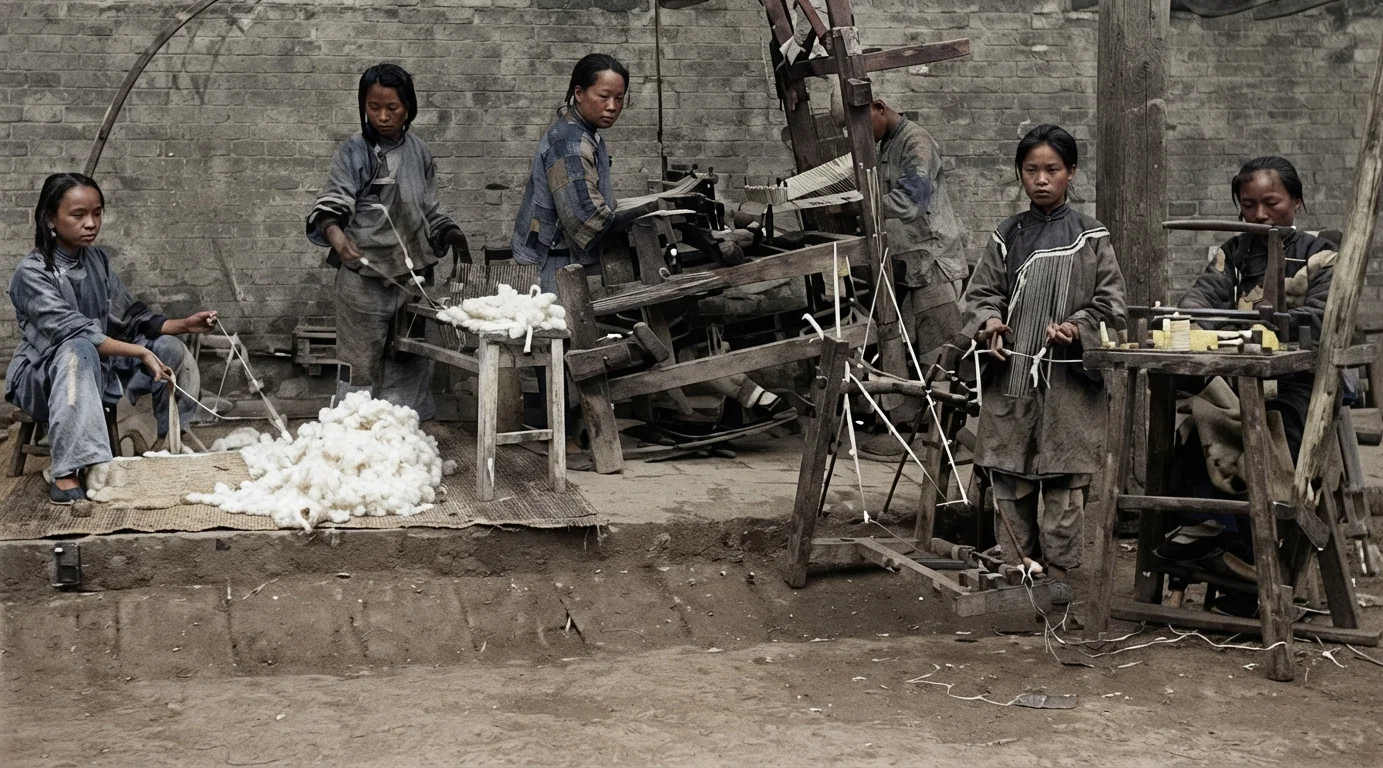
Chinese Weavers.
Dr. Machle and Miss Patterson Rescued.
Eventually Dr. Machle heard some one call him, and recognized the magistrate, who assured him that the mob had dispersed. Then another man assisted in finding and rescuing Miss Patterson from the pit in which she had hidden. This man had befriended her because at one time he had received help at the hospital. It was he who had shown her the hiding-place.
Attack on the Women.
The accounts of the massacre of the other missionaries are given by Chinese who witnessed the awful atrocities. I shrink from writing all that I have heard. Much must be left for the readers to imagine. The women were not spared the worst. Innocent little Annie Machle was the first to be put to death. She and Dr. Chestnut were the first ones found by the mob. They were stripped of all clothing and were thrown uninjured into the river. Dr. Chestnut could swim, and safely reached a sand bar out in the river. Little Annie caught hold of some bushes growing on the river bank, and so kept above water.
For some ten minutes they were let alone by the crowd who were interested elsewhere. But finally a heartless wretch ran a spear through the head of little Annie, and a number of men went out into the river, and one ran a three-pronged instrument through Dr. Chestnut's body and thus killed her. The two bodies were then brought ashore and were beaten and stabbed by the inhuman wretches, and finally, when scarcely recognizable as human bodies, they were again thrown into the river.
Mrs. Machle was the next one discovered. She was stripped and exposed to the ridicule of the crowd, then run through with a spear, beaten, and her lifeless body pierced again and finally thrown into the river.
Shocking Treatment of the Peales.
After an interval of about half an hour Mr. and Mrs. Peale were found. They were stripped of all clothing, and put up on an elevated place in full view of the crowd. They were made to stay there for about a half an hour, enduring jibes and jeers and insults. In vain Mr. Peale made efforts to shield his wife. Finally a miscreant crept up from behind and crushed him to the ground with a heavy stone. While his wife was forced to look on, his body was pierced through and through, and beaten until it was a shapeless mass. Then Mrs. Peale was beaten down with a heavy club, her body treated much as the rest had been, and with that of her husband was thrown into the river.
Thus ended the wild orgie, and with loud rejoicing the frenzied, bloodthirsty crowd went off to feast, leaving several scores to search the caves for the two missing ones. Fortunately darkness made it possible for the officials to rescue them in the manner already related.
Another Suspicious Feature.
The Mail's report gives another feature of the affair that would indicate that anti-Americanism was at the bottom of it. French Catholics are very influential in that vicinity. The reporter, writing from the scene, says:
The ringleaders in the mob the day of the massacre were recognized by the Protestant Christians as Catholics. To give further color to the idea that the Catholics had some connection with the affair, the French priests, altho several times requested to help quiet the crowd, the civil magistrate himself sending a special request to them, refused to do anything. I presume that the officials, if it is possible to suppose that they sincerely desired to protect the foreigners, recognized the ringleaders as Catholics, and knew that the priests could influence them, and so sent the request. At any rate, the French priests were not molested.
Boycott Influence.
The boycott agitation, to say the least, had got the people so aroused that they were ready for just such an outbreak as occurred. The Chinese are disposed to deny that the people of Lienchan knew anything about the boycott. But the day before Dr. Machle and party reached Lienchan, he was on shore at a small town selling Christian tracts. A man who had bought some tracts brought them back, saying, "If these tracts are American, I want you to give me my money and take them back." Similar things occurred a number of times that day. After they got to Lienchan they noted repeated evidences of the effect of the boycott agitation. Boycott placards were posted all through the city, and the elders had applied to Canton headquarters for large supplies of boycott literature.