X. Religions of China

6%

Pacific Press Publishing Company · Mountain View, California · May 8, 1907

FromSigns of the Times, Vol. 33, No. 19.

Read the full edition
X. Religions of China.

CHINA is not suffering for want of religion; for go where you will, in almost every place and in every condition, are to be found gods, idols, temples, Joss-houses, shrines, tablets, and myriads of ministering priests, monks, nuns, with their worshiping devotees, who with slavish and superstitious fear go thru the forms of what in these heathen lands is dignified by the term worship. As a race the Chinese are religious and disposed to worship; and in many instances, especially on the part of women, the assiduous and constant homage paid to these idols—demons, as the apostle calls them—is such as to excite both admiration and pity.
Our English word religion is generally thought to have been derived from a Latin word whose root idea is to bind, to fasten. Assuming this to be the central idea of the term religion, it must be said that China is religious, even to a fault; for if there ever was a race which, from a human point of view, was hopelessly bound to a great complex system of cruel and abominable idolatry, it surely is China. The objects toward which all this worship is directed may be both false and imaginary, yet the effect on the people who render this worship is both concrete and positive. Nor should it be thought that this worship of idols is without money and without price. China's annual expenditure on idolatry amounts to about 400 million taels, equivalent to some $275,000,000 U. S. currency. In addition to this there are sacrificed annually to Confucius, about 54,000 pigs, 11,400 sheep, 54,000 pieces of silk, together with many other things.
It is needless to say that this monetary loss is a mere trifle in comparison with the incalculable loss and positive injury represented in all the superstition, ignorance, spiritual alienation, together with the host of consequent evils which flow therefrom. China's social, industrial, and political miseries are as but nothing when compared to her midnight of spiritual darkness.
Temple, etc., Canton.

What, Then, Is China's Religion?

In one word it might be said to be ancestor worship; yet this falls short of fully answering the question. It can in truth be said that almost every religious form, sentiment, and belief find full expression in this universal and all-pervading worship of ancestors. The Chinese may differ on almost every other question, but when it comes to the worship of their dead ancestors, they are a unit, from the emperor to the humblest peasant. Other forms may or may not be carried out, but the dead ancestor never goes without his perennial honors.
But, to be more exact, the religion of China is a three-ply affair, consisting of Confucianism, the self-satisfied, self-righteous, ethico-political state religion; Taoism, originally a comparatively pure philosophic system, but later an indescribably confounded mass of superstitions; and Buddhism, a foreign cult, which is so absolutely senseless in all its beliefs and ceremonies that it is difficult to conceive how a people as sober-minded as the Chinese are could be induced to put faith in it.
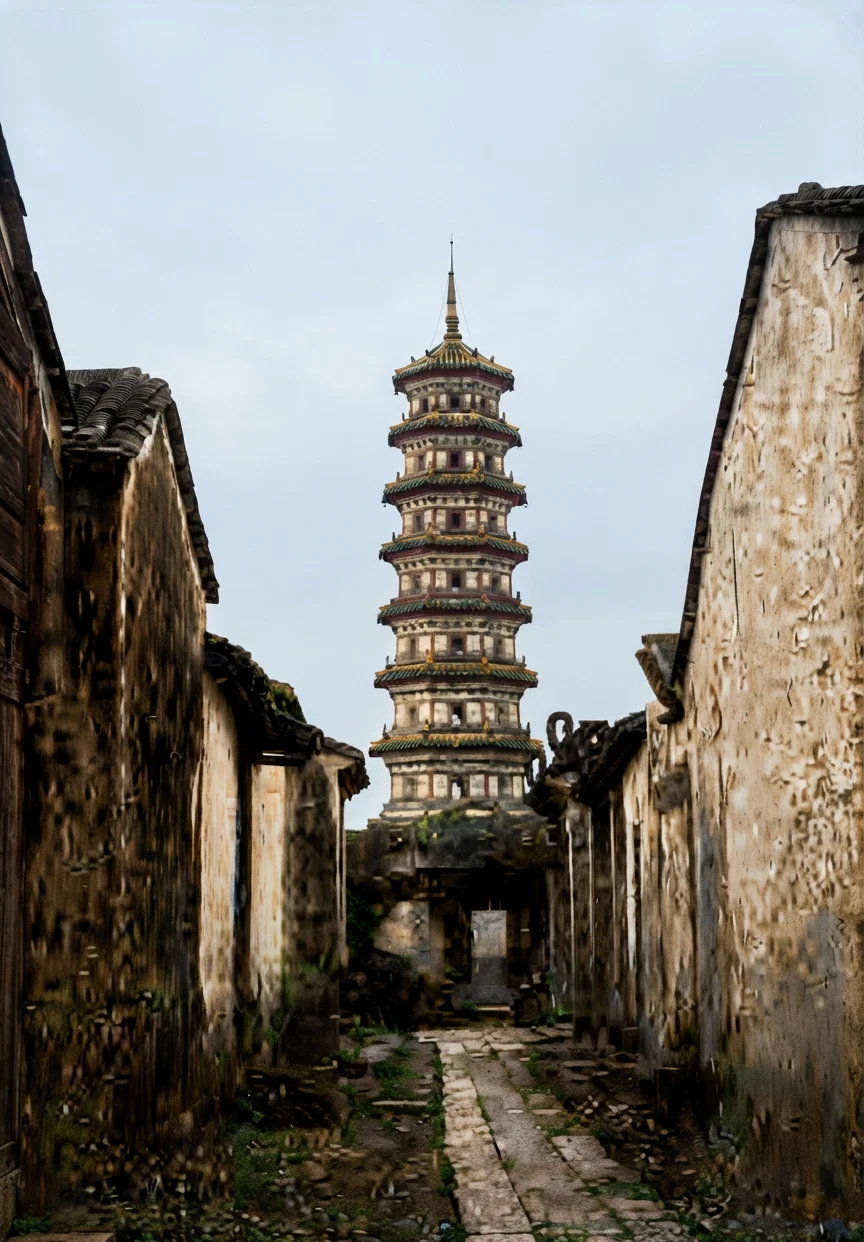
Flora Pagoda in Canton.

Confucianism

has as its founder and father, Confucius, who lived B.C. 551-479. Mencius, his disciple and next to him the greatest teacher in the Chinese world, lived some two hundred years after Confucius, B.C. 371-288. To every orthodox Chinese, Confucius is of course the greatest mortal that ever lived; he was the embodiment of all moral, intellectual, and political wisdom. Foreigners who have studied him deeply are not so unanimous in praise of his greatness.
He did not claim to be an originator, but merely a transmitter of the wisdom of the ancients. His own age left him severely alone, but after his death he was speedily raised to honor by the people, and imperial authority made him a god, and ever since that time he has been worshiped by the sovereigns twice in the year.
Confucius taught morals and ceremonialism, and both have to do with man in his relation to the State and society. He knows little or nothing of the future or of God. "Man's duty to God is left to take care of itself." His motto was, "Recompense injury with justice, and return good for good." He inculcated truthfulness and sincerity, tho he nullified this teaching by insisting in one of his historical works that for political and State purposes, it is at times expedient to conceal the truth—a very serious bit of teaching, as the history of this people abundantly testifies. He not only violated his oath, but justified himself, on the ground that as it was made under a threat, it was not binding upon him.
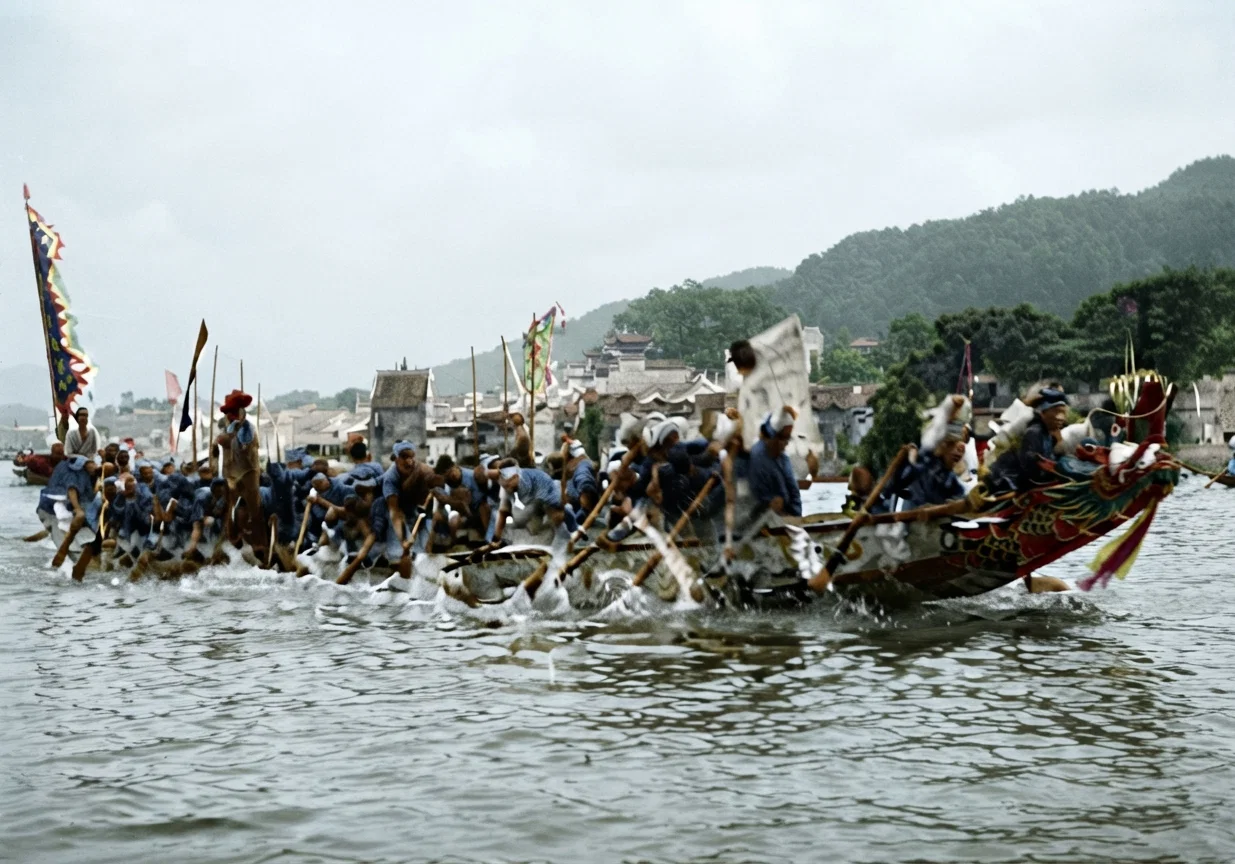
Dragon Boat in a Race, China.
The chief corner-stone of his ethical teaching is filial piety. Witness the following: "Of all the actions of man, there is none greater than filial piety; and in filial piety there is nothing greater than the reverential awe of one's father. In the reverential awe of one's father, there is nothing greater than making him the correlate of Heaven." This makes a dead man into a god, and fills China with myriads of imaginary spirits both good and bad.
The highest sentiment of his teachings is expressed in the Chinese golden rule, which teaches that we should not do to others what we would not have them do to us. This in itself is very good, but it has little Christian value, for the simple reason that it leads to self-righteousness, being without God, without due conception of the sinfulness of sin, and without the conscious need of the Saviour. Confucianism has no hope of eternal life, no forgiveness and cleansing from sin, no soul consolation arising from communion with the Creator-father—indeed, it has nothing but lifeless maxims and cold legalism to hold out to the hopeless, sin-laden sinner.
It is decidedly to the credit of Confucius that he confessed his own inability to conform to his own teachings. It evinces humility and is a confession that cold morality without a spiritual uplifting power is seriously faulty. J. N. ANDERSON.