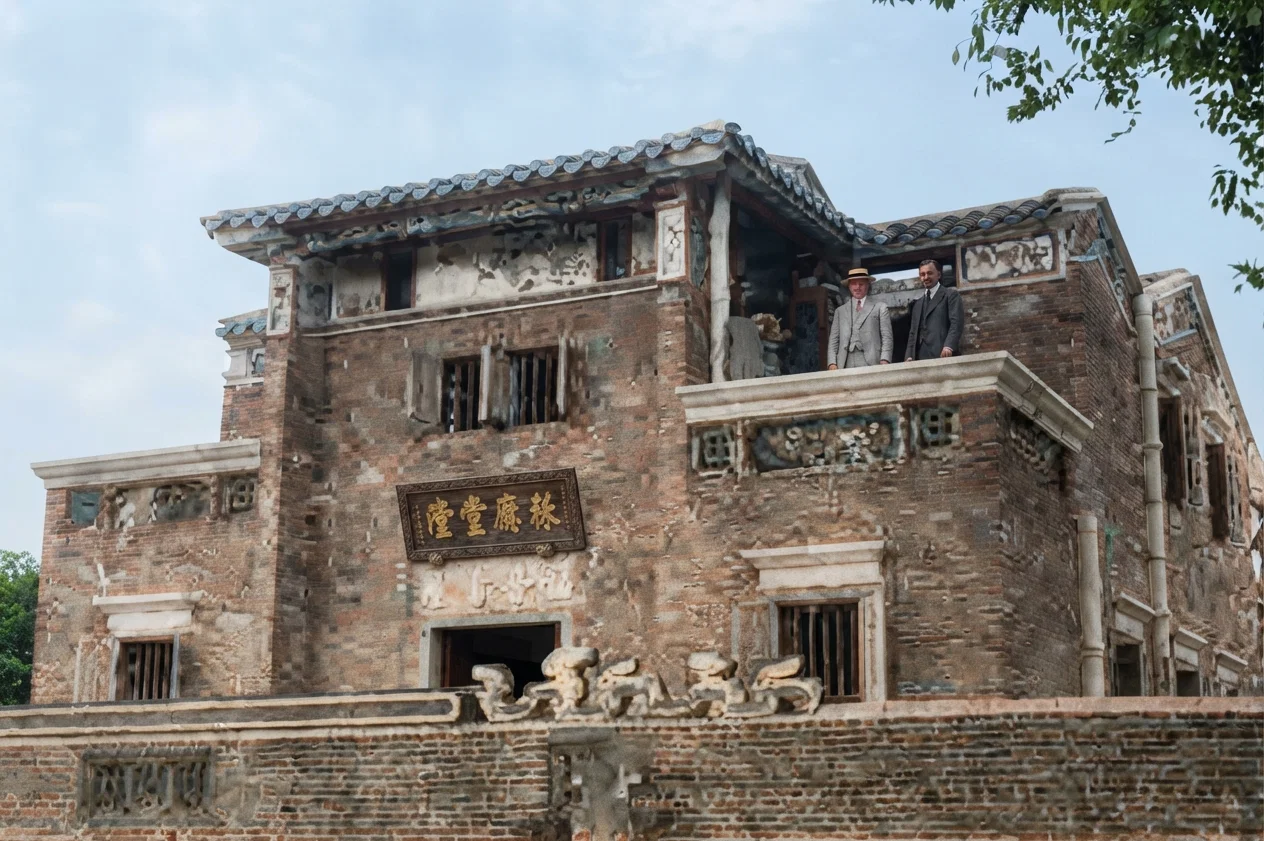
[Harlan P. Beach, in Missionary Review of the World.]
IMAGINE yourself in the cleanest and one of the best-built cities in China, whose inhabitants look westward up the mountain-side to a rude stone structure sheltering one of the oldest inscriptions in the empire, the Tablet of the Great Yü, reputed to have reigned more than two hundred years before the traditional date of Abraham, and who won his throne in consequence of having been a Chinese Noah, the saviour of the people from an awful inundation of that early time. While Yü doubtless did not perform his herculean labors in that part of the empire, the ancient tadpole characters of the inscription give that impression, and the people in general possess something akin to the pride of the American elite. At the foot of this mountain is one of the oldest and most famous of Confucian colleges, antedating the great universities of England. Heirs of such an antiquity, and with the reputation of having supplied China with far more than their proportion of officials and famous scholars, it is not surprising that the Hunanese refused to admit trade and the Gospel into the province until within four years, tho beginnings had been made before 1900.
Dr. Frank Keller, the founder of this mission, after being persecuted almost to death at a city to the southeast of Changsha, entered the provincial capital in 1901, being the first foreigner to gain permanent foothold within the walls. Providentially he rendered medical assistance to influential officials, one of whom immediately secured for him temporary premises, and their endorsement and the grip that medicine and Christian love gained upon the people soon made it possible for him to secure permanent buildings, which he and his colleagues have made into a most complete plant for the varied activities of the mission.
Let the reader again imagine himself near the south gate of Changsha, on College Street, about fifteen minutes' walk from the steamer landing. Many of the residences on this street belong to well-to-do families, and the mission compound is simply an adaptation to church uses of one of these courts, with its ranges of buildings running parallel to the street. On the right of the great central gateway is a chapel capable of accommodating as many as three hundred who hear the Gospel preached by missionaries or earnest native helpers. On the opposite side of the great gate is a book-room, supplied with an abundance of tracts, Bibles, and Scripture portions, as well as with scientific works and other productions of the presses of Shanghai, and presided over by a scholarly Chinese, who is a local encyclopedia concerning matters Christian and Occidental, and who regards it all as a bait to catch those who incline to literature. Farther back and adjoining the book-room is a day-school for boys and girls, in which western learning, and even English, are taught to as wide-awake a company of boys and girls as you can find in China. An addition to the usual China guest-hall is a neat case containing Christian books, concerning which visitors naturally inquire, thus making it easy for the missionaries to turn conversation into Christian channels. Corresponding to the guest-hall at the western end of this range is the prayer-hall, where each morning, except Sunday, some fifty men, women, and children gather for prayers—not formal prayers with which we are familiar, but a most helpful three-quarters of an hour spent in joint study of a carefully-prepared passage of Scripture, in prayer, and in singing. So highly is this service enjoyed that not a few who are employed in shops arrange for absence an hour each morning, working later at night in compensation.
A Temple of Christian Worship in the Land of Confucius.
The Sunday morning service is a marvelous adaptation of the Gospel to the two classes of hearers represented—some of them well acquainted with Christian truth, and others hearing the teachings for the first time. Older Christians of dignified bearing see to it that raw heathen make no disturbance, and so it happens that the audience lacks the riotous character of many such gatherings in newly-opened fields. The afternoon church service has mainly in view the instruction of those who are ignorant of the Gospel, and is generally conducted by a former well-known "wind-and-water doctor," or geomancer, now one of their earnest preachers. His wide reputation and prominence in conservative reform circles attract large audiences, who are delighted with his learning as well as with the fascinating way in which he presents the new truths of Christianity.
So contagious is the example of their foreign leaders that of their own accord the Chinese Christians have established a chapel in the south suburb and hold services there of great power. They have also established prayer-meetings in heathen homes, which thus early have been the means of bringing some into the church membership.
Some of the results that have come from less than three years' work in a most hostile and antiforeign city are worth noting.
Officials and persons of rank and importance have become exceedingly friendly, and not a few of them come in their chairs to classes and services at the compound. Even the son and daughter of Chou Han, a man who for years was the most pronounced leader of the antiforeign faction and the instigator of riots not a few, and who is now imprisoned because of his crimes, are visitors at the mission. A prominent woman has started a school for ladies of rank, in which Western learning is taught, as is the use of the sewing-machine, and even English, to teach which latter branch she desires to secure one of the missionary ladies. A Manchu lady of rank is an habitual attendant, and has so far overcome the tyranny of custom that one day while we were there she refused to wait for her sedan chair, but boldly walked through the streets to a prayer-meeting held in the south suburb—a most unusual proceeding, which proved the revolution that the new life had brought to her.
Never has the writer seen such a thorough acquaintance with the letter and the power of the Scripture in converts and inquirers of from three years' standing to those of a few months'. Almost every adult, and many of the children, bring copies of the Bible, or of the portion of it most used, to church, to morning prayers, and to the various meetings. The numerous Scriptures are looked up and read, often by one of the audience, and the expositions are so clear and logical that they could hardly fail to find lodgment in the heart.
The missionaries give themselves to the people with a Christ-like abandon at all hours of the day, and the "church in the house" is made like a large Christian family, where all are welcome, reminding the visitor of the halcyon days of the early Apostolic Church.
One notes that the contribution-box is not passed, and wonders if the obligation of giving is omitted from the church life. Inquiry reveals the fact that the members and regular attendants are contributing quietly more than a tenth of their income on the average, and that the reason why contributions are not taken in the large meetings is that it might create the impression that money was the object desired, and that the contributions were expected, much as is the price of admission to a lecture at home.