PRESIDENT ROOSEVELT continues to add to his list of appointments of Roman Catholics to office. The latest appointment of this sort has been that of Mr. Daniel W. Baker as United States Attorney for the District of Columbia. This appointment was announced on July 12. Mr. Baker is a Washington lawyer and a member of the law faculty of the old Roman Catholic Georgetown University, where his legal education was acquired.
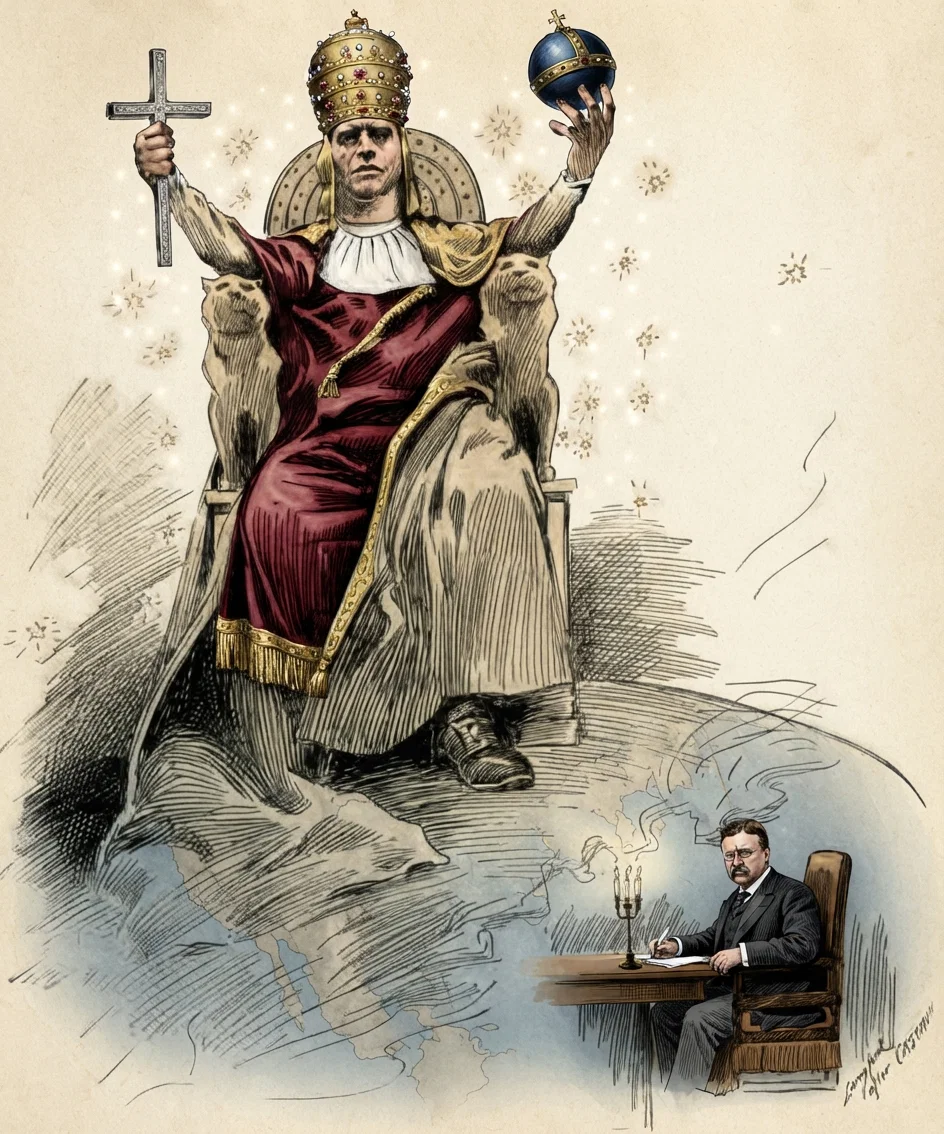
Dream of the Pope, the Dominion of the World. (Courtesy of Frank Leslie's.)
He is a son of the founder of Calvert College at New Windsor, Carroll County, Md., and his college education was received at the Roman Catholic Mount St. Mary's College, Emmetsburg, Md., in which institution his father was a professor.
It is said that "the President practically decided to appoint Mr. Baker as soon as he learned that he was a candidate."
Since the announcement a short time ago that the present incumbent was to go out of office on the 1st of August, the position had been keenly sought by a number of candidates. The others were able and well-known lawyers, but were doubtless handicapped by being in competition with a Roman Catholic, for there is reason to believe that the President is partial to Roman Catholics in such cases.
Another recent appointment by the President of a Roman Catholic to office has been that of Mr. Charles J. Bonaparte as Secretary of the Navy. Mr. Bonaparte is sometimes spoken of as the leading Roman Catholic layman of the country. "He is a very zealous Roman Catholic and an intimate friend of Cardinal Gibbons," says Mr. James Creelman, who interviewed Mr. Bonaparte immediately following his appointment. Mr. Creelman writes of "his devotion to the Catholic Church and the zeal he has shown in its interests," and says "he has been criticized sharply for having influenced President Roosevelt to allow public funds to be used for Roman Catholic schools in the Indian country."
Another recent appointment of this sort has been that of Dominic I. Murphy, "one of the leading Catholics of the country," as consul at Bordeaux, France. Mr. Murphy was formerly editor of the New Century, a Catholic periodical published in Washington, and it seems that his appointment was a reward for service rendered the administration as a Roman Catholic in that capacity. Writing of the appointment, which was made in May, the Washington correspondent of the New York Evening Post said:
The President's appointment of Dominic I. Murphy as consul to Bordeaux is representative of a sense of obligation which Mr. Roosevelt has very strongly felt. Mr. Murphy is one of the regular organization Democrats who supported Mr. Roosevelt in the columns of the New Century, a small Catholic weekly in this city, on the Catholic issue in the Philippines at a time when friends of the friars were threatening to make it highly difficult for the administration to settle ecclesiastical questions overseas. The administration, through Governor-General Taft, who visited Rome on his way out, treated the Catholic orders with great liberality, and this was recognized by a number of Catholic editors of Democratic affiliations. No one can ever charge the President with lack of gratitude for this support. About the first known of Mr. Murphy's adherence to the Roosevelt cause, outside of his immediate circle of friends, was his appointment as secretary of the Panama Canal Commission. When the old board with which he had been attached was reorganized he was left in a somewhat anomalous position. There was no call for a secretary in the new organization, as it had its own plans for doing that part of the work. Moreover, the decision to move headquarters from Washington to Panama was very disquieting to Mr. Murphy, who did not feel himself a yellow-fever immune. It has long been known that he was "looking for something else." Cardinal Gibbons of Baltimore visited the President in Mr. Murphy's behalf.
And of course the cardinal's visit to the President in his behalf secured for Mr. Murphy the "something else" for which he was looking. In an interview published last fall for the purpose of influencing Roman Catholics to vote for Roosevelt, Mr. Murphy said that he had "for a long time favored the Philippine policy of the administration," but that at first he "was inclined to doubt the wisdom of the course pursued by our government in the Philippines," as he "had read so much about our Catholic interests being unfairly treated in our new possessions." But after a "thorough investigation" of the matter he found "that President Roosevelt was treating the Catholic Church in the Philippines with eminent fairness." He declared that "as a Catholic I would not like to see the Philippine Islands turned over to the Filipinos," and impressed the point that the interests of the Catholic Church in the Philippines, and in this country as well, would be promoted by maintaining the Roosevelt administration. That administration has had much of such Roman Catholic support because of its attitude and course "on the Catholic issue in the Philippines;" and it is very true that "no one can ever7charge the President with lack of gratitude for this support."
He seems to have tried to show his gratitude at every possible opportunity, by appointing to office, and in other ways favoring Roman Catholics. Last fall while the Presidential campaign was in progress an Irish-Catholic-Democratic weekly of New York City published very conspicuously upon its first page—under the display headings, "He Is Good Enough for Us," "Why Our People Like Roosevelt"—the following list of Roman Catholic appointments by the President:
Appointed Archbishop Ryan, of Philadelphia, and Mr. Charles J. Bonaparte, of Baltimore, on the Indian Commission.
Appointed Bishop John L. Spalding, of Peoria, on the Coal Strike Commission.
Appointed Lawrence O. Murray, D.C.L., of New York, assistant secretary of the Department of Commerce and Labor.
Appointed Ex-Secretary of State, John T. McDonough, of New York, as territorial judge of the Philippine Islands.
Appointed William A. Byrne, of Delaware, assistant United States district attorney.
Appointed Joseph Murray, of New York, deputy superintendent of immigration.
Appointed Eugene A. Philbin, of New York, district attorney of New York County.
Appointed Edward J. Sullivan, of New York, United States consul to Trebizonde.
Appointed Charles H. McKenna, of Pittsburg, as judge in Porto Rico.
Appointed Dominic I. Murphy secretary of the Panama Commission.
Appointed full quota of army and navy chaplains to which Catholics were entitled, the first time in the history of this country.
Appointed a majority of Catholics on the Supreme Court of the Philippines.
Appointed Catholic secretary of education of the Philippines and 3,700 Catholic teachers out of a total of 4,500.
Appointed twenty Catholic governors of provinces of the Philippines out of a total of twenty-six.
Since the publication of this list the President has appointed Prof. Charles P. Neill, of the Catholic University at Washington, head of the Bureau of Labor. Mr. Neill had been previously appointed by the President to a responsible position in connection with the Coal Strike Commission. An appointment not included in the list is that of Robert J. Wynne, a Roman Catholic, to the Postmaster-Generalship, since appointed consul-general at London. Another appointment not included was that of General Davis, said to be a Roman Catholic, as governor of the Panama Canal Zone. It is said that the President's private secretary, Mr. B. F. Barnes, is a graduate of the Georgetown University, which is an ultra-Catholic institution, the instructors as a rule being Jesuits, and also that his former secretary and now Postmaster-General, Mr. Cortelyou, is a LL.B. of that institution.
Of course there is no impropriety in appointing men to office who are Roman Catholics; the impropriety is in appointing them to office because they are Roman Catholics. And it is just this feature that draws attention to Mr. Roosevelt's appointments of Roman Catholics to office; circumstances indicate quite strongly that the religious affiliation of the appointees had much to do with the appointments; that appointments of men who are Catholics have been made with regard to the Roman Catholic element, and as a sort of favor and compensation to that element. Roman Catholics seem to view the matter in that way, and therefore they need not be surprised if other people take the same view of it.