[For many of these items we are indebted to William Wirt Mills, in "King's Views of New York."]
ELEVEN great railroad systems center in New York, bringing from the interior supplies for the city's needs and merchandise for export, while the inland water-ways contribute their quota, and through the Narrows pass annually over 21,000 ocean-going vessels of 151 lines, which find wharfage facilities along the 353 miles of the city's water front. Over these lines during the year ending June 30, 1905, there entered New York City 788,239 immigrants.
NEW YORK'S 206 banks and trust companies in July, 1905, had resources aggregating $4,268,188,482; the 42 life-insurance companies supervised by the state, $2,454,669,487; the 38 fidelity and casualty companies, $70,476,877; the 39 fire-insurance companies, $106,633,670. The aggregate deposits in the 53 banks in the Clearing House Association average $1,159,000,000; in the 58 non-member banks, $231,000,000; in the 51 savings banks, $918,000,000; in the 44 trust companies, $871,000,000—a total of $3,179,000,000.
MOST of the important industrial corporations of the world have either their executive offices or important agencies in New York. Of the great American corporations, the business of 173 concerns, with an aggregate capital of $7,000,000,000, centers in this city, besides multitudes of smaller corporate bodies and individual manufacturers, and the aggregate wealth of all this interwoven financial and industrial fabric baffles computation.
THE value of the products of the city's factories for the year ending June 30, 1905, is estimated at $16,000,000,000, one-tenth of the entire output of the country. The city has 48,000 factories, employing 520,000 wage-earners.
THE underground, elevated, and surface railroads of the city represent an outlay of $230,000,000 and carry nearly 4,000,000 passengers a day. New subways to be built within the next decade will cost over $150,000,000. The Interborough system (Subway and Manhattan "L") alone carried an average of 1,018,382 passengers a day during the first quarter of 1905, and the Metropolitan system (the Manhattan surface roads) received 808,770 fares a day.
THE necessities of its vast business interests are recreating New York physically. Great steel-frame structures, from 18 to 31 stories in height, are replacing the six- and eight-story buildings of two decades ago. Already there are 32 sky-scrapers over 230 feet in height, and the Metropolitan Life's tower is to be 560 feet high. From January 1 to June 30 plans were filed for the erection of 6,570 new buildings at an estimated cost of $119,764,950, and for the remodeling of old buildings at a cost of $10,961,280.
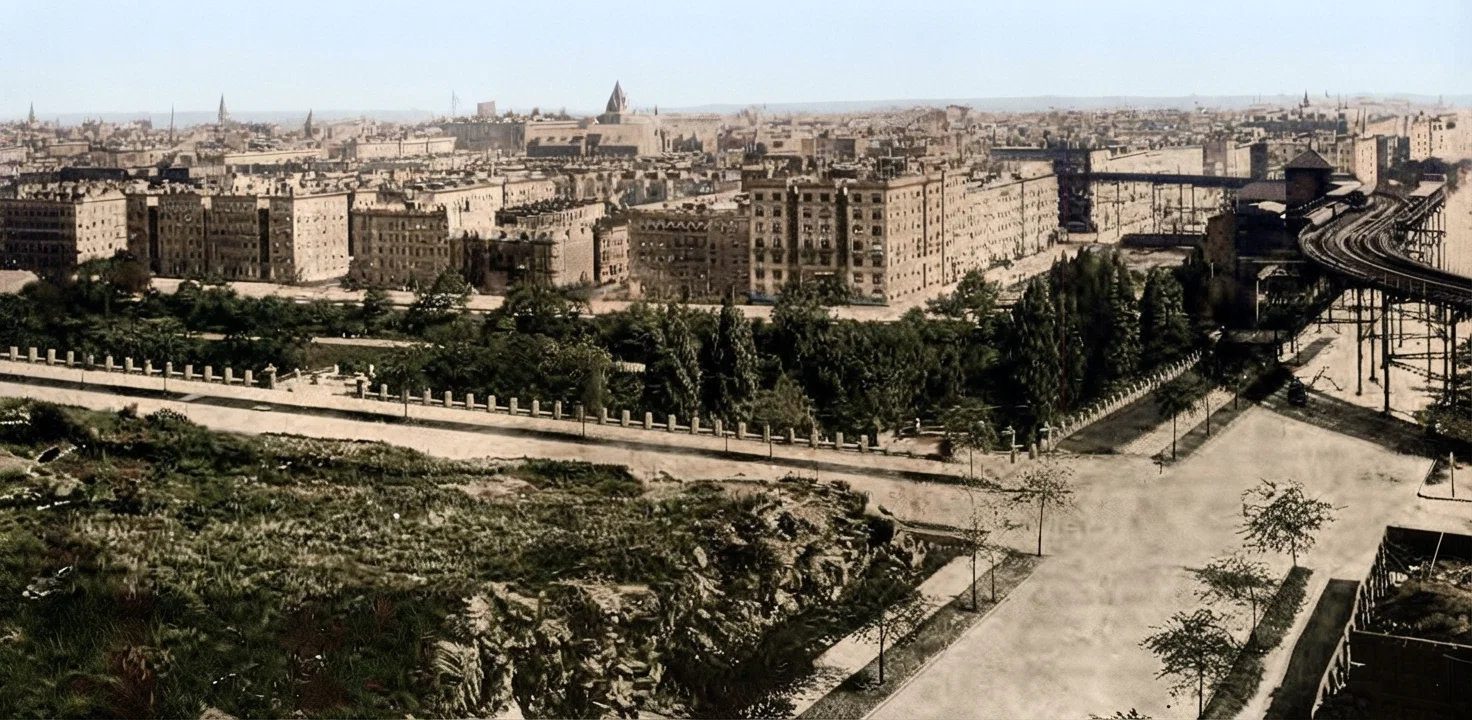
HARLEM, FROM CATHEDRAL HEIGHTS.
THE volume of business transacted in New York is illustrated by the receipts of its post-offices, which average $58,965 a day. For the year ending June 30, 1905, the receipts, including Brooklyn, aggregated $17,690,000, or 12 per cent. of the total income of the 72,000 post-offices in the United States, giving the department a net profit of $11,500,000. In Manhattan alone there are mailed daily 1,716,000 letters, and more than 2,000,000 pieces of mail are delivered. There are 937 publications issued in Manhattan, and the quantity of these mailed averages 337,835 pounds a day. There are 71 post-offices, 329 sub-stations, in the city.
ANOTHER illustration of the business activity of New York is found in its telephone statistics. There are 51 central offices, with 8,000 employees and 198,000 phones. The average number of calls per day is 1,650,000.
IT requires 14,000,000 tons of coal a year to supply New York, about 10,800,000 tons being used to make steam and electricity for heating and power. The average quantity of fuel on hand in the city yards is 422,000 tons.
MORE big hotels thrive in this city than in any other place in the world. Of 344 large hostelries, 51 accommodate over 600 guests each, and the ten largest are valued at $24,565,000. It is estimated that over 100,000 people visit New York in a day, besides the 250,000 commuters. In fine restaurants the city is also well supplied, some $40,000,000 being invested in eating-houses of a superior sort, catering to about 500,000 diners a day, who spend about $1,200,000 on their dinner. These places employ 60,000 people, and they take the entire output of vegetable gardens covering 60,000 acres. One hotel kitchen alone represents an outlay of $130,000.
THE city has 98 theaters, 12 beaches, 26 picnic groves, 25 athletic fields, 18 art galleries, 84 notable clubs, over 100 statues and monuments. It has 4 colleges, 16 high schools, 496 elementary public schools, with 11,273 teachers and 568,232 pupils, 469 kindergarten classes with 15,311 pupils, and spends on its public schools $24,231,850 a year—one-tenth of the cost of the public-school system of the country.
THE city is disgraced with 12,211 licensed places where spirituous liquor is sold. The fact that $11,619,190.63 is paid into the city in revenues blinds the eyes, hardens the consciences of the Christian church, and they smile, and see their sons and daughters go down to destruction.
THE borough of Manhattan annually consumes about 100,000 barrels of whisky, which cost the consumers4$2,500,000. To this item must be added 30,000 barrels of other spirits, sold for $500,000; 200,000 cases of champagne, for which $5,500,000 is paid; 4,000,000 gallons of other wines and brandies, costing $27,000,000; and, last but not least important, 5,000,000 barrels of beer, selling for $100,000,000. This makes a total of $135,500,000—a sum sufficient to create and maintain forever a great university like Yale or Harvard. It is a fact rather interesting to consider that, if all of this beer and liquor were put into a tank, and were allowed to run through an ordinary water-tap at the rate of a gallon a minute, the receptacle would require ninety years and thirty-six days to empty itself.
Rene Bache, in January Pearson's.
NEW YORK'S 1,439 churches own property valued at $183,972,340. Among some 3,000 charitable organizations and institutions are 132 hospitals valued at $14,782,400.
THERE are in the city an average of 212 deaths and 270 births a day, but constant accessions to the population from the rest of the country and by immigration make the net increase in the city's inhabitants about 270 a day. One-tenth of all who die are consigned to pauper's graves.
DURING the ten years from 1893-1903 New York City chronicled the fate of 5,986 suicides.
THE city library was organized in 1729, and a classical academy was opened in 1732. In 1765 the Stamp Act Congress met in New York. In 1770 a riot took place in which one citizen was killed and three wounded by British soldiers. This is sometimes called the "Battle of Golden Hill," and ranked by some as the first conflict of the War of the Revolution, seven weeks before the Boston Massacre. The noted Tammany Society, or Colombian Order, was established 1789.