CITIES need the pure Gospel of the Bible. The old-fashioned faith of past generations in the blessed Book of God, is something well-nigh unknown to-day. Pulpits uplift noted men more than Christ Jesus the Lord. Churches have fallen from pure religion so far that they have become to a large degree societies of fashion, a place for the rich to gather to be amused by some good orator a short time one day each week. Some exceptions to these are found, but generally speaking the laboring classes do not find church homes in the popular Protestant churches of our large cities of to-day.
In “Modern Cities,” by Samuel L. Loomis, in the chapter “The Threat of the Cities,” page 99, we read: “Now, city churches of the Protestant order are usually attended and sustained by persons of means and intelligence. It makes a man prosperous to be a Christian. The Protestant city churches are, therefore, to the laborer, the churches of the capitalist. He will have nothing to do with them. Their cushions and carpets, their polished pews, stained windows, and pealing organs, as well as the rich garments of their prosperous congregations, were purchased, as he thinks, with money wrested from his toil-worn fingers. What wonder that the invitations of the church ring in his ears like tones of hollow mockery, from which he turns away with bitter heart!”
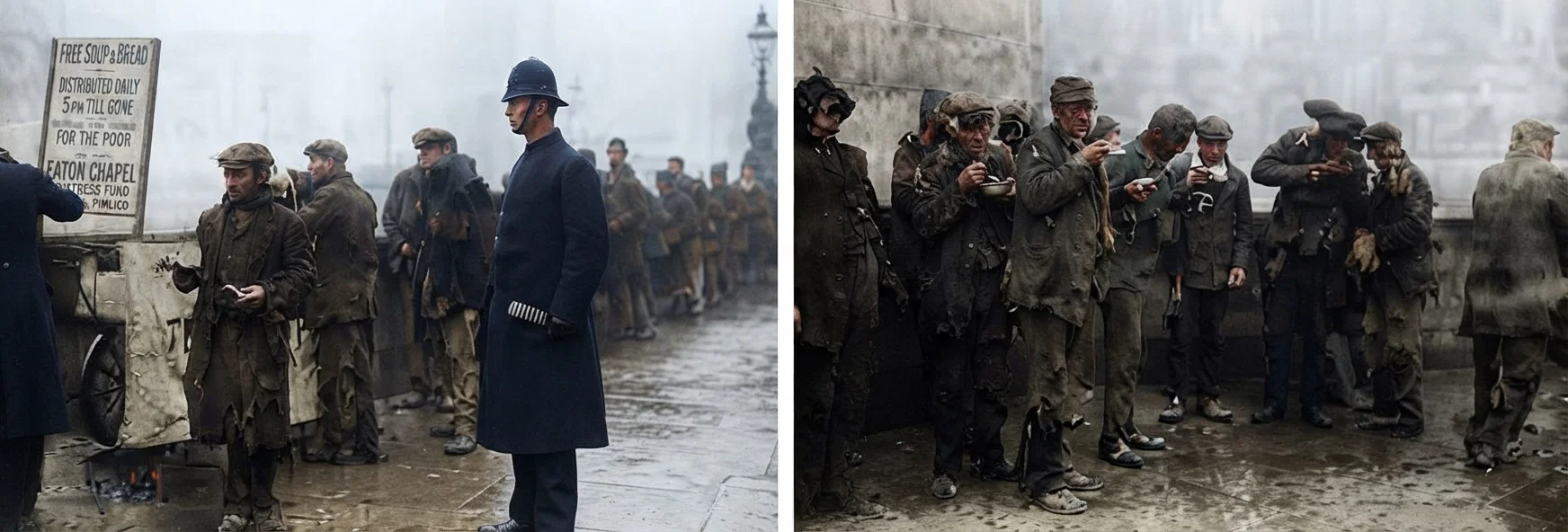
No city of the world presents stronger pictures of patient poverty than does London through the long, wet winter. It is one of the richest cities in the world. It has its types of the world's awful wretchedness. There is also there large charity. On the left is shown a scene of the distribution of bread and soup on the Thames embankment. A policeman is keeping order at the bread box and soup kettle. On the right is another scene of the homeless after receiving soup and bread. (Photos are from the Transatlantic Co., New York.)
The toilers in the cities feel the iron hand of fate that keeps them from enjoying more of the fruit of their toil. Unreasonably, it may be true, much of their condition is in their minds traced to the door of the church where, in many instances, worships their employer. Among themselves such as the following, a quotation from Iron Moulder’s Journal, not a Socialist paper, but a labor organ, passes between them and is freely discussed:
“One hundred workers, of as many occupations, will produce, working as they now work, treble the amount of all the necessities and comforts that one family will consume. How in God’s name is it that they can not get enough to eat and wear? What is it, and who is it, that takes it all from them and grudgingly doles back to them just sufficient to keep body and soul together for not the allotted life of man, but for the time necessary to work and starve them into the grave?”
The blessed Book of God sends the only true answer to these distressed souls. They should hear it fresh from warm-hearted Christian lips: “Go to now, ye rich men, weep and howl for your miseries that shall come upon you. Your riches are corrupted, and your garments are moth-eaten. Your gold and silver is cankered; and the rust of them shall be a witness against you, and shall eat your flesh as it were fire. Ye have heaped treasure together for the last days. Behold, the hire of the laborers who have reaped down your fields [toiled in your workshops and markets], which is of you
kept back by fraud [called legitimate profits to-day], crieth: and the cries of them which have reaped are entered into the ears of the Lord.”
To the laborers God sends this word: “Be patient therefore, brethren, unto the coming of the Lord.” The third angel’s message holds out the only hope to these people. This message of hope and cheer is certainly due, and long overdue, to the toiling multitudes in the great cities.
One other quotation from “Modern Cities,” page 210, emphasizes this special need for helping the common people. It should not be forgotten that Jesus was poor. He felt the pangs of poverty. He knows how to sympathize with the poor and distressed to-day—and He does. Mr. Loomis says: “No words can tell, brethren, no words can commence to tell, how tremendous is the importance of giving to our working people the knowledge of God through Jesus Christ. As water can not be boiled by applying heat at the top, so society can not be saved by a religion of the upper classes.
. . . The fire must burn down to the bottom or the fire must go out. Christianity, from the nature of it, can not remain the religion of a class; it must be the religion of the whole people, or that of none.”
A danger is here pointed out. After speaking of our leaders here in the United States, who have, generally speaking, sprung from the hard-working class, coming from homes of piety where the Bible was studied, and where prayer was often heard, this same writer adds: “But these humble homes, both in the country and in town, have now for many years been fast passing into the hands of strangers. What if our future leaders are being reared in Roman Catholic households, and cradled by the firesides of unbelief? Wo to the nation whose cottages have no Bibles. The poor and the stranger must be taught to know the God of our fathers; it is our only hope. This only hope
is a large hope. The Gospel was made for the poor—they need it, they hunger for it, they will receive it when it is faithfully preached.”
And so they will. Hundreds and thousands will take the pure water of life in the midst of the smoke and din and sin of the great cities, when messengers, humble messengers, in the love of Jesus, hand the life-giving cup to them. This is our real call to-day. It is not orators that are needed so much as Spirit-filled men and women to go to the perishing multitudes, as did Jesus Himself, and give them the blessed Word of God.