THE Moravians have been among the foremost in missionary enterprise and zeal. The writer, having picked up some bits of their history of self-denial and devotion and the blessings which have followed, would present it to the readers of the Signs of the Times, hoping it may encourage others in the great work before us.
"The Unita Fratrum," or Moravian Church as it is commonly called, was founded in Bohemia, in 1457, by followers of John Huss, the Bohemian reformer and martyr. It soon spread to Moravia, whence it derives its name.
After flourishing for a century and three quarters, it nearly received its death-blow at the hands of Ferdinand II., a bigoted Romanist. But a hidden seed remained in Bohemia and Moravia, secretly cherishing the faith and traditions of their fathers.
They Find a Friend.
In 1722 a number of these descendants of the Brethren, together with other awakened compatriots, emigrated to an estate belonging to the Count Zinzendorf, in upper Lusatia, Saxony, and there founded Herrnhut, which grew to be a flourishing town. Here, under the fostering care of this devoted man, the Moravian Church sprang into new life.
Count Zinzendorf belonged to an Austrian house of high antiquity. The first ten years of his life he spent with his grandmother. In that time, she, like the mother of Moses, so thoroughly instilled into his young mind the principles of the love of Christ, that, altho in after years his friends tried to dissuade him, and he was sent away to college and educated for the profession of law, and at the age of nineteen was sent to gay and dissolute France, where he spent some time, he remained steadfast to the teachings received in early boyhood. In his fourth year he began earnestly to seek after God; and while yet a child he framed a covenant which ran thus: "Be Thou mine, dear Saviour, and I will be Thine;" and it was often renewed afterward. Aware that powerful temptations would await him in France, he resolved firmly to maintain his Christian position, and hence wrote, "If the object of my being sent to France is to make me a man of the world, I declare that it is money thrown away; for God will, in His goodness, preserve in me the desire to live only for Jesus." Thus did God raise up a person to provide an asylum for those impoverished exiles from Bohemia. "I will never leave thee, nor forsake thee."
A Needy Field.
When Count Zinzendorf was at Copenhagen attending the coronation of King Christian VI., some of his attendants met a negro named Anthony, who dwelt upon the sad condition of Africans in the island of St. Thomas, and particularly that of his sister, who wished to be taught the true religion. This man afterwards visited Herrnhut, and a simultaneous desire was kindled independently in the hearts of two young men to devote themselves to Gospel work among the slaves in the West Indies. One of the two, Leonard Dober, was a potter; and with him was associated David Nitschmann. Their funds amounted to a trifle over three dollars apiece. Count Zinzendorf took them in his carriage as far as Bautzen, and then, with a blessing, bade them Godspeed. A bundle on their back their only luggage, they set out thence on foot for the capital of Denmark, a distance of six hundred miles. Pious persons on whom they called by the way, tried to dissuade them; only one in that whole distance spoke an encouraging word. But special service for God never fails of special help from God. They reached Copenhagen, where they at first meet ridicule and opposition. They are told that no captain will take them on his ship; that, if they reach St. Thomas they will be unable to support themselves. Frightful stories are related about the ferocity of the Caribs. The two brethren do not argue the matter, and make but little effort to answer objections; they keep quietly about their business of trying to reach the West Indies, ready to go into slavery themselves in order to reach the negroes, as Anthony had represented would be necessary.
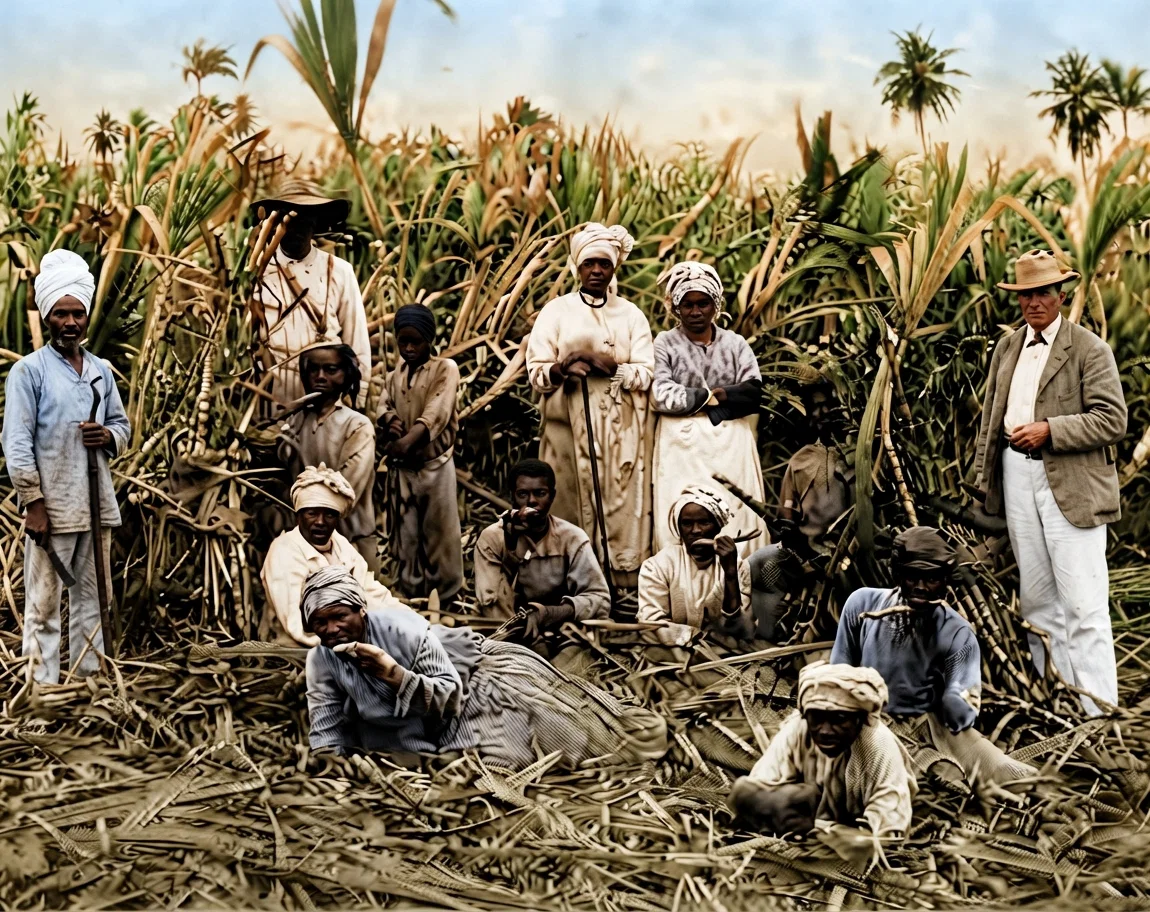
Cane-cutters of Jamaica.
The Way Opens.
An unseen hand was guiding, the adorable Comforter was sustaining these devoted men. At last their Christian constancy won favor and efficient sympathy. The royal chaplains became interested; so did a few other high officials, who gave enough to pay their fare out, as well as to procure tools for carrying on their trades. Some members of the royal family, among them the queen, lent their aid. The Princess Amelia, unsolicited, gave them money toward their expenses, and a large Dutch Bible, which proved a very seasonable gift, for, being refused passage on any Danish ship, they were compelled to avail themselves of one from Holland, and embarked October 8, 1732. Here, too, as often, the good hand of God was visible in the very disappointment. St. Thomas had been in possession of the Netherlands; the negroes spoke Dutch, and the missionaries now had an opportunity, during their voyage, to learn the language which would be required in their work.
The day after landing, Dober and Nitschmann went in search of Anthony's sister, and, finding where she lived with her husband and younger brother, they made known Anthony's salutation. By request, they opened and read his letter to her, in which occurred the quotation, "This is life eternal, that they might know Thee, the only true God, and Jesus Christ whom Thou hast sent." Beginning then and there, they preached the Gospel to the heathen slaves gathered round. The negroes understood the drift of the message, and clapped their hands for joy. Every opportunity for instructing the blacks was improved, and among those early awakened were Anthony's sister and her husband.
After some months Nitschmann, according to previous arrangement, returned to Europe. Then a year and four months passed before Dober heard from Herrnhut. While sitting by a watch-fire one evening, suddenly three men stood before him. A vessel had just come in, bringing from Herrnhut missionaries destined for this and the neighboring island of St. Croix. An appointment as general elder at Herrnhut caused Dober to return to Germany in 1735. But the precious seed he had sown not only brought forth fruit to the honor and glory of God before he was called away, but it has gone on bearing fruit, aided by other missionaries from other denominations, until it has spread over the entire West Indies, and thousands of these benighted heathen souls have been brought to accept the Gospel plan of salvation.
Now Hearing the Last Message.
In 1892 the Third Angel's Message reached the West Indies. God has blessed our efforts, until in Jamaica alone, more than fourteen hundred have accepted the truth, and a good beginning has been made in Barbadoes, Trinidad, and a few other islands. But, with all that has been done, only a commencement has been made. On many of the islands there is not a single laborer, and where there are workers there is a call for more. Where are the Dobers and Nitschmanns who will say, "Here am I, Lord, send me"?13
THE HEART OF THE GOSPEL.
A STORY is told of Lapaux, a member of the French Directory, that with much thought and study he had invented a new religion, to be called "Theophilanthropy," a kind of organized Rousseauism, and that, being disappointed in its not being readily approved and adopted, he complained to Talleyrand of the difficulty found in introducing it.
"I am not surprised," said Talleyrand, "at the difficulty you find in your effort. It is no easy matter to introduce a new religion. But there is one thing I would advise you to do, and then, perhaps, you might succeed."
"What is it? What is it?" asked the other with eagerness.
"It is this," said Talleyrand, "go and be crucified, then be buried, and then rise again on the third day, and then go on working miracles, raising the dead, and healing all manner of diseases, and casting out devils, and then it is possible that you might accomplish your end."
And the philosopher, crestfallen and confounded, went away silent.—Selected.