IN the Scriptures we read, "Behold, how great a matter a little fire kindleth!" Until a few years ago the world was giving but little attention to that tiny insect called the mosquito. But since the Spanish-American War, and since the visitation of yellow fever to New Orleans, this little creature has been occupying a realm of such great importance as to involve a remarkable revolution in medical knowledge of the etiology and prevention of yellow fever.
This little pest to-day is commanding the respect and dread of the scientific world for its ability to propagate and transmit disease; and a war is being waged in behalf of its extermination. In the present instance, there is arrayed on one side the medical branch of the general government in conjunction with the local authorities of Louisiana, besides the combined forces of local citizenship, hundreds of thousands of dollars, tons of sulphur and pyrethrum, scores of barrels of oil, salt, and other agencies of destruction; while on the other side is to be found the tiny mosquito. What has brought about this [[FIGURE]]
spectacle upon which the eyes of the whole world are looking?
It has been demonstrated that yellow fever and other diseases may be propagated and transmitted by mosquitoes, of which there are at least three species, the culex, anopheles, and stegomyia fasciata. The culex, or gutter mosquito, and the anopheles, or swamp species of the insect, elaborates and transmits by inoculation malarial fever. The stegomyia fasciata, which is a fresh-water mosquito, is the intermediary host which carries yellow fever parasites from a patient to a well person. It has been shown that, in order to carry on her deadly work, the stegomyia fasciata (the Latin name of this mosquito) must bite a yellow-fever patient within the first three days of the appearance of the disease; then a period of twelve days must intervene for elaboration before the disease can be imparted to another body. After that time, and during the life of the creature, sometimes 150 days, it is prepared to deal a bite which will cause yellow fever. It has been demonstrated that in no other way can the fever be contracted, and this is why there is such a warfare being waged against the mosquito.
The mosquito theory was brought before the world as the result of careful and ceaseless study and research of physicians, who gave the subject of tropical fevers special attention. In 1881 Dr. Carlos J. Finlay, a British subject born in Cuba, promulgated the theory of the transmission of yellow fever by the stegomyia mosquito. His study, research, and demonstrations were conducted in Cuba, the chief focus and home of the disease, Havana being never without it from 1762 to September, 1901, a period of 140 years. As a result of his demonstrated conclusions in connection with other scientists, he recommended the very measures which are being used against the propagation of the fever, viz.:
To prevent those insects from stinging yellow fever patients.
To destroy, as far as possible, the mosquitoes which have been infected.
Finally, to consider any place unsafe so long as the last mosquitoes which have stung yellow-fever patients may be alive in it.
Dr. Finlay's theory was not accepted at first in general, and it required more argument. At the close of the Spanish-American War, a commission, known as the United States Army Yellow Fever Commission, composed of Major Walter Reed and Drs. Carroll, Lazear, and Agramonte, was sent to Cuba to study the conditions, and report its findings.
The first visit was in the early summer of 1900. Their conclusions fully corroborated the mosquito theory. Dr. Lazear died a martyr to the cause of science, having submitted himself for experiment's sake. During this and other experiments it was demonstrated that the disease was not contagious, that is to say, the fever could not be communicated from person to person, or from contact with clothing or atmosphere surrounding patients. Non-immunes were placed in rooms specially screened from mosquitoes, in which were the bed and bedding of deceased patients, and, in every conceivable way, attempt was made to contract the disease by contact with possible infection. Failure to take the fever was invariably the result. On the other hand, non-immunes were placed under a mosquito netting in which were placed infected stegomyia mosquitoes, resulting in the person's taking the yellow fever.
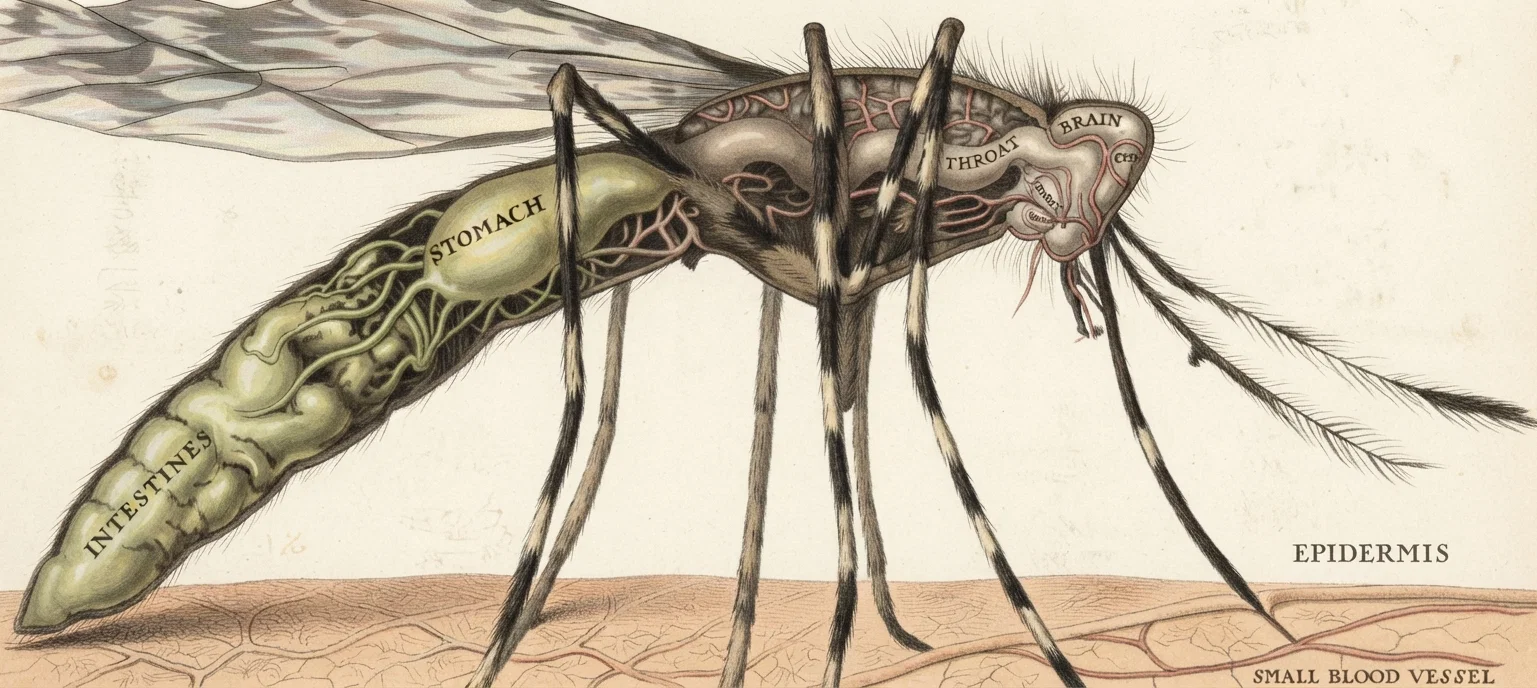
Stegomyia fasciata, the yellow fever mosquito, very greatly enlarged.
It has been generally thought that yellow fever was a filth disease. But this has been demonstrated to be an error, for the disease may be contracted by the most careful in diet and general hygiene. It must be said in this connection that the patient who has been in general good health, whose blood is not filled with the poisons of a wrong dietary of meat and drink, do not permit the fever to linger long in their systems. The daughter of the writer had the fever, but the physician had no occasion to administer medicine, and said that her general condition was such that the fever could not make the inroads which were so general in persons having other conditions.
In demonstration of the fact that the mosquito theory is an established matter, some figures are given, and comparison made with other epidemics. In 1878 the medical fraternity were working in the dark for the most part in waging war against the spread of yellow fever in New Orleans. The mosquito was not taken into account, and the totalities of that year were as follows: Total number of cases, 25,000; total number of deaths, 4,046.
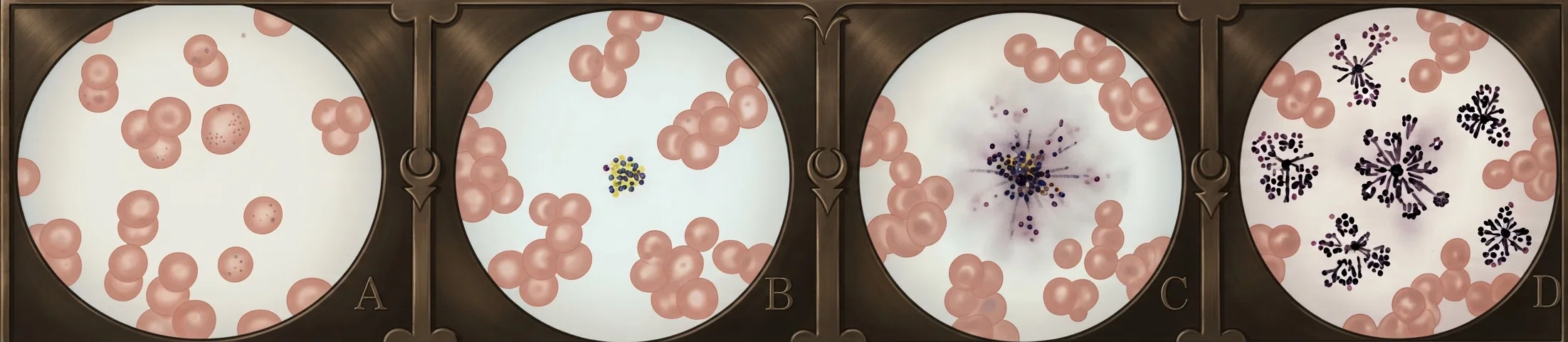
These cuts illustrate the growth of the yellow fever germ colonies in the blood of one stricken with that disease.
In 1897, total cases, 1,907; total deaths, 298. Fever began September 16.
The present situation shows that there were 100 cases on July 20, 21, the first reporting made. On that date there were reported 21 deaths. Up to September 20, involving a period of 76 days, the figures are as follows: Cases, 3,000; deaths, 388; discharged, 2,372; under treatment, last date, 240.
It will be seen that the fever situation is under control, and there is no other way to account for it than upon the hypothesis that the mosquito is the known propagator and transmitter of the disease.
The campaign against the fever has been somewhat difficult, because of the failure to secure full and accurate reports of new cases, sometimes the first news of yellow fever in a home being the death of the patient, which must be reported before a burial permit is issued. Ordinances and laws have been resorted to, in order to help stamp out the scourge. Tons of sulphur have been used to fumigate homes in destroying the stegomyia, for the stegomyia mosquito is a house insect. Cisterns, which contain the family supply of drinking water, must now be screened, for in them the mosquito lays its eggs, producing the larvae, from which comes the pupa, and finally the mosquito. Besides screening, oil must be put into the cisterns, about a quart being ample to cover the surface. The oil closes access to the air which the embryo must have, resulting in its death. Thus do we see what a remarkable insect the stegomyia is, and to what great trouble in labor and talent and time man is put by this erstwhile insignificant and tiny creature.
There are many lessons growing out of this campaign, the most important of which is that, if we obey nature's laws, we may be enabled to ward off the evil, or to control and defeat it, if inoculated, instead of permitting disease so to fasten itself as to control us.
New Orleans, La.
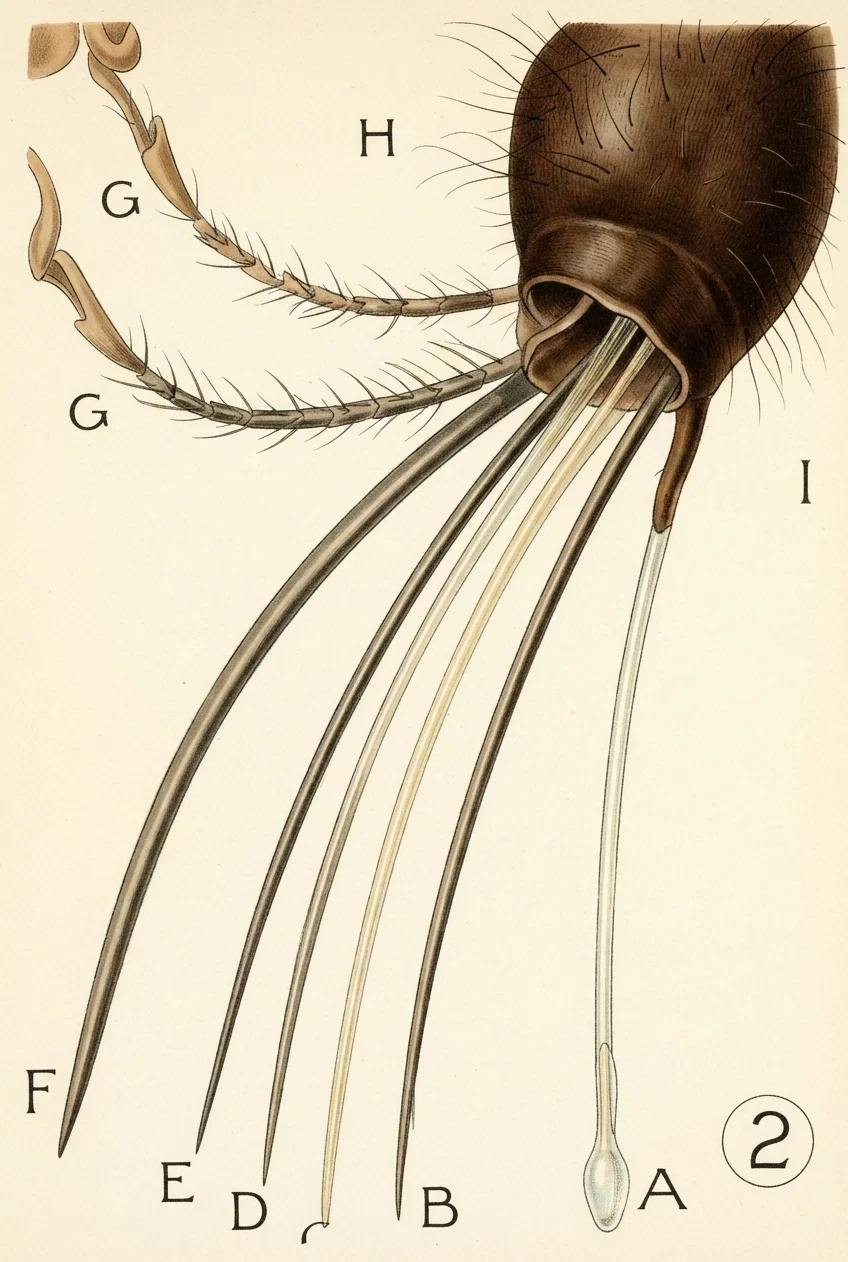
The weapon of the mosquito separated into its parts. The part of the bill with the bulb at the end contains the irritating poison.