TO OUR FELLOW CITIZENS

5%

Pacific Press Publishing Company · Mountain View, California · Jul 4, 1905

FromSigns of the Times, Vol. 31, No. 27.

Read the full edition

TO OUR FELLOW CITIZENS.

IT is with no desire to reflect upon our common country that this issue of the SIGNS OF THE TIMES is sent forth. We are glad to recognize—
That this is a great and glorious country;
That the government was founded on the blessed principles of equality and liberty as no other which ever existed;
That despite all the inconsistencies of state laws, despite the many years of slavery within its borders, it has been the grandest, freest government that earth ever knew; and,
That its flag has symbolized freedom and humanity to all the earth.
We do not wonder that the patriot's heart throbs with new joy and forceful impulses as he contemplates his country's past.
We can understand that to any one less than Christian one of the most beautiful, one of the most thrilling objects upon which a patriot's eyes ever looked with more kindling joy, is the flag of this country,—the Stars and Stripes,—waving in the free winds of heaven.
We respect the whole-souled ardor of the loyal citizen as he responds to his country's call.
All these we appreciate and heartily recognize. We have been there.
But, fellow citizens, the true statesman and the true friend of his country must make deeper research, must take broader view. It will not do to cover with the court-plaster of expediency the ulcers of the body politic, nor limit the view to the little valley of the immediate present nor near probable future, even yet hidden by the glory of the past. He must probe for the rotting ulcer, he must extirpate the roots of the cancerous growth; the life-blood of the body must be purified before the death sores will heal. He must climb the mountain and take a larger, clearer view if he would know the condition and outlook of his country. He must take cognizance of the great general trends which reveal the principles actuating the life. He must know that only by adhering to the law of its life, the reason of its existence, can the nation continue to exist.
The Christian, if he be true to his Master, must search deeper still. He must, by the radium power of God's Word and Spirit, look into the hidden springs of human action. Are the sources selfish?—Then the end is death. Are they unselfish, consistent?—Then there is continuance of life and vigor.
The Christian must get up into the "high mountain," even the high mountain of God, and by faith in the prophetic ken as unrolled in the "more sure word of prophecy," he must see as God sees. He can not look upon the land of his birth as the only land, or the land for him and his alone. He must see that all lands are his, blood-bought by Jesus Christ. He can not as a Christian confine his love to the land of his birth. He will love all men because all are the purchase of his Redeemer; and, as a redeemed one, he is debtor to all, "both to the Greeks, and to the barbarians; both to the wise, and to the unwise;" both to the Russians and to the Japanese; to the each and to the all.
The Christian loves all lands, because "the earth is the Lord's." He loves all because they are the purchase of "the precious blood of Christ." Moreover, he looks beyond this life to the life to come. He believes and knows God. He knows that "the Most High ruleth in the kingdom of men, and giveth it to whomsoever He will;" that even the wrath of man shall praise Him and the remainder of wrath shall He restrain; that when a nation will not work out His will, "He removeth kings, and setteth up kings," and that, finally, Christ Jesus the Branch will have gathered out of the kingdoms of earth those who will be eternally loyal to Him, and who will share with Him His universal kingdom, which is to come by His power alone from the ruin of all earthly kingdoms. All this God has again and again foretold in His holy Word.
The Christian should know as no one else can know, be he historian or statesman, that a nation must be true to the law of its life if it is to continue to live and prosper. He knows that the moment a church, a nation, even as a man, departs from the law of its life, from that moment its decline is at hand.
Has this government departed, is she departing, from the law of her life, from the principles which gave her existence? In the light of the evidence presented in this issue of this paper, in the light of much more which might be presented, could we answer otherwise than to say, "She is so departing?" Bigness is no evidence of strength. Plethora is no sign of health. If the Christian sees the danger, is it not his duty to give warning in no uncertain tones? Can he be excusable to High Heaven if he give it not? Are we carrying out the spirit of the charters of our liberty in weakly yielding to the Church of Rome, in the indorsement of the Sunday institution, thereby constituting a civil court the arbiter of religious differences? Few are those who realize these dangers. Fewer still are those who, amid the craze of commercialism, whirl of patriotic sentiment, the maze of political chicanery, and the flood of political gush for political purposes, dare raise their voices in faithful warning, for fear of being regarded as enemies, or, at least, pessimists. But the truest friends to nation, country, and people are those who give faithful warning of the evil day.
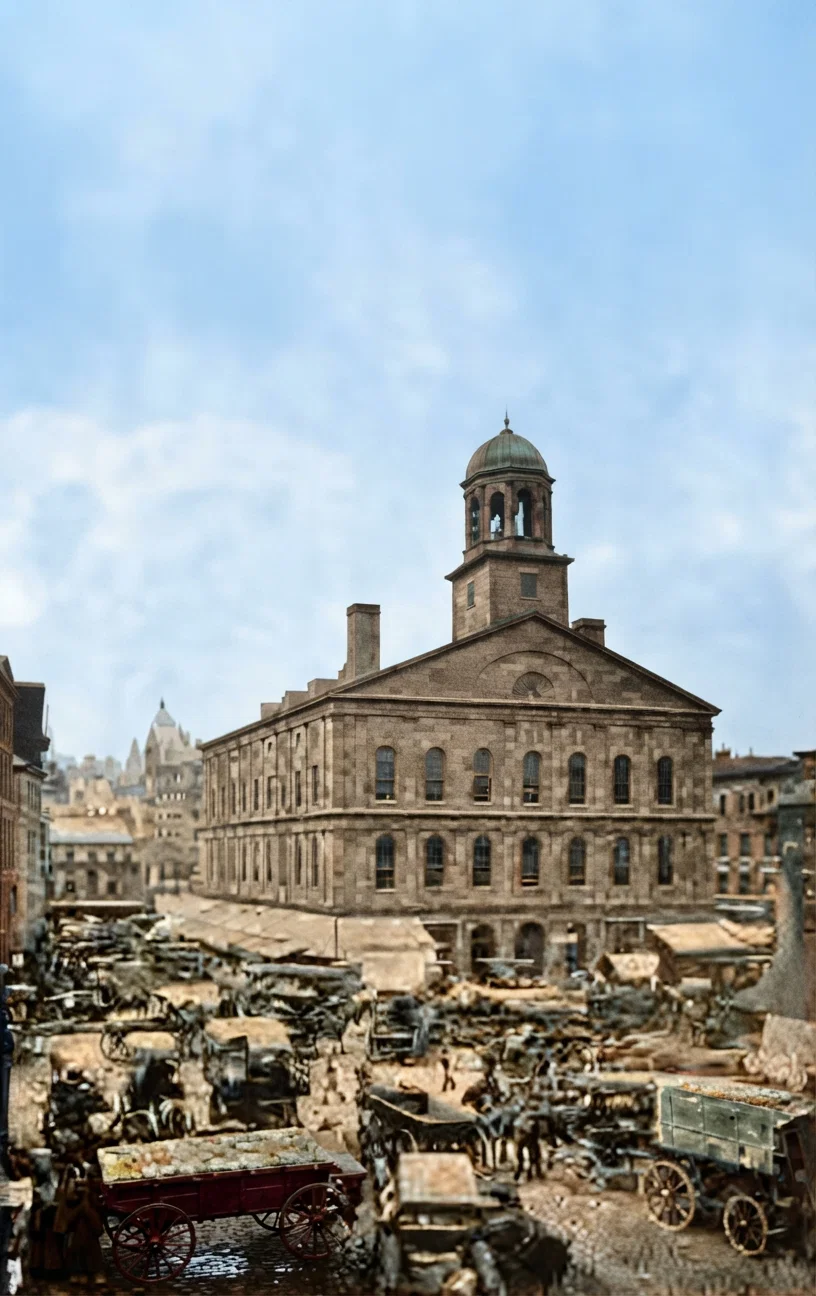
Faneuil Hall, the Cradle of Liberty.
O friends, fellow countrymen, will you not heed the warnings? Statesmen, legislators, judges, will you not, as did the fathers of the Republic, as stated by Madison, see "all the consequences in the principle," and avoid "the consequences by denying the principle"? Or will you be charmed by the siren voice of an apostate Christianity, and lured to ruin, or be carried on to destruction on the almost resistless tide of a plutocratic ambition?
What will be your choice?