IN placing before the reader the following astounding facts indicative of the lavish expenditure, the ostentatious display, and the wanton waste, which are so obtrusively in evidence in the world of ultra wealth and fashion, my object is not to entertain or gratify mere curiosity. Neither is it my purpose to find fault or to condemn My object is a serious one; namely, to make evident to the reader the very solemn fact that the social phenomenon herein portrayed is to our generation one of the many premonitory signals which our heavenly Father has displayed in His prophetic Word.
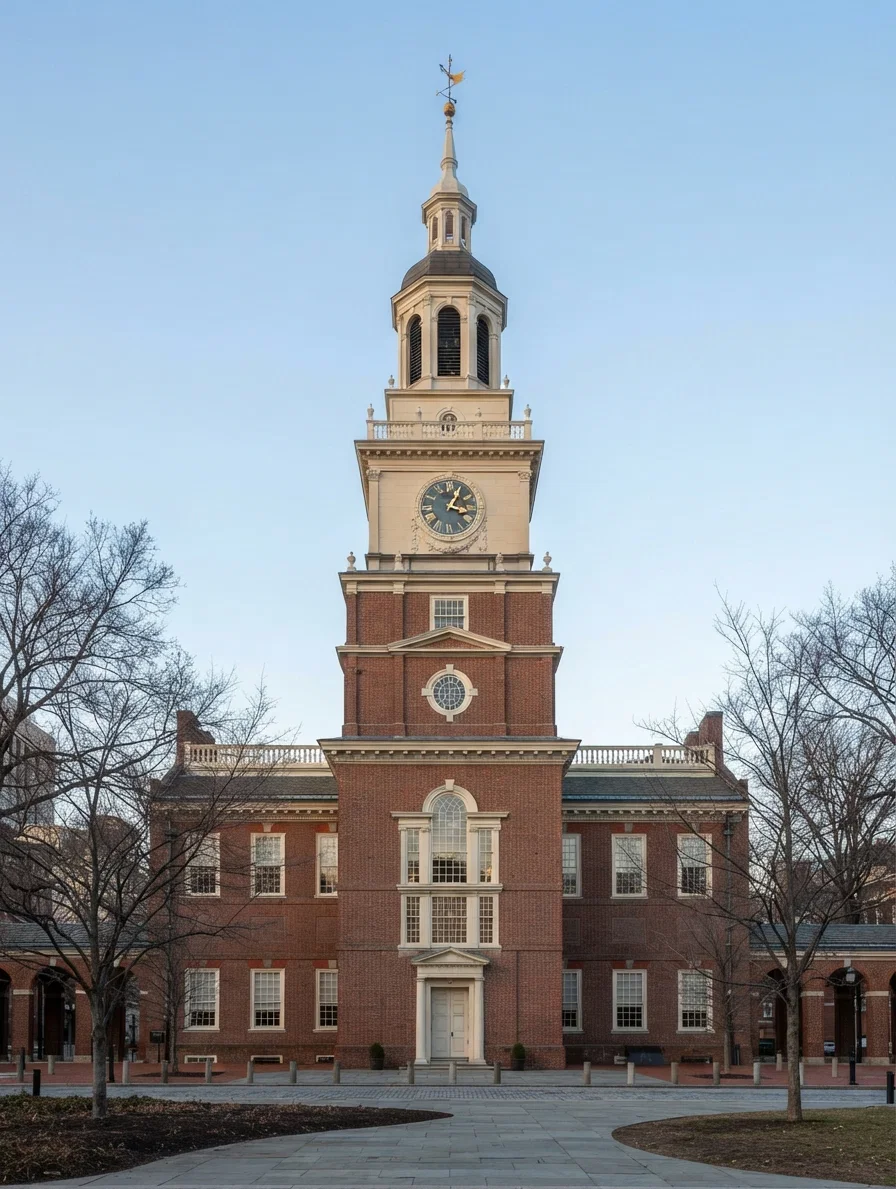
INDEPENDENCE HALL
"Ye have lived delicately on the earth, and taken your pleasure." These words are an excerpt from a prophetic anticipation of some of the social and economic conditions that would obtain in the days when "the coming of the Lord is at hand." This direct, incisive forecast of Inspiration, relating to our own time, is a part of the fifth chapter of James. Another divine foretelling of precisely the same tenor, and likewise finding its fulfilment "in the last days," was given through Paul, and is found in 2 Tim. 3:1-4. Direct and unequivocal, it can not be misunderstood. Omitting what is not essential to my theme, it runs thus: "But know this, that in the last days grievous times shall come. For men shall be lovers of self, lovers of money, . . . LOVERS OF PLEASURE rather than lovers of God." The following is an Old Testament picture of the same latter-day phenomenon, and is given in Isa. 22:13: "And, behold, joy and gladness, slaying oxen and killing sheep, eating flesh and drinking wine; let us eat and drink for to-morrow we shall die."
Is the church of Christ warranted in believing and teaching that these foretellings of the Holy Spirit find their fulfilment and verification in our day? The following array of facts make it indubitably evident that the foregoing prophetic premonitions are being strikingly fulfilled in these romantic days. And, of course, such fulfilment is one of the numerous present-day signs betokening the early realization of "that blessed hope, and the glorious appearing of the great God and our Saviour Jesus Christ." Titus 2:13.
Inventing New Ways of Spending Money.
A popular writer has recently declared that "fortunes are to-day so numerous that the owners find it difficult to spend the income." There are actually many persons who make a handsome living by inventing new methods of spending money. The urgent requirement is for something incredibly expensive and startlingly novel, whether it be in the way of dress, of equipage, of household decorations, of supplies for the table, or what not. Cost is not considered except as an enhancement of whatever may be desired. Indeed, the more costly a thing is, the better, if only for the reason that an extravagant price puts it beyond the reach of ordinary persons, whose possession of it would render it commonplace, or even vulgar. Hence it has been seriously alleged that any one who has the ingenuity to create novel methods of self indulgence, which are at once spectacular in form and fabulous in cost, need not long be in want of lucrative employment.
Hostetries that Smell of Money.
Two or three of the largest hotels in New York City, which a few years ago were regarded as touching the topmost point of gorgeousness and sumptuous appointments, are to-day shunned by the ultra "smart set" of our American moneyed oligarchy, as too cheap and popular. Hence for the exclusive accommodation of these rare souls, a number of smaller, but more lavishly expensive hostetries have recently been built in New York and a few other large centers. One of these in New York, completed in August,121904, will under no circumstance admit more than two hundred guests, and these must be persons who are not only primates among multimillionaires but are admittedly of the highest (?) and most exclusive social caste.
To designate this hotel as a "palatial" one would be to use a grossly inadequate adjective. In respect to embellishment and luxury, nothing conceivable has been omitted. The furniture alone cost $1,500,000. The furnishings of a single room vary in cost from $4,000 to $10,000. The curtains for each window represent an outlay of $300; and the portières for each door represent an expenditure of the same amount. The walls of some of the rooms are covered with hand-embroidered silk or satin costing $60 to $75 a yard. Because of its relative cheapness, mahogany furniture was eschewed as being too common. Circassian walnut, being the rarest and most costly cabinet wood in the world, is accordingly the material of which the furniture consists.
All the corridors are walled with the most costly white marble obtainable. Even what is unseen must not be cheap, because cheapness suggests economy and economy spells vulgarity.
For a suite of five rooms, with baths, the guest pays $150 per day. Three rooms cost him $12,500 a year, exclusive of meals. In one of the most sumptuous of New York apartment houses, a modern Midas pays $15,000 for a suite of unfurnished rooms. He spent $6,000 in decorating the walls.
In the February Success Magazine, Mr. Cleveland Moffett tells his readers that a friend of his, who pays $8,000 a season for the rent of his Newport cottage, said to him: "Newport is the most expensive city in the world; it's twice as expensive as New York. Mr. Moffett avers that a rental varying from $3,000 to $7,000 for a cottage for the "season" of three months, is an ordinary affair at Newport. But any one of the many villas commands a rental of 5,000 or more dollars the three summer months ending in September. He declares that "no summer city in the world can show so lavish an expenditure in so small area," as Newport. Even the unimproved land, adjacent to the city, sells readily at the incredible price of $43,000 an acre. The cottages built to be rented to the money burdened votaries of "pomp and pleasure" were erected at a cost of $250,000 to $1,000,000.
There are forty of these places in Newport where the running expenses incident to the keeping up of lawns, gardens, greenhouses, etc., amount to sums varying from $10,000 to $15,000 for each place. The grounds of one of these places were improved at a cost of half a million dollars, and twenty laborers are required for the mere details of landscape gardening.
Enormous Cost of an Ordinary Fete.
Hundreds of recklessly expensive fêtes take place every season at Newport; and, of course, a relatively large number at all the other resorts of the "exclusive sets." Each one of the splendid functions represents an outlay ranging from $10,000 to $20,000. The fabulous cost of "swell" dinners given by and for the opulent epicures of our day is not so much owing to the expensiveness of the food actually consumed, as it is to the gorgeous decorations of the table, dining-hall, and grounds. These decorations are on a scale of extravagance quite amazing to ordinary folk. They consist not only of flowers, costing sometimes thousands of dollars, but of all sorts of superb rustic scenery.
A Newport florist said to Mr. Moffett: "The flowers for a single ball cost $2,000." "How is that possible?" inquired Mr. Moffett. "How is it possible?" ejaculated the florist. "Suppose you are giving floral favors of ten dollars each, in the cotillion? You think ten dollars is too much? I can show you on my books where Mrs. H., at her ball, paid me fifteen dollars each for 120 floral favors. That made $1,800, without even starting the decorations."
The florist described another sumptuous ball "where the walls were festooned with laurel wreaths, and at each loop of the wreaths hung an enormous gilt basket filled with exquisite pink roses among which sparkled dozens of tiny electric lights." That trifling item alone absorbed a cold thousand dollars. A theater, built expressly for the occasion, on the lawn, and removed the next morning, cost an additional two thousand dollars. Several thousand dollars were added for a fully equipped vaudeville entertainment, with singers, acrobats, jugglers, and dancers—all brought from New York for the occasion. The extra electric lighting effects on the grounds usually cost $5,000 for the evening. These are only some of the items that contribute to the enormous total cost of a single ball, two or three of which are given in Newport alone every week of the summer months.
Washington Monument, Washington, D. C. Corner-stone laid July 4, 1848; cap-stone set Dec. 6, 1884; dedicated Washington's birthday, Feb. 22, 1885; height, 555 feet; weight, 81,120 tons; cost, $1,187,710. It is a wonderful monument, materially considered. But the principles of liberty held by the man it commemorates are eternal.
Occasionally, however, an exceptionally "swell" ball is given in some center of fashion and luxury, which may represent an expenditure of $30,000 to $100,000. A typical instance is the much discussed Hyde ball recently given in New York. The newspapers reported the total cost of this magnificent function at $100,000. Apropos of this fête, the editor of a New York paper coolly remarked: "If a man wishes to spend $100,000 on a costume party and he has it to spend, . . . no one has a right to find fault—provided it is a good party. When people have money to burn they would certainly suffer cruelly if they were not allowed to burn it." Morally no one can have such a right.
Speaking of another notorious ball, a popular writer recently exclaimed: "The results of months of preparation and the outlay of hundreds of thousands of dollars squandered in a few hours!" All that remained of it were some faded flowers that had cost $10,000, some scraps of food that had cost at least $15,000, and some rumpled costumes that had cost more than $100,000.
And on that very night thousands of famished men and women wandered homeless in the streets of New York, and ten thousand children in the same city spent that winter night, hungry and cold, because of the desperate poverty of their helpless parents.
Ostentation in Dress.
That this is an age of unprecedented luxury in dress is patent to all observers. "Women's costume costs more to-day than ever before in the history of the world," declares one who has made the history of human apparel a special study. The sums lavished on clothes by the very rich is incredible. "The cost of women's raiment has practically no limit; and a lady of highest fashion can hardly be comfortable on a dress allowance of less than $20,000 a year," soberly affirms Mr. René Bache, in a late number of the Saturday Evening Post. He adds: "If her husband is liberal he may give her $25,000 without fear that he is encouraging her to indulge an undue extravagance." He further declares that if a money king has two or three grown daughters, unmarried and out in society, it is obvious that a million dollars will barely suffice to clothe the women of his family.
A writer for Success recently asked the owner of the largest dressmaking establishment of New York, with branches in Newport, London, and Paris, how much it cost a woman of real fashion, for gowns alone, each year. He answered promptly, "ten thousand dollars." He said that many of his patrons each spent $12,000 a year for frocks, but that he thought $10,000 was ample. "If a woman spends only $5,000 a year for this one item, we do not take her very seriously," he naively added. Being asked how many gowns a "smart" woman needed for the Newport season, he answered that twenty would suffice. He said further that a first-class gown could not be bought from his firm for less that $500. Being asked how often a lady wore one of these gowns, he answered, "Three or four times." After that it was consigned to the limbo of the att'c or was given away.
Mr. Bache, who is an authority on feminine apparel, says that a woman of fashion never13feels comfortable with less than sixty gowns a year. He says that a lady of conspicuous fashion thinks nothing of thirty-five dollars apiece for the lace handkerchief which she carries to social gatherings, and that she is liable to indulge in tears if it be gently hinted that eight dollars a pair is too much to give for her stockings.
When Miss G., a New York heiress, married the Duke of Roxburgh, in 1903, she had seventy hats made for her trousseau, and she considered the allowance to be only moderate. Indeed, young women of her social status expect to indulge themselves in about thirty hats for each season, or sixty for a year. These comprise morning hats, evening hats, reception hats, driving hats, sailor hats, and auto hats. In Mr. B's leisurely phrase, "An auto hat may cost as little as $75, being small and compact, but a carriage hat of sable and lace, or ornamented with a bird of paradise, may separate her dear papa from $500 in good money."
After making the most painstaking and methodical investigation among the most exclusive dressmakers and milliners in New York City, Mr. Moffett ascertained that there were 6,000 women in New York City alone, who spend in the aggregate more than forty million dollars a year on dress! One hundred of these women squander from $30,000 to $38,000 each on their yearly dress supply. One thousand spend $15,000 each; and the remainder let slip $5,000 each, every year, for wearing apparel. Mr. Moffett estimates that if these six thousand women of New York would manage to get along with $3,000 each, a year, for dress allowance, they would save $24,700,000 annually, which could then be used to relieve the awful suffering of New York's thousands of destitute women and children. Now try to imagine the beneficent results if the women of fashion in all the other centers would condescend to do likewise!
It requires sixty sable skins to make a lady's coat of moderate length. If these skins are the genuine Russian sable, they will cost $550 apiece. Hence, the complete coat must cost sixty times $550, or $33,000. Some of the women of extreme wealth wear sable coats long enough to reach the ankles. Such a coat comprises eighty skins costing $44,000. A muff of the same material commands $2,750; and a boa of four skins adds $2,200 to the cost of a complete set of furs. The point lace alone, which adorns many a fashionable wedding gown, costs $1,500. The April number of Success contains a cut of a point de gaze handkerchief, fourteen inches square, and is valued at $1,000. It is the property of a wealthy New York woman. The making of this handkerchief occupied an expert lace worker, in Belgium, a full year. A single pearl necklace was recently sold at Tiffany's, in New York, for $200,000. This is thought by many newspaper writers to be a rare exception as to price. Yet René Bache writes in the Saturday Evening Post, that "a necklace of pearls worth $300,000 is nothing very extraordinary, and $100,000 is certainly not too much to pay for a tiara, while a 'stomacher' to match may easily cost $100,000." This represents an expenditure of half a million dollars on three pieces. In addition to these, a lady of the "smart set" must have ornaments for the corsage, and a number of very costly rings. Stones of pearl cost from $5,000 to $20,000 each; while a single ruby may cost as high as $40,000.
An eastern writer, with a nose for curious facts, recently discovered that there are twenty men in New York City who wear link cuff-buttons worth $3,000 a pair, or $100,000 in the aggregate.
In fact, $100,000 is about what New York men spend every day at their clubs during the season!
It is not uncommon for a man—of the millionaire class—to spend $6,000 a year for dress, the principal item being twenty suits. He pays $124 for a suit with frock coat, and $85 or more for a business suit. He replenishes his wardrobe each year with a supply of six dozen shirts at an outlay of $330 a dozen! Thus we see that fondness for extreme ostentation in dress is not confined to the "gentler" sex of our pitiful humanity.
A student of sociological subjects recently made a tour of inspection among New York's poor in the Eastside tenement district. He was surprised to find that large numbers of children were entirely shoeless and stockingless, even in the most rigorous winter weather. By way of contrast he related a true incident he had observed in Chicago. A mother, who was the daughter of one of the richest men in the world, had her little boy always wear white kid shoes, and owing to the dust and smoke of the streets she found it difficult to keep them clean. One day she met another mother who was also perplexed by the shoe-cleaning problem; and "she said with naive enthusiasm, as if she had made a great discovery, 'You know I have solved that whole difficulty. I do not send little Johnnie's shoes to the cleaners at all any more. I just buy so many dozen pairs at a time and let him wear a new pair every day. Isn't that really clever? It's a great idea!'"
Dr. Josiah Strong informs us that the amount spent for clothing by the average tenement family is $49.85 a year. These families mostly consist of six and seven members; and there are a quarter of a million of such families in the metropolis alone. From this Mr. Moffett shows that if a rich woman denied herself even to the extent of spending only $3,000 a year on dress, she would still be spending enough to clothe sixty poor families. "And the $30,000,000 that might be saved, that is, the excess above $3,000, now spent on dress by our rich women, would at this rate clothe 600,000 families, practically all the deserving in the United States." There are some very estimable women who do manage to dress on $3,000 a year!
As it was in the days of Noah, so shall it be in the days of the coming of the Son of Man. They were EATING AND DRINKING, "and knew not until the Flood came, and took them all away; so shall also the coming of the Son of Man be."