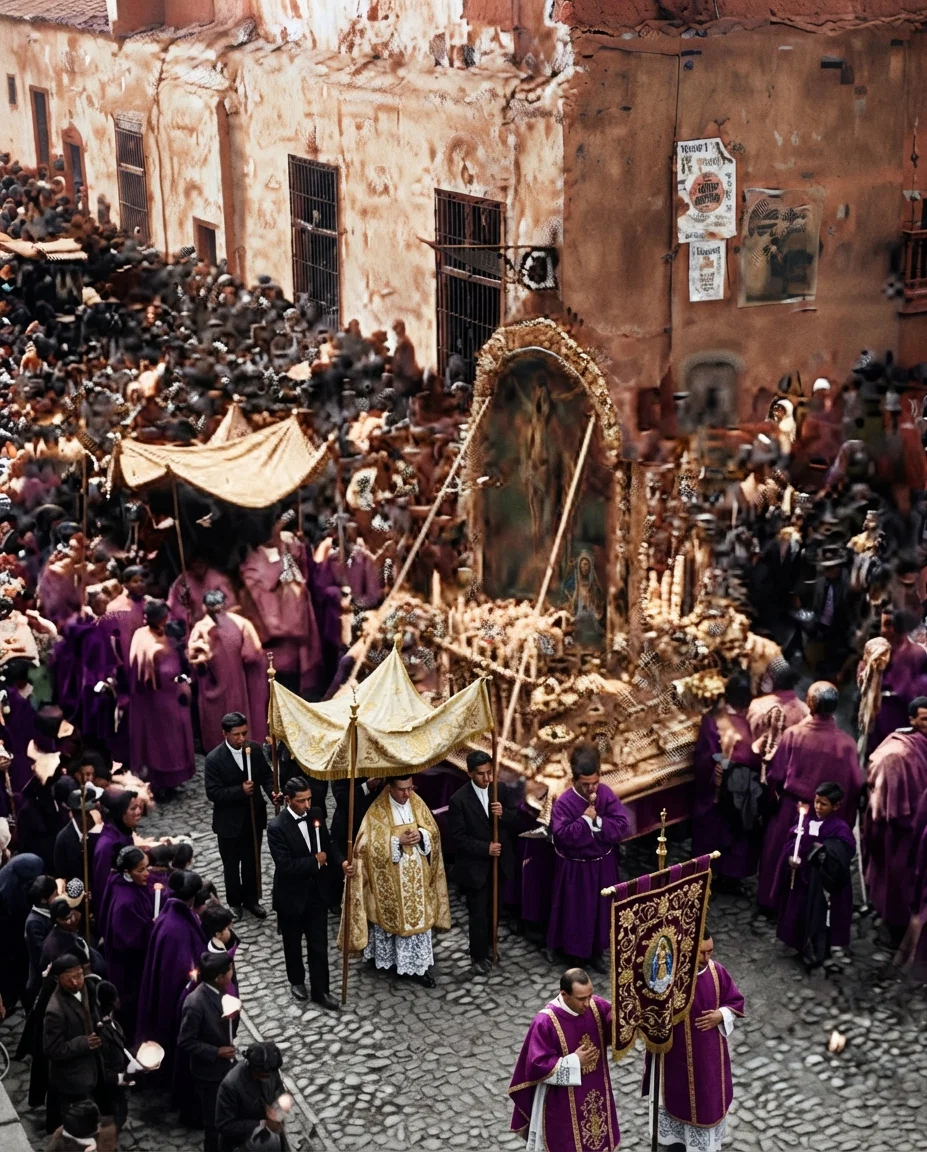
ON the morning of Oct. 18, 1904, as I was on my way to the post-office in Lima, Peru, on entering the Plaza de Armas, or great square in the center of the city, I noticed thousands of people emerging from one of the streets. I looked down the street from which they came, and, as far as I could see, the street was crowded with people, who surged to and fro like the waves of the sea. I stopped in the plaza to see what the great demonstration meant.
In the fore part of the procession were several priests, carrying a banner. Then, in the midst of the crowd were about five hundred women, dressed in purple, each carrying a lighted candle, and singing as they passed. Then followed hundreds of women with censers, in which they were burning incense, such a cloud of which arose that it made breathing difficult. Hundreds of men and boys and girls were carrying lighted candles, as tho to lighten some one through the darkness.
On they passed, until I saw the center of display, which was a life-sized picture of Christ hanging upon the cross, painted on canvass, on the back of which was a painting of the Virgin Mary carrying the Babe in her arms. Ten candles were burning before either image, while the deck of the platform which sustained it was strewn with flowers. Many silver medals were hung on either side, by persons who had been miraculously healed, all of which made it so heavy that the twelve men who bore it were required to rest every few yards.
As the "Lord of Miracles" passed by, every head was bared, with the exception of mine, which made me so conspicuous as to call forth mutterings from the crowd against the "cursed foreigner" who would not honor the "Lord of Miracles." Next came the priest, dressed in his gorgeous sacerdotal robes, with six men carrying a canopy over him to shield his delicate person from the scorching rays of a tropical sun. Then followed the band, to whose slow, measured strains of music all were marching.
The throng stopped before the great cathedral in front of the plaza, and made way for the "Lord of Miracles" to pass inside, where the priest said mass for the dead. They came out again, and, with slow, steady tread, moved on to the next church, where the same ceremony was repeated, and so on, until all the churches in the city were visited.
In the meantime, I hurried to the house for my camera, and hastened to a street where I knew they would pass. Seeing a balcony upstairs which would be a favorable spot from which to get the picture; I ascended the stairs, and asked permission of the lady to take a picture of the procession, which was most willingly granted. As the family seemed to be very intelligent, I asked the meaning of such a demonstration. They said, "O, you are a stranger in the city." Assuring them that I was, they said, "That is the 'Lord of Miracles.' That Lord has performed some wonderful miracles."
"O, yes," I said, "and why do they carry him around in that way?" "O, that is to avert the great calamities," they said. They then related to me the terrible earthquake of Oct. 28, 1746, to Feb. 17, 1747, in which Lima was destroyed, and Callao, the port seven miles distant, was wiped out of existence by a mighty tidal-wave that swept in over the land.
Annual Catholic Procession in Lima, bearing the "Lord of Miracles" from church to church to protect the city from earthquakes.
At half-past ten o'clock on Friday evening, October 28, as the people were holding a solemn festival in one of the churches, there came such a mighty movement of the earth that nearly every building in both cities was shaken to the ground, burying the inhabitants beneath them. This was immediately followed by the sea withdrawing, leaving the harbor dry. But suddenly it returned, carrying ships and shipping with it, and depositing them far back into the city. Of the twenty-three ships anchored in the bay, nineteen were either sunk or carried back into the city, where they were dashed to pieces. Not a single wall in the city was left standing. Again the sea withdrew, as if to gather more strength, and, returning with greater fury, swept in across the country, and threatened the city of Lima, which is situated seven miles from the coast. A mighty mountain rose out of the sea, called, to-day, the Island of San Lorenzo.
Of the 8,400 inhabitants of the city, but twenty-one were left to tell the sad tale. Terrible was the consternation in Lima—parents looking for their children, and children for their parents; brothers seeking their sisters, and sisters their brothers; many running here and there in search of a priest to whom they could confess their sins, and receive absolution. Language fails to describe the horrors which befell those two cities, neither can the most vivid imagination form a picture of the scene. In twenty-four hours two hundred distinct and mighty shocks were felt. The inhabitants of Lima were gathered in the plaza, expecting that each moment would end their miserable existence. During the days which followed, there fell a rain of such a peculiar character that it burned the grass in the fields, many people dying from sickness caused by it.
But why continue describing a scene so terrible? Suffice it to say that in the 112 days that the earthquake lasted, the earth was shaken 430 times. Thousands of people died afterward, as a result of an epidemic caused by the thousands of bodies lying unburied.
Some time after this terrible earthquake, according to the tradition, some negro candy-sellers were, at the close of the day, counting up their profits. They had stopped by a white wall, and, using a piece of coal for a pencil, were making their figures on the wall, when suddenly the Lord appeared, pictured on the wall as He had been crucified. Frightened almost out of their senses, they fled to the priests, to whom they made known the wonderful apparition which they had seen. The priests then went to the place, and confirmed the story of the negroes.
By some means, tradition continues, the Lord communicated His will that a convent be built in that place. The church of the convent was built, enclosing the wall, which was left standing, on which the image can still be seen. A painting of the apparition was then made on canvass, and is kept in the church with the original. But each year, on the 18th of October—two days before the anniversary of the great earthquake—it is taken out, and for two days is carried through the streets of Lima, visiting all the churches in the city. Again, on the 28th and 29th of October, the anniversary of the terrible catastrophe, the same procession is witnessed in Callao, the port of Lima.
They believe that thus the cities will be spared the repetition of the awful destruction. That piece of painting has the credit of performing other miracles besides averting the earthquake, as, for example, if any one is seriously ill, he promises the "Lord of Miracles" that, if restored to health, on the great anniversary he will help to bear him in the great procession. In case he recovers, he attributes his healing to that image. He is, therefore, one of the carriers.
Thus, in this twentieth century, the people are held in ignorance and superstition by the darkening influence of Rome, while the missionaries who seek to enlighten them are persecuted, and forbidden to hold public meetings, under pain of imprisonment. The public burning of Bibles is not a thing of the past in Peru, but is practised to-day, whenever the people can be sufficiently stirred up to do it. And they would burn the missionaries, too, if they dared.