The New Hebrides — Their Extent — Their Formation — Climatic Conditions — Vegetation
By C. H. PARKER
ELDER Parker has been for a considerable time a missionary in the New Hebrides Islands. Hence what he tells us in these paragraphs is from his own experience and observation. This week he tells about the islands themselves. Next week he will tell more about the people and their customs.
When the Master said, "This gospel of the kingdom shall be preached in all the world for a witness unto all nations," He knew of the faithful men that would be raised up whose all-consuming passion would be to put the Bible into the hands of each person on earth, and in that person's native tongue. He knew of the faithful men and women who would come from all the evangelical churches, burdened with an indescribable desire to carry the gospel of the great Book to "every creature" in all the world. He saw them sailing the seas, exploring continents, facing dangers and privations and hardships of every kind, and all that they might tell the glad story, and enter into the joy of seeing others rejoice in the new-found pleasures of the "blessed hope." He saw all this seed sowing followed by the great and final message proclaiming His soon coming.
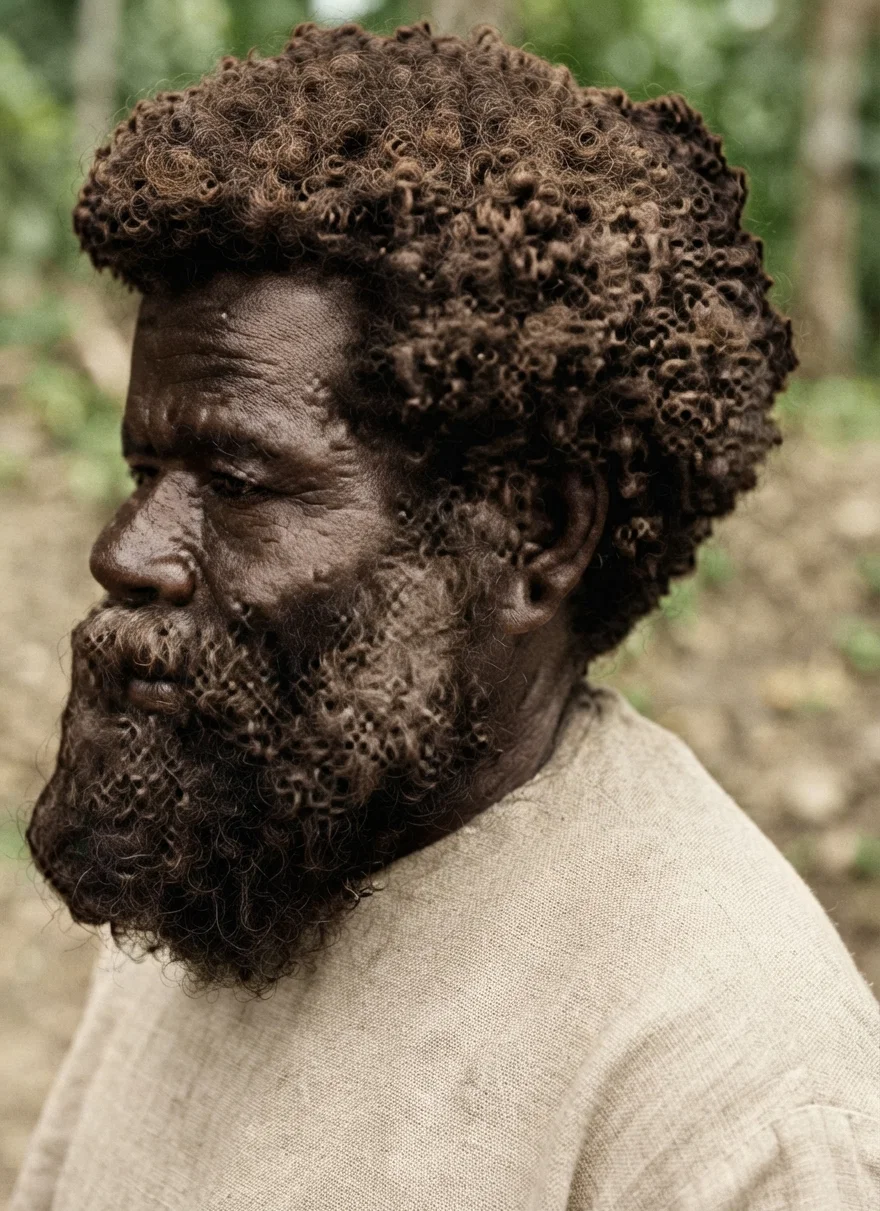
FIRST NATIVE PASTOR IN THE NEW HEBRIDES
How sublime is the thought of being a part of such a great plan of the Infinite One! What a miracle it is that men can be led by divine grace to give up all that this world holds dear, and devote themselves to the labors, to the afflictions and the dangers, incident to fulfilling the divine plan! But when one understands what it really means, how can he refuse to enlist?
THE New Hebrides consist of a group of islands somewhat more than thirty in number. Two of these are about two hundred miles in circumference. They are Santo, which is sixty-five by twenty-five miles, and Malekula, sixty by twenty-eight. The Hebrides group extends four hundred miles in a northwesterly and south-easterly direction. With the exception of the Fijis and New Zealand, no group in the South Seas can compare with them in extent and resources.
The names of the principal islands of the group, proceeding from the south in a north-westerly direction, are Aneiteum, Futuna, Aniwa, Tanna, Erromanga (Martyr's Island, for here is where the Rev. John Williams, Mr. Harris, and the two Gordons were massacred), Efate, or Sandwich Island, Hinchinbrook, Montague, or Nguna, Three Hills, Shepherd Islands (five in number), Panin Islands (two in number), Epi, Ambrym, or Chinambrym, Pentecost, Aurora (which disappeared, but has put in appearance again), Lepers' Island, Bartholomews, Malicolo, or Malekula, and Espiritu Santo,—the last two the largest in the group. They are about two hundred miles from New Caledonia on the south-west, and about one thousand five hundred miles from Australia.
The group was first visited in 1606, by Quiros, the Spanish navigator, who discovered some of the northern islands, especially Espiritu Santo; but he imagined that they formed part of the great southern continent, which he called Tierra Australis del Espiritu Santo. They were again visited in 1768, by Bougainville, who did little more than land on one of them, but ascertained that they were not a continent, but a number of islands, which he called the Great Cyclades.
It was reserved, however, for the great English navigator, Cook, to explore the group thoroughly. On his second voyage, in the year 1774, he sailed twice through them, discovering all the southern islands, and examining the northern more carefully than had been done previously. He gave the name New Hebrides to the group, from observing a striking resemblance of some of them to the old Hebrides off Scotland. Scottish missionaries still declare that the contour of some of these islands strongly reminds them of the mountains of the Skye.
VOLCANIC ACTIVITY
Most of the islands of the New Hebrides are of volcanic origin. Some of them bear traces of recent igneous action. On Aneiteum there are appearances of extinct volcanoes, and the natives point out a spot where a volcano existed in a state of action until a recent period. Their tradition is that their gods had compassion on the inhabitants, and drove the fire away underground to Tanna. The extinction of the one may have been coincident in time with the breaking out of the other, and the superstition may have arisen in this way.
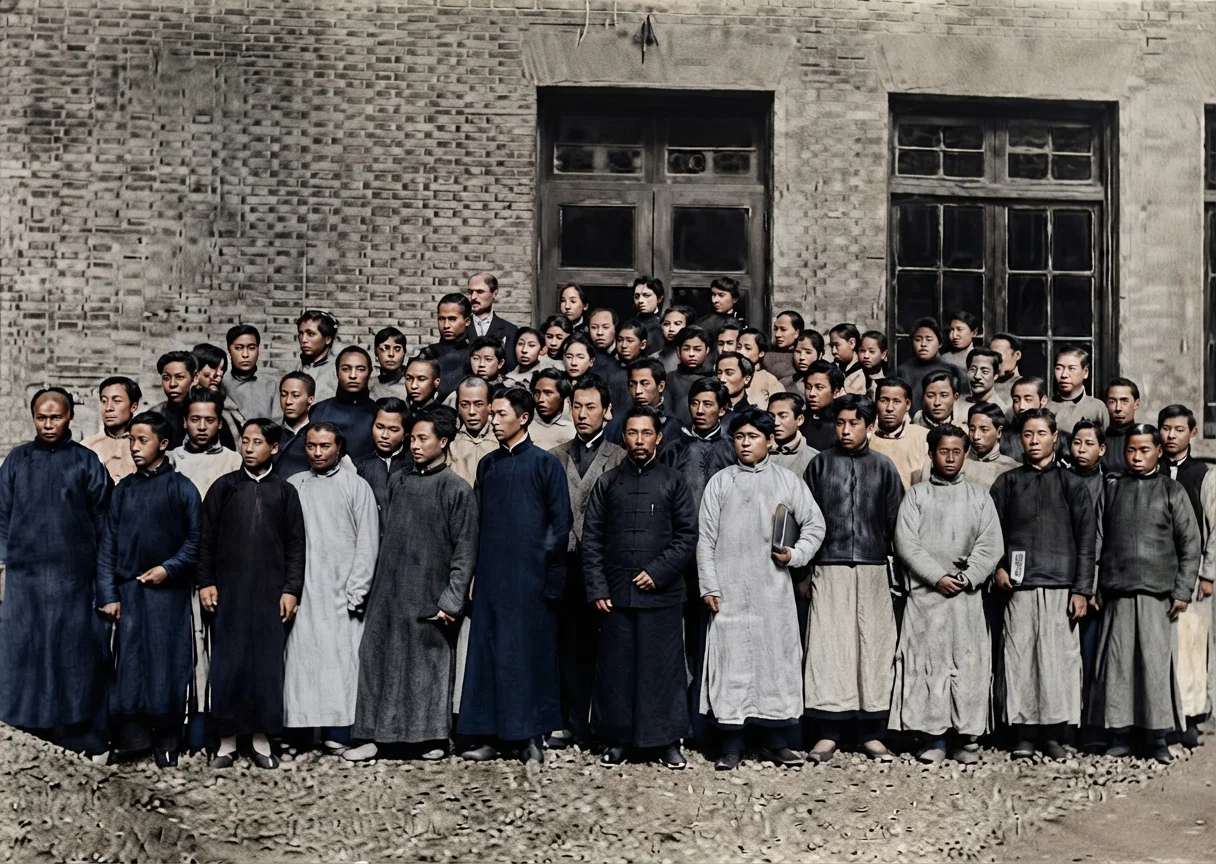
GROUP OF STUDENTS ATTENDING CHINA MISSION TRAINING-SCHOOL, SHANGHAI
Three volcanoes are known to be in operation in the group — one on Tanna, one on Ambrym, and the third on Lopevi, a small island close to Paama in the north. On the first of these, and probably on the others,
there are hot springs, which the natives utilize to boil their food. On Tongoa, one of the Shepherd Islands, in some places the ground is so hot that the natives cook their food by burying it for a short time in the earth.
In 1881 a volcano broke out in the sea off Trator's Head, on Erromanga. These points are all nearly in a line from about northwest to southeast, and nearly in the general course of the group; while much in the same line to the north, active volcanoes and hot springs are found in the Banks Islands, which may be considered the extension of the New Hebrides in that direction.
But Aniwa, and some smaller islands of the group, and the Loyalty Islands, the next group to the southward, are of coral formation, and every form of coral abounds in them all. In many places, bands of coral mark the several upheavals that have taken place, but they are not so generally encircled by barrier reefs as the islands of some other groups.
Slight earthquakes are experienced, and occasionally more severe. Last December the Ambrym volcano burst out into a furious eruption. Half of the island was devastated; many of the natives licked up by the lava or cooked in the water, and the Presbyterian hospital, which was under the skilful management of Dr. Bowie, was blown up into the air by a crater forming under it. The inmates had sufficient warning to escape. A boiling mass of waters has taken the place of the well-planned and well-kept buildings of that institution.
The soil of volcanic islands is generally fertile, and this is the case with the New Hebrides. From what has been already said, it will appear that they are either mountainous or hilly.
CLIMATIC CONDITIONS
The climate may be described as perpetual summer. In the southern islands, the thermometer rarely registers above ninety-five degrees Fahrenheit, or below sixty-three degrees, the mean temperature being about eighty degrees. The heat is sometimes intense; but the agreeable trade-winds, which rise and fall with the sun, serve to moderate its severity. In the daytime, the weather is seldom comfortably cool at any season; but the night air is damp and chilly, and to expose oneself to it between sunset and sunrise is imprudent. In the northern islands, the heat is greater, ranging from seventy to one hundred degrees, the mean temperature being about eighty-five degrees.13
THE WET AND THE DRY SEASON
In these islands, the wet and the dry season take the place of the summer and the winter of temperate climates, only that in the southern hemisphere, the greatest heat is from December to April. That is also the rainy season, and rain falls in quantities unknown in temperate climates, sometimes continuing for weeks at a time. The streams are swollen and the low ground submerged, and traveling is difficult or impracticable.
Thunder and lightning are at that season matters of daily occurrence. The hygrometer indicates an atmosphere thoroughly saturated with moisture. Vegetation grows with a rapidity scarcely conceivable by those unacquainted with the tropics. That season is also very tempestuous, the destructive hurricanes peculiar to these latitudes always taking place at that time.
From April to December is the dry season. Rain seldom falls in quantities, but showers are frequent. The weather then is more agreeable, and the atmosphere more healthy. Vegetation does not grow so rapidly as in the wet season; and toward the close, the foliage loses slightly its verdant hue, and assumes somewhat of the autumnal appearance.
THE PREVAILING DISEASE
Malaria is the prevailing disease, and the persistent attacks of the malaria mosquito keep one's system impregnated with this disease. No one is immune. Quinin seems to be the only asylum, but it soon shatters the system, black-water fever often occurring from overdosing.
The natives are afflicted with sores, which become very virulent, and eat large holes to the bone, which in turn becomes affected. The filth in which the people live only aggravates these sores, and draws a cloud of bottle flies, as well as the smaller varieties, to cover them. Large numbers of the islanders are infected with skin diseases, which cover their bodies.