THE SABBATH

4%

Pacific Press Publishing Company · Mountain View, California · Feb 8, 1905

FromSigns of the Times, Vol. 31, No. 6.

Read the full edition

THE SABBATH

BY L. A. PHIPPENY

THE COVENANT-LAW.

THE everlasting covenant was established in creation with every creature to whom life was given. It was established with them by virtue of creation. The very work of creation itself was a promise on the part of the Creator to give life and its blessings forever. Thus God entered into covenant relation with His creatures. The creatures entered into the covenant without volition, but with the joy and gladness that attend unalloyed bliss.
The wonderful facts of everlasting life and an eternal home were revealed to Adam and Eve in their sinless condition through their natural endowments of understanding and knowledge. In this revelation was manifested and seen also the character of their Creator-Father—a character of love. These blessings of life were the objects of their creation—objects of the everlasting covenant with them. As they viewed the marvelous provisions for their comfort and enjoyment in the manifold things of nature, the character of the Father was further revealed, and the terms of the covenant-testament were further unfolded before them. And as for their part in the covenant, they were a very integral part of it, as being the recipients of the blessings, and the subjects of God's revelations.

The Law in Adam.

It was not necessary for Adam to be orally taught right principles and right ways of living. Righteousness was builded in his nature. Righteousness itself was one of the conditions of the covenant, and the man had it as a natural endowment. In him was manifested the character of his Father, and the whole creation was in harmony, progressing in life. In Adam was exemplified the truth of the word, "In the way of righteousness is life." Every act of his life was an outward manifestation of the holy character within. Every act of his, and every development in the harmonious relations of nature were but expressions of the divine character. In every manifestation of the thought of the Creator in creation there was expressed wisdom, holiness, the perfection of that eternal character. And this was all embodied and embraced in the everlasting covenant-testament.
The righteous, perfect man Adam had only the one way of living before he sinned. This was the way of his Father. This way of living, this manner or mode of conduct, was in harmony with the laws of his being. The divine principles incorporated in his nature and manifested in all the revelations of God about him were the laws of life for him. This is what a law is—a way or rule of conduct or action. God's ways in creation are his laws, and they express righteous principles and a righteous character. My ways and manner of life are determined by my character and proclaim that character. For Adam, endowed with perfection of wisdom and understanding for his dominion and station, these natural endowments and the revelations of the Master Builder constituted a perfect code, defining naturally his relation toward his Creator, the relations of man to man, and his attitude toward the dominion at large. No spoken law was required, no command or prohibition needed except the reservation instituted as the enduring test of loyalty. It was not until sin perverted man's judgment and altered his character and his manner of living that it became necessary to teach orally the principles of righteousness ordained by the Father in the beginning.
It becomes evident, therefore, that the revelations of the divine character in creation are at once covenant, testament, and law. As covenant-testament there are the divine promises of life and its blessings to intelligent beings who are in turn an essential part of the covenant-testament; there are the conditions of righteousness, demanding the manifestation of the divine character in every part of his creation; there is the divine pledge of the absolute establishment of the promises by the death of the Testator; and there are the principles governing the Creator's own life reproduced in His children and throughout the whole creation.

The Identity of Law and Covenant.

These facts concerning the identity of the everlasting covenant-testament law are further shown from several scriptures bearing directly on the point. Through Hosea the Lord reproves backsliding Ephraim and Judah, telling them that "they like Adam [the representative of the race] have transgressed the covenant." Hosea 6:7, margin and R. V. When Adam failed, when he chose another way than God's way, that was a transgression of the everlasting covenant. It was a repudiation on his part of his part in it. But that did not destroy the covenant, for it was made with other worlds besides this one. Neither did it destroy the covenant with this world, for the Lord's part remained. The covenant contemplated every contingency, and provided for this very emergency. Its latent powers were then displayed in the further unfolding of the plan of redemption, which took Adam in again by grace, and by faith in the Redeemer to come.
But this transgression of the everlasting covenant was sin, and sin is defined to be the "transgression of the law." What law is meant is clearly set forth by Paul, who says: "By the law is the knowledge of sin (Rom. 3:20);" "I had not known sin, but by the law; for I had not known lust, except the law had said, Thou shalt not covet." Rom. 7:7. We readily see, therefore, that the law referred to is what is known as the moral law of the Ten Commandments. Further, in his argument concerning deeds done for mere outward show, and concerning the real depth and breadth of the law of God, Paul calls attention to the entrance of sin and death when Adam fell, and shows clearly that the law defining sin existed at that time; for, he says, "sin is not imputed when there is no law." If there had been no law when Adam disregarded the Lord's command as to the tree reserved for test of loyalty, he would not have transgressed anything.
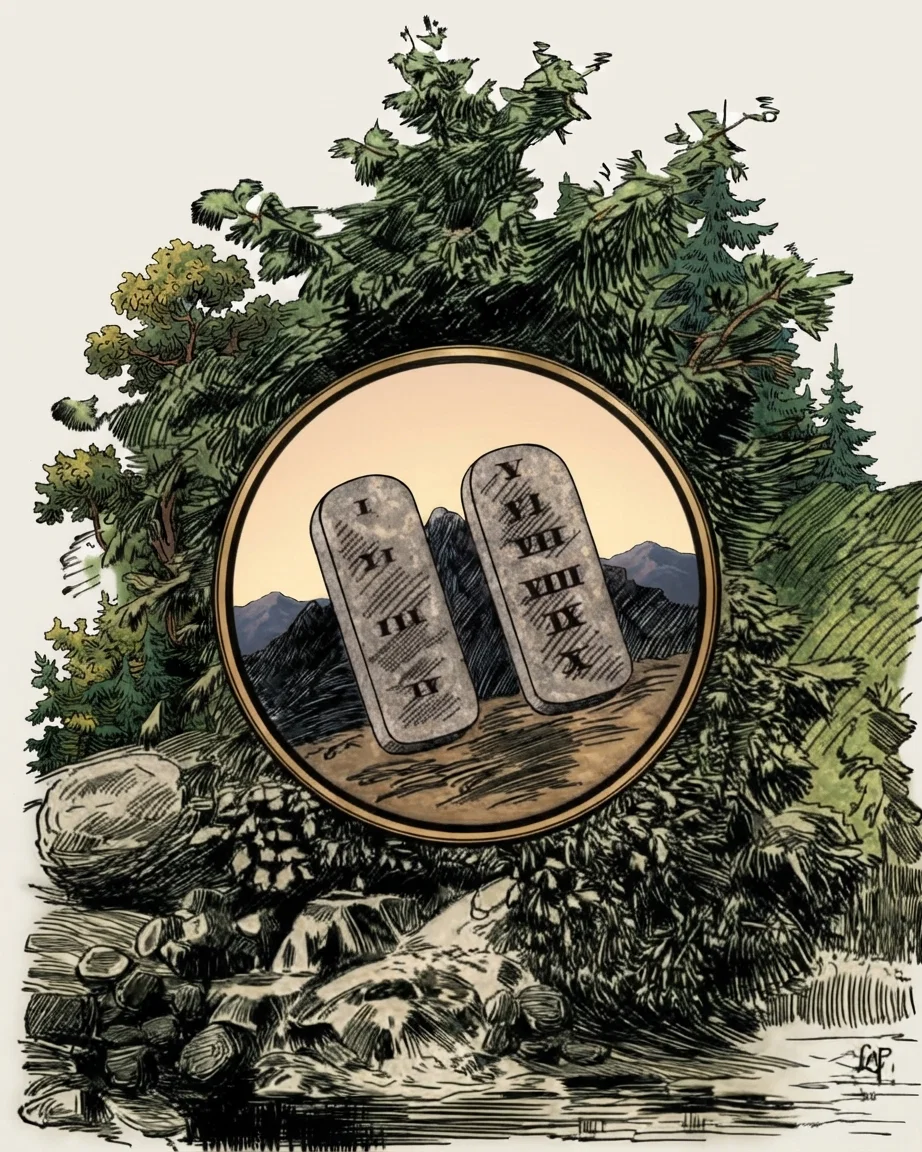
Further, Moses, rehearsing to Israel the history of the forty years from Egypt to Canaan, refers to "the day that thou stoodest before the Lord thy God in Horeb, when the Lord said unto me, Gather Me the people together, and I will make them hear My words, that they may learn to fear Me all the days that they shall live upon the earth, and that they may teach their children. . . . And the Lord spake unto you out of the midst of the fire . . . and He declared unto you His covenant, which He commanded you to perform, even Ten Commandments; and He wrote them upon two tables of stone." "And the Lord delivered unto me two tables of stone written with the finger of God; and . . . the Lord gave me the two tables of stone, even the tables of the covenant." Deut. 4:10-13; 9:10, 11.
Here is the law defining sin, for its tenth precept is the divine prohibition against covetousness. This is the law transgressed by Adam, for sin is the transgression of this law only, and, through Adam's transgression, sin and death passed upon the whole dominion. This is likewise the covenant transgressed by Adam, and that covenant was the everlasting covenant, and its transgression was sin. Thus the identity of the law of Ten Commandments and the everlasting covenant-testament is fully shown.

The Law in Positive Precepts.

The question is sometimes raised, Why is the moral law of Ten Commandments couched in negative terms, and how can this fact, together with the words of the prologue of the law spoken from Sinai (referring to the deliverance from Egypt), be reconciled with these other evident facts concerning the identity of this law with the everlasting covenant-testament? The law spoken from Sinai was couched largely in negative terms merely because of sin. Where sin exists; where wrong courses of action are indulged in, the prohibition always appears prominently in the statement of the law. Nevertheless, the law taught to Israel, and teaches to all the world, the great positive facts relative to the true God that were known to Adam in the beginning without the negation. They may be stated in positive terms as follows:1. There is one God. 2. Worship Him. He is a God of love, justice, mercy. 3. Reverence the name of God. 4. Honor the Sabbath day and delight in it. Labor six days, and do all thy work; but the seventh day is the Sabbath of the Lord thy God; for in six days the Lord made heaven and earth, the sea, and all that in them is, and rested the seventh day; wherefore the Lord blessed the Sabbath day, and hallowed it. 5. Honor thy father and thy mother, and thou shalt live forever in the earth that God has given thee. 6. Preserve life. 7. Be pure. 8. Respect the rights and possessions of others. 9. Speak truth. 10. Be content with what you have.
Here is duty to God and to man expressed in principle in its fulness. It is likewise all summed up in the words of Jesus Himself, when He was asked to name the great commandment of the law: "Thou shalt love the Lord thy God with all thy heart, and with all thy soul, and with all thy mind. This is the first and great commandment. And the second is like unto it, Thou shalt love thy neighbor as thyself. On these two commandments hang all the law and the prophets." And the words of the preacher are: "Let us hear the conclusion of the whole matter: Fear God, and keep His commandments; for this is the whole duty of man."
This is the law and the covenant-testament founded in creation and the facts of creation. It is the covenant-testament that was broken by sin, and which Jesus the Maker and Testator came to establish. It expressed His own holy character, and when He came in the flesh He exemplified it in every particular. It contains the promises and the conditions—and in it in principle is every fact—of the Gospel and the plan of salvation. Its principles are the principles of righteousness and life. "All Thy commandments are righteousness." "In the way of righteousness is life." "Moses describeth the righteousness which is of the law, That the man which doeth those things shall live by them."

God's Call in the Law.

The declaration of this great moral code-covenant from Sinai was a call to Israel and to all the world to return unto God. God's message to Israel was Salvation, Salvation, and the call rings across the ages to us. The work of salvation for individuals in ancient Israel was the same as that work now. It involved a knowledge of God—a heart knowledge—a conviction of sin, repentance, and right living. It required faith in God's plan of saving sinners. The Gospel of a Redeemer to come was therefore preached to them as unto us is preached the Gospel of a Saviour who has come. Hence, the holiness of character revealed to them in the law was a constant teacher to them, pointing them to the One whose blood would be shed for their sins. Unto them Christ was the end of the law—the object of it, the fulness of it—for righteousness, even as He is to-day for us. That law is ever a teacher to lead men to Christ, and, having found Him, the redeemed soul will continually exemplify in his own life the righteousness of the One whose character is expressed in the law, and he will tremble at His word.
And so Jesus Himself said, "I am the Way, the Truth, and the Life." He is the Way, because He represents the only true rule of conduct—the law of life. He is the living expression in human flesh of the character of God, the living expression in human flesh of His own character before He became flesh. He is the Truth, which is the word,—the statement of God's eternal purpose, living with us, one among us. He is the Life,—the sum and unalterable result of being the perfect representation of the way and the truth. Therefore He is made unto us "wisdom, and righteousness, and sanctification, and redemption," the fulness of the revelation of the Godhead, even as He was unto Israel of old, and unto Adam, and Abraham, and David, and unto every soul in every age who has sought after God and found Him.
[The next article in this series is "The Old and New Covenants."]