BAPTISM AT ROME

6%

Pacific Press Publishing Company · Mountain View, California · Aug 16, 1905

FromSigns of the Times, Vol. 31, No. 33.

Read the full edition

BAPTISM AT ROME.

LATE one night, after I had retired, a gentleman who wished to speak with me was announced. I arose, dressed, and entered the parlor to find there a gentleman of tall stature, broad shoulders, a strong personality, and a highly intellectual face
He stated his case in a few words. He was professor of Latin and Greek in the highest college in Rome. He is one of the best Latin scholars in Rome, which is saying much when we remember that we are at the headquarters of the Latin Church; but he had no hope of eternal life, and from what he knew of this world he believed the next would be very beautiful. "Now pastor," he said, "if you can give me the assurance of being saved in God's everlasting kingdom, I shall be eternally grateful to you. That is all I ask, and is the only reason for which I am here." Then he added, "I wish to put myself in your hands as a child of five years to be taught what I must do."
A man so humble, I thought to myself, surely can get help from the Lord. I appointed a day for him to come and study with me. He wanted to come every day, but at the time I could not teach him so often.
He had learned of me through a young officer who had studied with me, and who had been so greatly struck by the message that when he found his friend, the professor, seeking in vain for light, he told him that he would bring him to a person whom he might embrace with open arms, for he was a man who knew the Bible. He told him that I taught the prophecies.
"Well," said the professor, "I want to see him if there is any help for me." I assured him that I could eliminate the Church of Rome from the list of the possible true churches in two studies. This pleased him very much, as he saw we had something definite to offer him. With Daniel the second and seventh chapters, I succeeded in showing him that the Catholic Church is not the true church.
He continued his studies and went forward day by day; his countenance began to brighten until he told me, "I could peacefully go, now, if God called me from this life; whereas before I was afraid." One day he asked me what he must do to unite with our body. I told him that he must be baptized. He said that he was ready. Then I told him that we do not use tobacco nor liquor in our church, and in a few simple words I explained to him the reason. He smiled and said, "How true that is; and to think I have lived so long before finding it out! I have a cigar in my pocket which I shall throw away when I get downstairs."
At our next study he did not appear; but at the one following he told me that he had been sick from the effects of stopping the tobacco and wine. He had been a great smoker, but he persevered, and to-day he said, "I worked four and a half hours without interruption; whereas when I was smoking I could work only three hours at a time."
He had, of course, the question of the Sabbath to meet, as his college held sessions on Sabbath. He presented the matter to the president, who said he would not refuse him, but, as it was a question of every Sabbath, he would have to present the matter to the faculty for their decision, and in the meantime he himself would teach the professor's classes on the Sabbath.
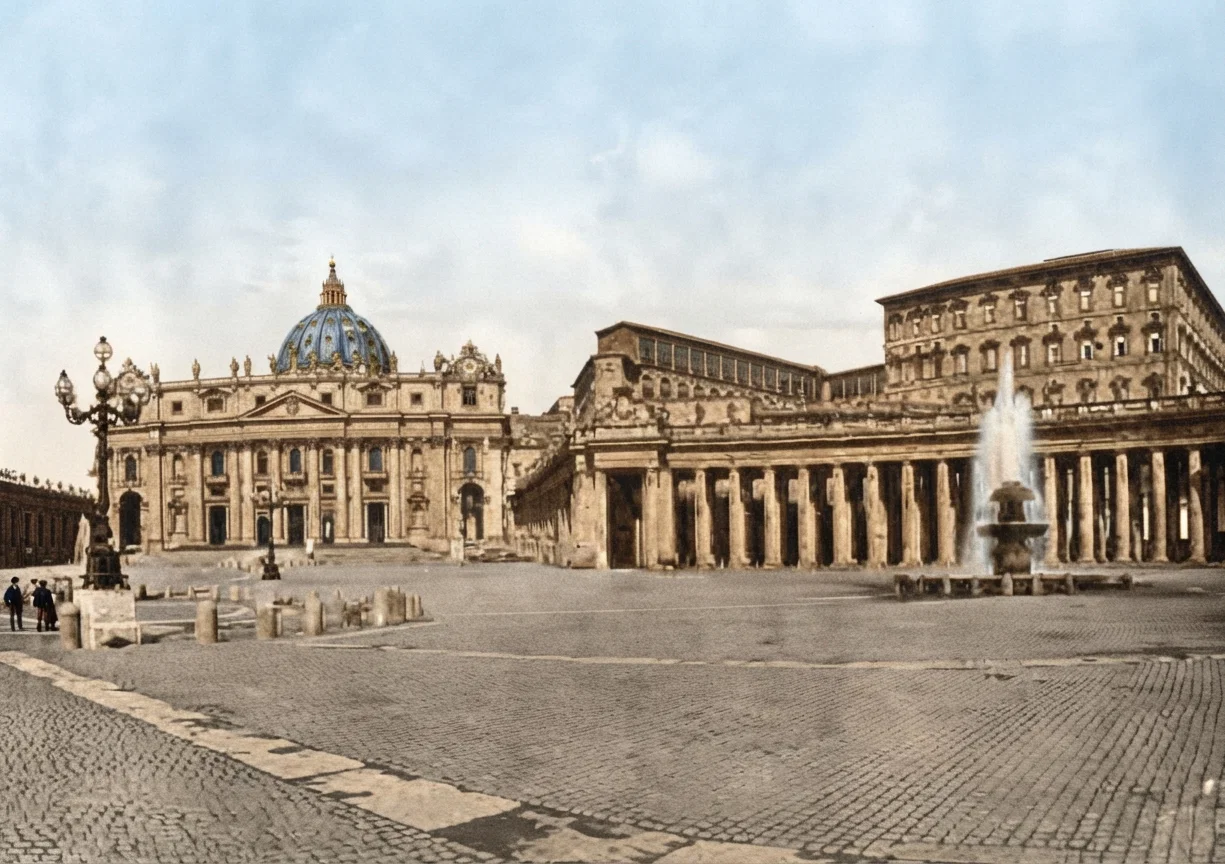
St. Peter's and the Vatican.
The professor was born of parents strongly Catholic, and was educated for the priesthood. He rose step by step until he became professor of theology in one of the large Catholic seminaries. While there, doubt began to rise about a number of the Catholic doctrines, especially that of transubstantiation. He studied out for Himself that Christ was the Word, and that by eating the Word we eat Christ, and not by eating the host. He communicated his views to the head of the seminary, who became very angry, and said that the Catholic Church never changes, for it is founded on God who never changes.
He left his position. The church authorities tried hard to get him back, and wished to call him before the Board of the Inquisition and make him recant.
He refused, for if he had complied he would have been imprisoned in some old monastery.
Knowing no other religion than the Catholic he became an infidel, but while in Florence he began to consider the world about him, and after reading a little tract he decided that there must certainly be a God. So he came to Rome for the express purpose of studying what other denominations taught.
He secured a position as professor, and in the meantime studied different churches. He studied three churches, but still he was hopeless and full of doubt. The Baptists offered to baptize him, but he said he was not convinced and therefore would not be baptized. He told me that one of the strong reasons that decided him against them was because he did not see Christ in the members.
Then he came to us. We did not need to urge, but he himself asked for the privilege of uniting with us. Every one of us has seen the great change that has come over him. His countenance now is bright and bespeaks the joy and peace of heaven. Even the Baptist pastor, whom he has since visited, said that he had never seen so great a change in a man.
During the time that our brother was studying with me he was called upon by what purported to be a committee of citizens, but whom he found to be a committee of dignitaries of the Church of Rome, who wished to speak with him. They offered him a position as editor of one of the large Catholic reviews. But he answered that altho in the past he worked along those lines, now he did not believe in them. They replied that he should not let that stand in his way, as they offered him a great position with a large salary. He replied that he would never sell himself, and so closed the matter. I pray that God may make him a power for the Message in this dark land.
CHAS. T. EVERSON.