THE purchase of Alaska from Russia was looked upon by many, at the time of the purchase, as a bad bargain for the United States. The first thought that comes into the mind of people generally, when Alaska is mentioned, is the thought of ice, frost, snow, and blizzards. But Alaska has been a surprise, even to her purchasers. Wonderful and valuable things are being brought out of those bleak regions.
Among the interesting exhibits that Alaska furnishes for the Portland Fair is the ivory obtained from whales and walruses, which has a market value of a dollar a pound. There are some specimens of ivory which came from prehistoric animals, and are presumed to be about 6,000 years old. This ivory is found on many creeks, in many cases partly buried in the frozen earth, and comes sometimes in pieces ten or twelve feet long. The ancient ivory is found all the way from Dawson to Nome. In some cases it is partially decomposed, but in general it is hard and firm, and is nearly as valuable as the new ivory.
Skagway has en route a remarkable collection of vegetables and wild flowers of the kind which most people are not accustomed to associate with Alaska. Rampart, one of the newer camps, where hydraulic mining is being carried on most successfully, has shipped one of the finest collections of minerals. From Tanana will come an unusually interesting timber exhibit. Tanana has almost unlimited timber resources, which, as yet, are undeveloped. Important among these is a prolific growth of wonderfully fine birch, which grows in that far northern land to a diameter of from twelve to eighteen inches, and is of perfect grain. When Alaska's exhibits are all in place at the Fair, there will be a wealth of fur exhibits; for that country abounds in fur-bearing animals. Alaska also has her educational displays, with portraits of teachers and students, and pictures of school buildings, which tend to dispel the impression that Alaska is entirely wild and rough. There are samples of some marble which one day will be a principal product of this land of gold.
Case after case of ores and nuggets convince the editor that, regarding the mineral wealth of Alaska, the half even yet has not been told, while the large variety of ores, including copper, tin, zinc, and iron, impresses one with the versatility of the mineral resources. There are also a number of glass jars filled with crude oil, which tell of another great possibility as yet but meagerly investigated.
One of the most interesting exhibits at the Exposition is furnished by the national government. It illustrates the work now being carried on by the Agricultural Department for securing a definite knowledge of the soil and agricultural possibilities of every square mile of the United States. This work will take eighteen years, and will cost at least $6,000,000. When the work of the Bureau of Soils has been completed, it will be possible for a man intending to purchase a farm to write to the Department of Agriculture, and secure from that department a detailed map of the section in which his farm is located, together with a description of the section. Then, by looking up his intended purchase on the map, and consulting the descriptive booklet, he can determine to a nicety its value. The map will show by different colors the nature of the soil, while the descriptive booklet will tell its value, which has been determined by examination of the soil, study of the railroad facilities, and examination of the markets and other qualifying conditions. The soil maps and booklets will enable many farmers, who have been only partially successful, to learn wherein they have failed by trying to raise crops unadapted to the nature of their lands, and will instruct them as to what crops are best suited to their farms. It will instruct them, also, as to the best methods of cultivating soils of different kinds.
The Soils Division was established as a separate bureau of the Department of Agriculture on July 1, 1901, and since that time its force has been increased more than twelvefold. Up to Dec. 31, 1904, the Bureau has mapped 88,855 square miles, in small patches scattered over the whole United States, and it is estimated that eighteen years more will be required to complete the work.
The investigation of the soils is conducted in this wise: Selecting some town in the area to be surveyed, the party goes out in the fields, and takes frequent borings. They examine the material carefully, noting the texture, whether sand, silt, or clay, the changes which take place at varying depths, the presence of gravel, the drainage conditions, and the character of the crops or native vegetation. Moving forward in its work, if the party finds that the material changes, either in the surface soil or in the subsoil, sufficiently to influence plant growth, the character of this change is noted, and the boundary lines between the two types are traced out. Separate samples of the soil and subsoil are sent in to the Bureau's laboratories, where painstaking examination of them is made.
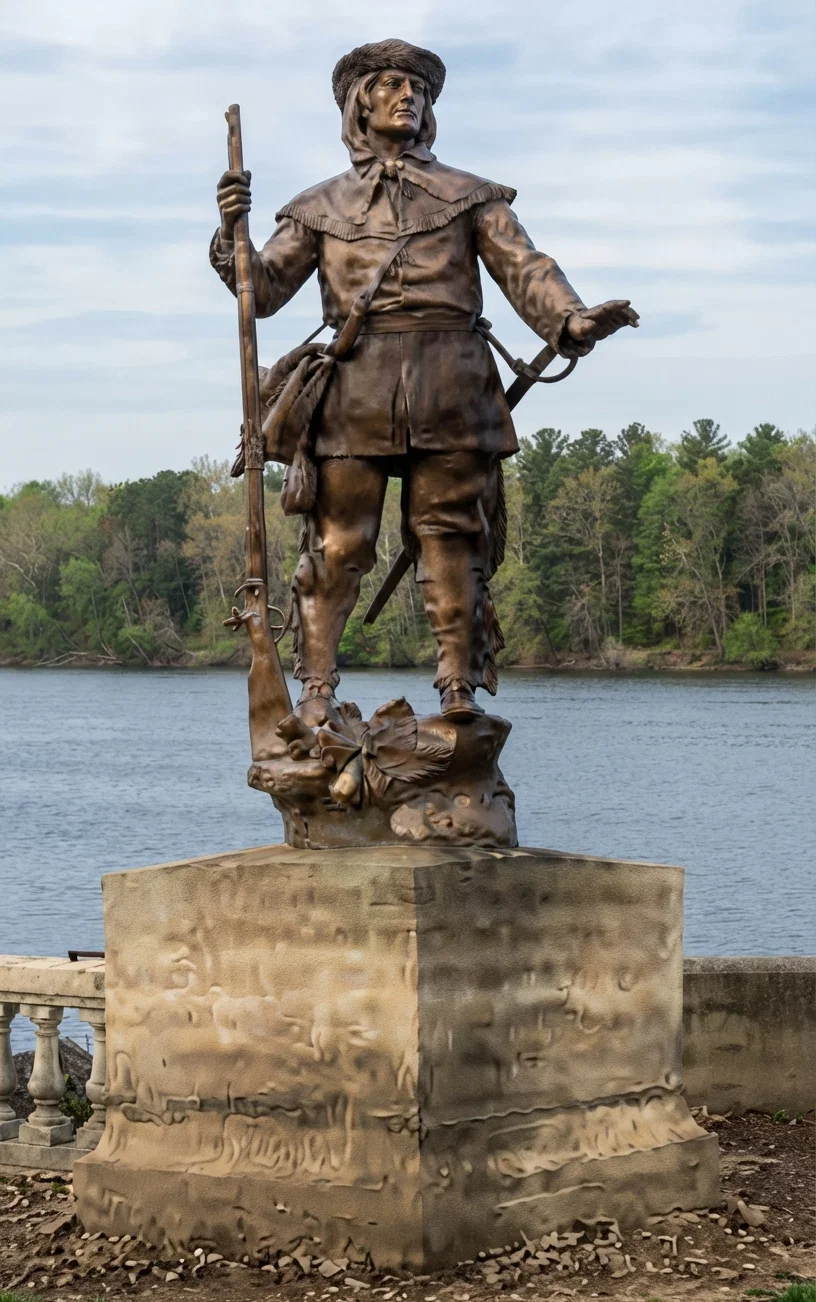
Capt. William Clark, born 1770, died 1838.
At the Lewis and Clark Exposition, the manner in which the work is carried out is shown in an interesting way by means of maps and models. The exhibit has attracted a great deal of interest among farmers in the Pacific Northwest and those from the East who have come to the Fair.
In the United States Government Building at the Lewis and Clark Fair there is a model which shows, in a clear and interesting way, how land at present worthless, on account of the alkali salts which it contains, may be made extremely valuable by the removal of these salts, which, in many cases, were brought in by over-irrigating the land. The plan adopted, as most practical, is one whereby a drainage system, preferably by means of tile drains, is used. The alkali area is flooded by irrigation methods, and then drained, so that the alkali salts are washed out of the land. For the purpose of demonstrating the efficiency of this method, the Bureau of Soils is under-draining and flooding tracts of land near Salt Lake City, Utah; North Yakima, Wash.; Fresno, Cal.; Tempe, Ariz.; and Billings, Mont. At Salt Lake City and Fresno the experiments have already proved so successful that good crops were grown on the formerly worthless lands during the season of 1904.