ANOTHER peace congress is called at The Hague, and the nations are sending their delegates thither. Only a few years ago he who is now the beaten ruler of a distracted empire convened a similar congress; but before the ink had dried upon the engrossed copies of their resolutions, he was planning the extension of his domain in the far East. He pushed his plans until Japan dared lie listless no longer under the menace of his pretensions. Then came a fearful and bloody war. It is ended. Russia has lost heavily in men, guns, and means; and her navy is practically destroyed. Again her ruler calls a peace congress, and again his representatives will propose a limit of naval construction; for without that, Russia will be fearfully behind her greedy and militant rivals.
Every nation in the world would welcome peace if it did not have to relinquish any of its ambitious designs. Russia wanted peace; but she wanted Manchuria more than she wanted peace. Now she wants peace; but when war suits her designs better, she will accept the gage of battle again. In this attitude she is not unlike the other nations of the world—peace when it does not interfere with national projects.
But now while the program of the second Hague congress is being prepared, and while the different nations are settling the question of delegates thereto, another program is being pressed vigorously forward by every great nation in the world; it is the program of war. Even China is aroused from her sleep of centuries. She is fast increasing the size of her fighting force, and is giving to her army the best training possible in harmony with Western ideas. Reports from China state that military representatives of other nations have been wonderfully impressed by the showing made by China's army in its recent maneuvers. Heretofore China's army has been a byword and a joke among military attaches. They are not joking about it now; and the possibility of having to reckon with China as a mighty military power in the not distant future, is worrying the great nations already. Russia, it is reported, will keep 300,000 troops on the border of China. She has used China about as she wished in the past, and China has yielded to demand after demand, because she dared not do differently. Japan, in protecting herself against Russian encroachments, has pointed out to China the road to the same goal. It is possible that Russia may, before many years, have occasion to use her China-border troops, and may find as great a surprise awaiting her there as she did in Manchuria. There are other nations that have pressed China in the past, that are holding Chinese territory for which they have given no equivalent. When China feels able to assert her rights, there is no doubt that these nations, too, will have to abandon their acquisitions or fight for them; and in that contest they will have to reckon with Japan as well as with China.
Japan has acquired much in the late war. She has taught some lessons and learned many. She is preparing to maintain what she has acquired, her navy has been largely increased by her captures from the Russians, and she is building other vessels. She has learned the chemical secrets of high explosives and how to use them. She has learned how to make arms of precision, and does not need now to depend upon foreign nations for these supplies. She is now making in her own shipyards battle-ships of the very largest size and greatest efficiency, the guns to arm them, the armor to protect them, and the engines to drive them.
In Europe, the great nations are building larger and stronger battle-ships and swifter cruisers than ever before. They are studying the problem of how to mount more guns and more effective guns upon their decks and in their barbettes. They are all manufacturing and perfecting submarines; while their army officers are studying the problem of more effective artillery and small arms.
The general board of the American navy has recommended the construction of battle-ships of greater tonnage than any yet projected for the American navy. They are also considering the problem of installing ten, instead of four, twelve-inch guns on each battle-ship, and of increasing the tonnage of some of the battle-ships already authorized from 16,000 tons to 18,000 tons. There are now building in American shipyards six battle-ships of 16,000 tons displacement, which will be ready for commission within twelve or fifteen months, together with six large cruisers, and many smaller crafts.
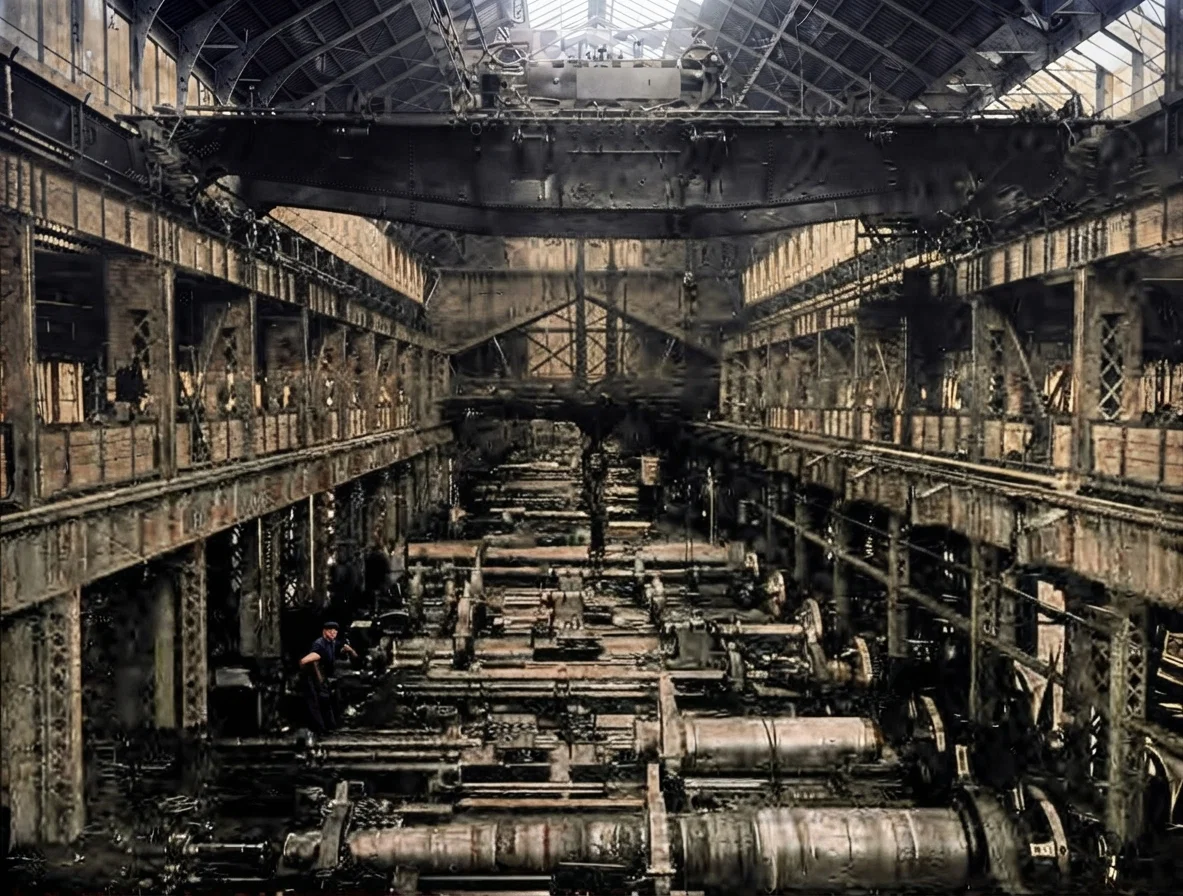
A Great Crane in the Famous Krupp Gun Works,
The new peace congress will be lauded as another evidence of the growth of a universal peace sentiment; but the attitude of the nations and their feverish preparations for war teach us that the "peace and safety" cry is a false one. Be not deceived. The coming of our Lord is not ushered in by a period of universal peace, but by a period when men's hearts are "failing them for fear, and for looking after those things that are coming on the earth." Luke 21:25-28.