(An echo from the Mutual Edification Club by Ada M. Learned)
"He that loveth a book will never want a faithful friend."—Barrow.
IN considering the subject of books as our companions and their influence, we can not place in the same catalog with the many books listed on the shelves of libraries that most wonderful of all books, the Bible. Excluding all reference, therefore, to the Book of Books, and considering only those which are creations of man's mind and the product of his genius, there are five phases of this question which may be briefly mentioned as follows:
1. The spirit which some books breathe exerts a strong restraining influence over men and women to keep them from becoming careless and negligent of doing what they know to be right. The influence of these books really becomes almost an inner conscience speaking to the individual.
2. From the volumes of poems which have been written,—good, bad, and indifferent,—there are some which will never be forgotten, some which we all love to read and reread. In certain moods they bring to us consolation and comfort which at the time we may not be able to find anywhere else.
3. There is a type of books to which the general name, "Character Builders," might be given; books which make one want to do and to be; biographies, histories; books which cultivate a spirit of progress and growth—the kind of books that Theodore Parker had in mind when he said, "The books which help you most are those which make you think most."
4. There are many helpful books leading one away from the works of man, back to the creations of God. Some of Henry Van Dyke's beautiful little sketches are illustrations of this class. It is difficult to understand how one can read such books and not feel that he must get out under the blue skies and listen to the voice of the out-of-doors.
5. Then there are bright, happy little books, simply written perhaps, but perfectly suited to bring smiles to sad faces, to bring sunshine where there may be showers.
Perhaps the following overheard conversation may help to make clear a few thoughts along this line.
The Gossip of the Books.
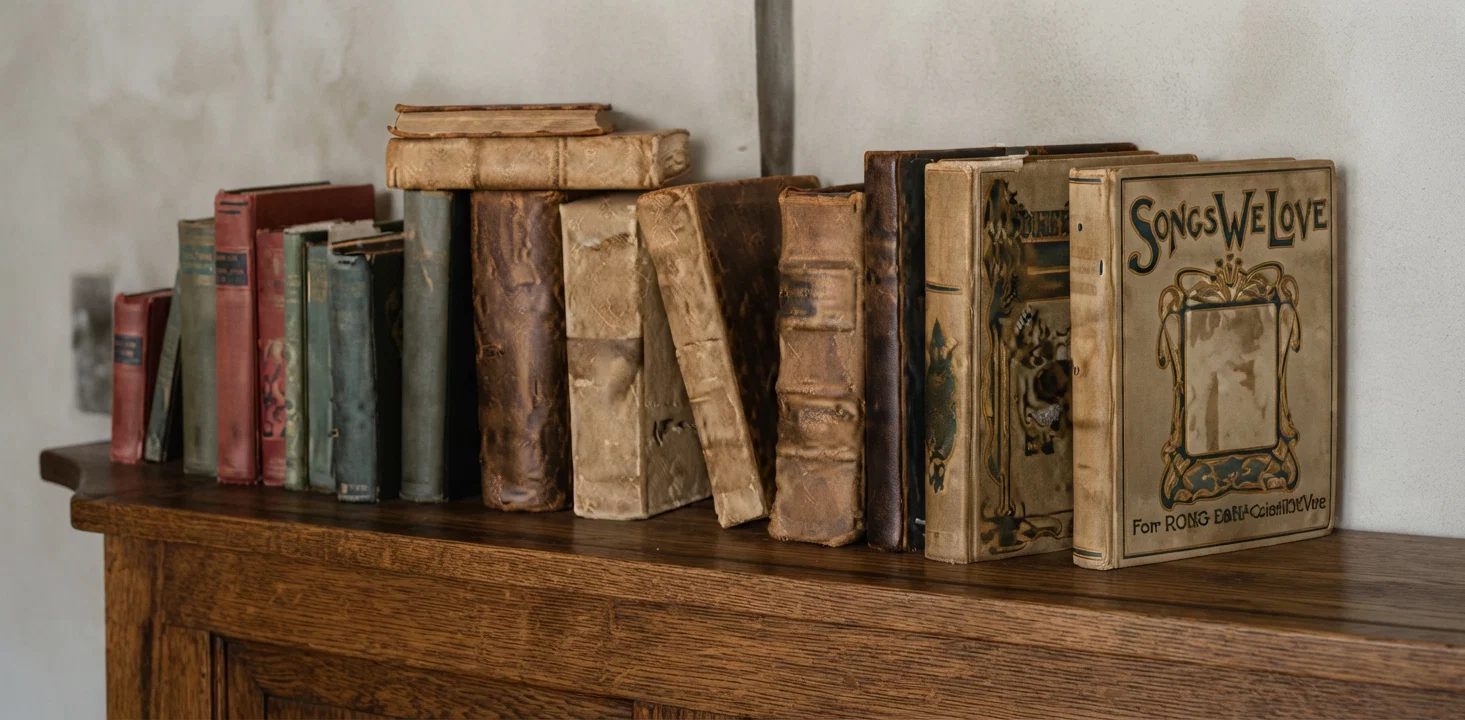
It was only a row of well-worn books; silent usually, but on this dull and rainy afternoon something was needed to bring in cheer and to dispel the gloom in the old home. It made no difference to the books if they had been relegated to a dark and dingy attic. Talk they could, and talk they would.
Many, many years ago an ambitious Sailor Lad, with eyes turned seaward, had bravely said good-by to the old home and mother. It was a dilapidated, water-soaked little book that was speaking just as we opened the attic door that rainy afternoon:
"Yes," the little book was saying, "you may smile, but I did get lonely. I was the only companion he had on all those long sea voyages. His mother slipped me into his little box just before he left. We stopped at many strange ports and heard many strange languages, and sometimes my Sailor Lad would be so interested in the new sights, amidst new peoples, that I feared I would be forgotten; but he did not forget me. I think his mother said something to him about me just before he left home, and occasionally he would take me out very tenderly, and read me very thoughtfully. I have grown old and worn, I admit. My Sailor Lad used to talk to me sometimes and tell me how I kept him from trouble, but I never understood just what he meant."
"Only a Row of Well-Worn Books."
A sigh escaped the leaves of another well-worn book, a volume of sweet, old-fashioned poems. "Ah, I wish I had seen something of the world. Why, I can't remember that I was ever out of the house! A dear old white-haired lady used to keep me near her, but I haven't seen her for a long, long time. I well remember the morning she put you in that tin box. I was new then, and so proud that she didn't send me away!"
"And it was well that I did stay at home, for at times I was certainly needed. She used to take me down from the shelf, and read and read; and I know—or, I am pretty sure I know—what might have happened if she hadn't found some pleasure and consolation in my little verses."
"Well, I think I had a pretty hard life," spoke up a rather bulky-looking volume, bearing the imposing title "Character Builders," badly thumbed and soiled. "I realize that I, too, look the worse for wear, but it is better to wear out than to rust out (casting a disdainful glance to a corner of the attic where a number of books, only paper-covered, were lying, dusty and not so badly worn). You are familiar with the old saying that sometimes one has to blow his own horn if no one else will blow it for him. Can any of you row of books tell me who that distinguished gentleman was who slipped in here one day not long ago, and when he espied me grabbed me by the back, he was so delighted to see me once more? Of course you don't know. He is called 'Senator,' and that day he told me a little secret that I am going to tell you."
"He said that when he was a boy he liked to read stories; spent hours reading 'blood and thunder' books, detective stories, nonsensical, imaginative tales. Finally one day he said to himself, This will never do. I must stop. I can't remember anything I read any more; I am getting so I don't care for good reading. I mean to be a great man when I grow up, and as people are
not better than the books they read, I am going to read only good books—books worth reading.
"So he selected me (some of the row of books smiled rather sarcastically), and he told me the other day that he truthfully believed no small part of his success was due to the good, solid reading he had found within my covers. I know I'm considered 'dry,' and called 'dull reading,' but I have worn well, and I can be read and reread to advantage."
The bulky volume straightened up so squarely after this long, conceited speech that a small book at the very end of the shelf almost fell off; but gaining its equilibrium, the little book ventured that they might be interested in its tale, and the row of books instantly looked "Attention!"
"I have always lived in the big, noisy, dirty, bustling city. I didn't like it, either, for I know what blue skies, and flowers, and green grass, and birds, and babbling brooks are. Why shouldn't I know? I tell people what they are. I'm called a 'Nature Book.'"
"But the Boy decided he wanted to go to the city, and go he must. He took me along. I wanted to stay with the Boy, but how I did dislike that city! I was left alone in the room a great deal. When the Boy had a moment to drop into a chair, he seemed so tired, and it was so noisy there that he would pick me up, read a line, and then actually throw me across the room."
"No wonder your back is broken," interrupted the Book of Poems.
"But I still remember whenever he was15the most weary his hand always reached out for me.
"Finally after a number of such experiences—O, so many that I lost count!—he said one day, 'Little Book, I am going back to the country, back to God's country. I am going to leave this grind, and turmoil, and tumult, that people call living, and I am going back to the real country you tell about.'"
"And he did go. I suppose that's why I have eventually found my way here. But I would rather be sitting here this rainy afternoon, quietly visiting with you, than to be in that dirty, noisy city. And I have hosts of brothers and sisters, and every one of them will tell you the same story. Somehow we get around the hearts of men and women until they respond to the call that we give to come back to Nature and to the simple life."
The next book we heard speaking was a volume called "Smiles" by its companions. It was not very large, but had bright cheery-looking covers, still intact altho the leaves certainly indicated hard and constant wear.
"Where do you suppose I have spent most of my life?" the cheery book was asking, "can you guess?"
"In some hot climate, I should judge, for you look well-baked," replied one book.
"Somehow I fancy from your peculiar odor that you have spent most of your days in a drug store," said another book.
Said the Sailor Lad's book, "Maybe you've been sea-voyaging, too, for you certainly look as tho you had had salt water or something even more destructive spilled on your leaves."
"You haven't guessed yet," replied Smiles. "I have made my home in a hospital. I think it is a fine place to live. One can do so much good, and really it is not such a dreadful place after all. Time and again the lady in white cap and apron has handed me to some long-faced, solemn, tearful-looking patient, and within five minutes you should note the change of
countenance! Sometimes they would smile, and more than once I have known the sadest to actually laugh out loud. I never knew exactly what there was about me that proved so amusing, but I know I always affected people that way. So you see I enjoyed my hospital life.
"My last case—you know after a time I really came to consider myself one of the nurses, I was so invaluable—was an especially querulous old fellow. I remember the first time he took me. He didn't keep me very long. But soon he called for me again; and after we were acquainted I hardly had time to visit any one else. He really quite fell in love with me, for when he left he begged the nurse to let me go with him, and she did after obtaining a promise that my twin brother should be sent to take my place.
"But I hadn't been at this home long before the old gentleman left very suddenly, and from all I could ever observe he took none of his belongings with him; and so here I am. But I am just as happy and cheerful as ever, and I am confident if I had a chance I could still do much good in this old world."
The books heard voices, real human voices, and immediately ceased their book talk; and when two elderly people entered the attic, the row of books were as demure and silent as only a row of old books can be.
"John," said the old lady, "let's take this row of books down to the living-room. They mean so much to us. They have been companions to all the family, and the influence they have had for good can never be measured. I feel as if they were almost human. You remember Charles Kingsley said, 'Except a living man, there is nothing more wonderful than a book.' Even now I often like to read one of them, and I do not think their days of usefulness are passed. A good book is the best of friends, the same to-day and forever."
The prospect of leaving the dingy attic and occupying their rightful place as mem-