THE heavenly sanctuary is the center of Christ's work for the human family. It is the great "power-house" of strength to the Christian. Every one who by living faith is connected with the heavenly sanctuary, can, in the strength imparted from that center of light and power, overcome every temptation that falls athwart his pathway. I fancy I hear some one saying, "If I knew more of that heavenly sanctuary I could have stronger faith to claim the power emanating from it; but there is so little said about it in the Bible." True, there are not many texts that definitely describe the heavenly sanctuary; for man, sunken in sin, can not appreciate heavenly things. But there is no other subject that the Lord has taken as much pains to define clearly to the human mind. A large portion of the Bible is devoted almost wholly to this subject.
The key that unlocks the whole subject of the sanctuary is found in Heb. 8:1-5. There we are told that the heavenly sanctuary was built by the Lord Himself; that Christ, our "Elder Brother" officiates there in our behalf, and then, as the soul goes out in an earnest longing to know more of the mighty Priest and that holy place, Paul adds: "For if He were on earth, He should not be a priest, seeing there are priests that offer gifts according to the law; who serve unto the example and shadow of heavenly things, as Moses was admonished of God when he was about to make the tabernacle; for, See, saith He, that thou make all things according to the pattern showed to thee in the mount."
An Object-Lesson
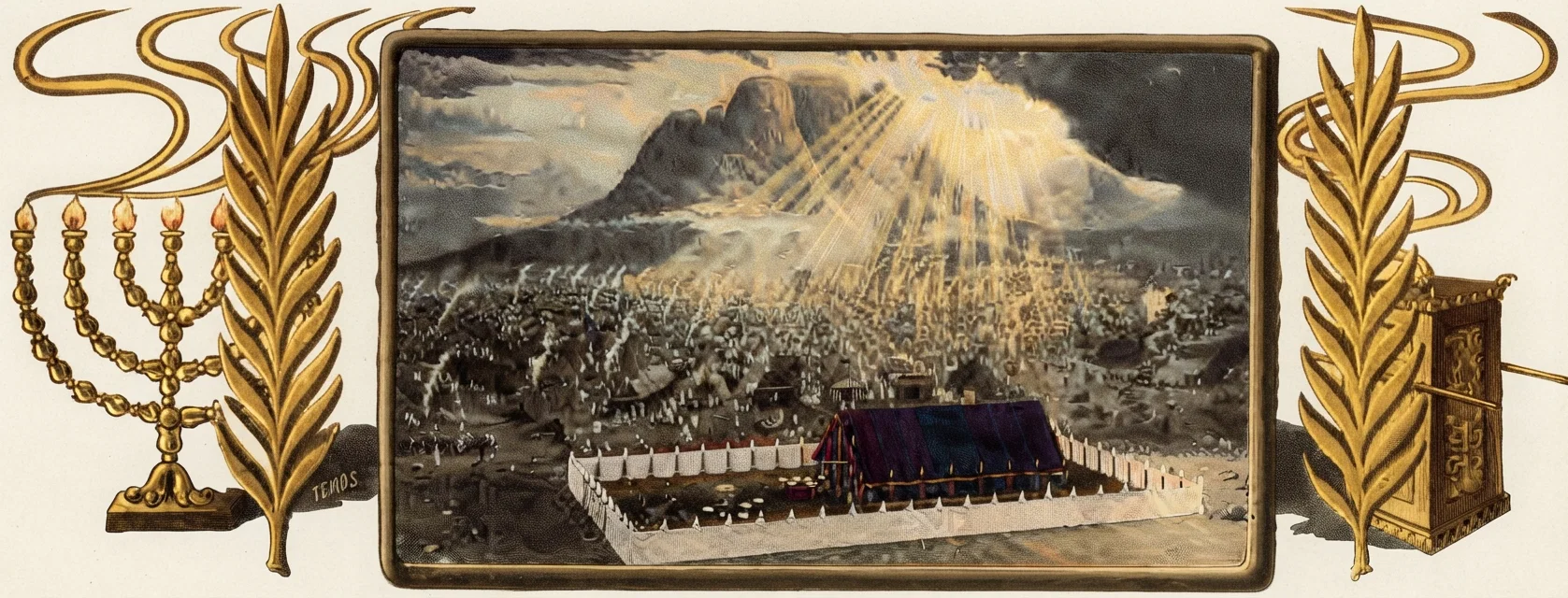
Do you long to know more of the heavenly sanctuary? If so, study prayerfully and carefully the description given of the tabernacle built by Moses in the wilderness; for Moses was admonished by the Lord to make it according to the pattern he was caused to see upon the mount. Ex. 25:40(margin).
Moses, the only man favored by being allowed to speak "mouth to mouth" with God, was given a view of the heavenly sanctuary, and commanded to build an earthly one as a shadow of the heavenly one.
Many years ago the writer was driving through the streets of London in company with a friend who had always been a deep student. Neither of us had ever been in the city before; but as we entered the heart of London my friend began to recognize places. He pointed out the "Old Bailey," "Newgate Prison," and other places of interest as we passed them; finally he said, "Now we shall soon see the dome of St. Paul's Cathedral," and sure enough, a turn of the road brought us in full view of the massive dome of St. Paul.
In surprise I said, "You have been in London before."
"No," he replied, "this is my first visit to London." "But," I persisted, "how do you know all the places of interest?"
His reply was, "All my life I have loved to read of these places noted in sacred and profane history, and from a child I have loved to study pictures of noted places, and they are all in my mind. I know the city altho I have never seen it."
In like manner the Christian that studies the word-pictures and descriptions given of the earthly tabernacle will have clear, well-defined ideas of the real building, the heavenly sanctuary.
Examples and Shadows
The individual who studies prayerfully and carefully the work of the priest in the earthly sanctuary will know of a surety the work of our High Priest in the heavenly sanctuary; for those earthly priests "served unto the example and shadow of heavenly things." In the shadowy service the sinner who realized that the "wages of sin is death" brought an innocent lamb to the door of the tabernacle, and, by confessing his sins over the head of the innocent lamb, and taking its life, he showed his faith in the "Lamb of God that taketh away the sin of the world." The lamb was slain, and the priest presented that blood before the Lord within the sanctuary. The sinner was forgiven; not through any virtue in the blood of the lamb, but because by bringing the lamb and taking its life he showed faith in the real "Lamb of God," whose blood does have power to cleanse even the deepest-dyed sins.
As we study of the earthly priest presenting that blood before the Lord in the earthly sanctuary, our faith can more fully grasp the fact that when we claim Jesus as our Lamb, our Sacrifice, and confess our sin to Him, He will plead His blood before the Father in our behalf, and we go free in Him; because, "by His own blood He entered in once into the holy place, having obtained eternal redemption for us."