IT should ever be borne in mind that the whole economy of Israel was typical, as well as prophetic, of the work of Christ and His ministry of the Gospel for sinners. There was no one part alone that could or would illustrate this work; it was necessary to have many things given, many illustrations drawn, that the church should understand the whole and complete work of the Saviour of the world. He was not only to be a type of Moses and the work that he did, He was also to be a type of Aaron and the work that he performed. John 5:45-47; Acts 3:22; 7:37; Heb. 3:5, 6; 5:1-5. His life and death was not only illustrated in the daily offering of the lamb; it was also illustrated in the slaying of the Passover. Isa. 53:4-7. 1 Cor. 5:7. His work of atoning for sins was not only to be seen in the daily sprinkling of the blood by the priest in the holy place, before the veil; it was also to be illustrated in the blood and atonement on that especial day set apart for this purpose; namely,—The Day of Atonement. It was necessary that all these objects and similes should be given to Israel in order that they, at that time, and the people later, should know and understand the different features of the work and ministry of Christ. Rom. 15:4; 1 Cor. 10:11; Heb. 4:1, 2, 11.
It is the purpose of this article to consider the work on the Day of Atonement in the type, what it meant to the people then, what it was designed to teach the church to-day.
Origin of the Day of Atonement
The great work of the priests in their daily ministration has already been considered, and the reader has learned much precious, up-to-date Gospel truth from the reading of these articles. But the Day of Atonement, its work and its lessons, means everything to the generation living to-day. The first intimation in the Bible that such a day should exist is found in Ex. 30:10, and was given to Aaron in connection with the purifying and cleansing of the altar of incense. The text reads thus: "And Aaron shall make an atonement upon the horns of it once in a year with the blood of the sin-offering of atonements; once in the year shall he make atonement upon it throughout your generations: it is most holy unto the Lord." And the further and fuller accounts of this day and its work will be found in the following scriptures: Lev. 16:2, 3, 5, 7-10, 15-34; 23:26-32; Num. 28:7-10.
The substance of these scriptures is that on this special day the high priest was not only to enter into the holy place as on other days, but was to enter within the most holy place within the veil. Ex. 26:31-34. After having offered special offerings for himself and his household, he was to take of the entire congregation of Israel two goats. Lev. 16:5. These two goats were to be presented alive before the Lord at the door of the tabernacle of the congregation.
Casting the Lots and Sprinkling the Blood
When this was done, the priest was to cast lots upon these animals, one of which was for the Lord (Jehovah) and the other for the scapegoat, or, as the margin renders it, Azazel. This term is a proper name, and is used even to the present time to represent the evil one, or Satan.
The goat of the Lord was to be offered up for a sin-offering, or, as the Hebrew renders the word, chatos. The priest himself was to take the life of the animal, and the blood was to be carried into the most holy place of the sanctuary. In this sacred apartment the priest was to sprinkle the blood seven times on the mercy-seat, and before the mercy-seat. He was also to take in his hands a censer full of burning coals from off the altar, and in the censer was to be placed the sweet incense, and a cloud was to arise from this fire to cover the mercy-seat, while at the same time a beautiful, fragrant odor would be transmitted. Lev. 16:13.
Sanctuary Cleansed
The sprinkled blood which was placed on the mercy-seat and before the mercy-seat, was to cleanse the congregation of Israel and make an atonement. Verse 17. It was also used to cleanse and make an atonement for the sanctuary itself, for after this was done the priest was to sprinkle the tabernacle of the congregation and the golden altar of incense. Ex. 30:10; Lev. 16:18. When this was finished, then the sanctuary itself was cleansed from all uncleanness of the children of Israel which it contained. Lev. 16:16. In other words, this blood was to cleanse the sanctuary where the sins of the children of Israel had been kept during the entire year. Hence this day comprehended the cleansing of the sanctuary.
A Solemn Day
During this day God had given command that the whole people should abstain from labor, should come up to the sanctuary, and should afflict the soul. The person who did not fulfil this command was cut off from his people. In other words, the man who refused to carry out God's command during the Day of Atonement was a lost man, and had finished his probation. This day, therefore, comprehended the work of judgment, and of sealing; for men's cases were decided by the course they pursued on that day.
The Writing and the Sealing
During some of the festivals and holy days of the year, especially the New Year's Day, and the early part of the Day of Atonement, there are many prayers repeated by the people. Among these prayers are found the following: "Our Father, our King, write our name in the book of life." "Our Father, our King, write our name in the book of remembrance." "Our Father, our King, write our name in the book of success and prosperity." But as the Day of Atonement draws to its close the form of the prayers is changed. "Our Father, our King, seal our name in the book of life." "Our Father, our King, seal our name in the book of remembrance." "Our Father, our King, seal our name in the book of success and prosperity." And when the solemn service has been brought to a close by the repetition of this word, "The Lord, He is God," seven times, and the benediction of the Kadesh, the men will grasp the hand of their fellows and give them the following salutation, "I hope you have a good seal." It can thus be understood what a solemn time this day was to be to the people of Israel—the whole to be devoted to heart-searching; to confessing of sin, to laying aside of every worldly project and prospect, to righting one's self with his neighbor, to feeling that he is to prepare himself to meet his God.
People Interested in Most Holy Place
At the same time the interest was centered in the work of the high priest in the most holy place of the sanctuary. Was the priest still ministering before the Lord? Had every Israelite fulfilled every obligation according to the command of God? Was God pleased with the work of the priest and the people? Was the priest still alive in that glorious yet sacred shrine filled with the cloud of incense and the presence of God? O, how they would listen to the movements of the priest; for as long as the sound of the bell and the pomegranate could be heard the people were assured that there was yet hope for them, and that the priest was interceding for them. Ex. 28:33-35.
Cleansing the Holy Place and People
When the work in the most holy place was finished, the high priest gathered up all the sins of all the camp of Israel, taking them to himself, so to speak, and started on his way out to the door of the sanctuary. Entering the holy place, he took of the blood of the sin-offering and cleansed the altar of incense by sprinkling this blood upon its horns seven times. When this was done, the priest's household, the whole people of Israel, the sanctuary, and the entire holy place was cleansed, and sin in figure was now removed from the holy places of God and from all the people of God. Lev. 16:15-20.
Sins Confessed
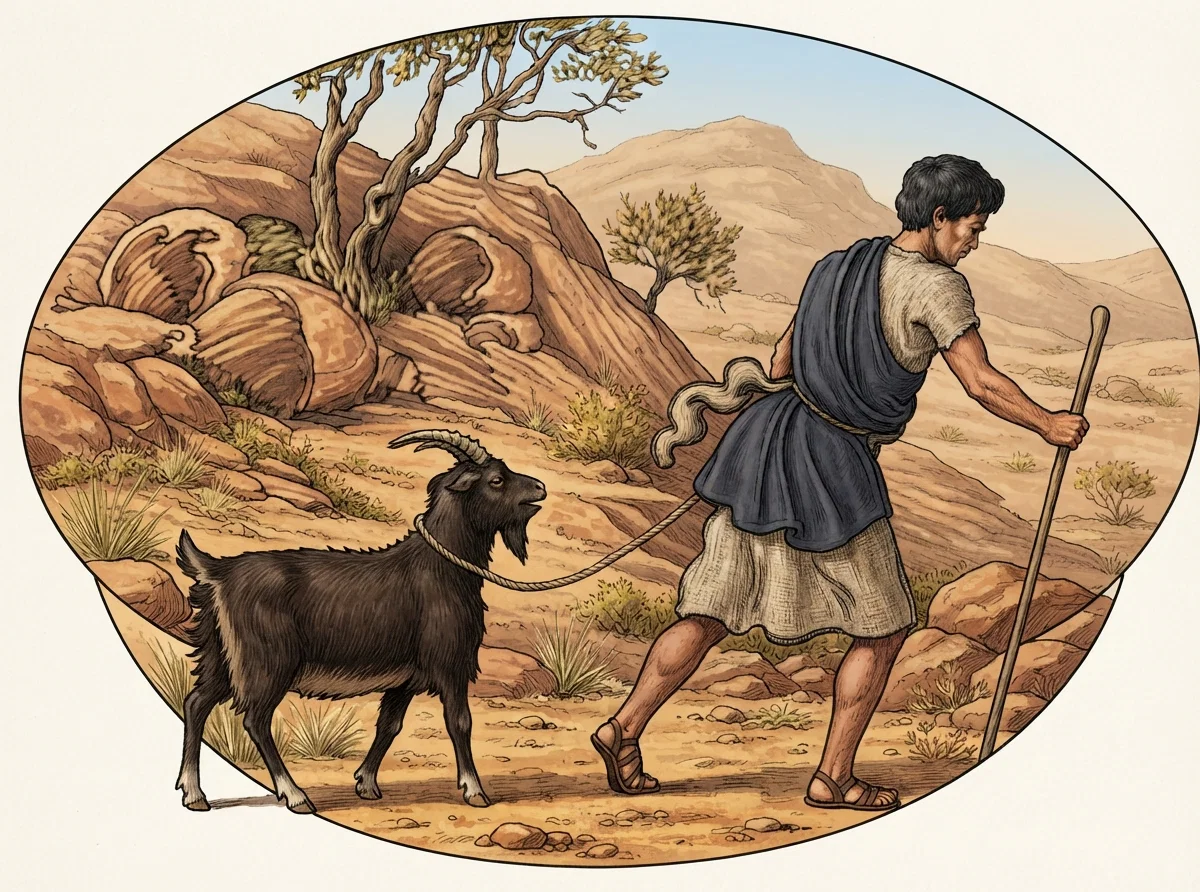
When the priest reached the door of the sanctuary he called for Azazel, or the scapegoat, which was brought to him by a man appointed for that work. The minister of God would then place both of his hands upon the head of the live goat and confess8upon him all the sins of all the people of Israel. These sins were not the sins of sinners; they were the confessed and forgiven sins of saints. These were the sins that had been forgiven during the year when the people confessed them; and now the record of them was removed from the sanctuary and placed upon the head of Azazel. The man appointed would then lead the goat bearing the sins of Israel away into the wilderness or desolate place, and there the goat would remain in the wilderness. There is, however, a tradition which says that the man led the goat to a precipice and threw him over and his neck was broken. Thus the atonement once a year was performed, and Israel and the sanctuary was cleansed from sin and its record. Lev. 16:20-22.
The Lessons in the Type
To summarize, then, the work of the Day of Atonement, we find that the lesson it taught in the type was as follows:
The cleansing of the sanctuary; the removing and blotting out of sin; the day of judgment and sealing of the people; the placing of the sins of Israel upon the head of Azazel. Could Israel have seen its lessons then, how much more it would have meant, and would still mean to them! What precious and blessed instruction they would have received from these truths, and how significant they would have been to them! But they had become merely a form to the people, and thus lost the power of the truth.
Scape-goat being led into the wilderness
Yet we should remember that all of this was but a shadow, a type, an object-lesson, to the church of God to-day. Rom. 15:4; 1 Cor. 10:11; Heb. 4:1, 2.
Message of the Sanctuary and the Judgment
Since the great message of God was proclaimed to the world in the years 1836-44, based on Dan. 8:14, and Rev. 14:6, 7, we have been living in God's great antitypical Day of Atonement, when our great High Priest began His finishing work for the Israel of God in October, 1844. Even now He is performing the work of judgment, is cleansing the heavenly sanctuary, is blotting out the sins of the people of God, is sealing the church with His own seal. Acts 3:19-21; Rev. 7:1-4. Soon He will leave the most holy place of the heavenly temple; and then the sins of all the church of Christ which have been forgiven and blotted out will be placed upon the head of Azazel, the real scapegoat, upon Satan himself, who will then be placed in the separated, banished, lonely, chaotic wilderness of this earth, which has been returned to its original state of chaos by the seven last plagues and the appearance of Christ; and for 1,000 years he shall remain in this state with all of the evil angels, bearing the sins of the Israel of God. Revelation 16:6:14-17.
The camp of the people of God will be cleansed, the record of sin in the heavenly sanctuary will have been removed; all the sins of God's children will have been blotted out, and the church is with her Lord, enjoying the blessed presence in heaven for 1,000 years. Rev. 20:1-6.
Dear reader, have your sins gone to the sanctuary before you? Is your case clear before the Supreme Court of the universe? May God grant that so it shall be.