LESSONS FROM POMPEII

8%

Pacific Press Publishing Company · Oakland, California · Mar 2, 1904

FromSigns of the Times, Vol. 30, No. 9.

Read the full edition

LESSONS FROM POMPEII.

THE ancient city of Pompeii, which lies buried at the base of Mount Vesuvius, and which once was on the shore of the Bay of Naples, at the mouth of the Sarnus River, owes its fame to the suddenness and completeness of its interment. It was not a great city, altho the seaport for several other towns in Campania. But its sudden burial while yet at its best was the means of preserving until modern times the most perfect illustrations of ancient arts and customs that are to be found in the world.
POMPEII and the neighboring town of Herculaneum were buried by an eruption of Mount Vesuvius in the year A. D. 79, nine years after the destruction of Jerusalem by Titus. Yet so changed was the contour and topography of the country in that vicinity, as also the course and mouth of the river, that the site of the city was unknown for nearly seventeen hundred years. While it was once on the shore of the bay, it is now about two miles distant.
IT is evident that the people of those days were superstitious in regard to localities thus devastated, and did not venture to settle there again for some generations, or perhaps the land was unfit for culture for a long time. At any rate, those who came afterward and cultivated the ground were unconscious of what was under them. It was the more modern spirit of research for things ancient, and the spirit of speculation in relics of the past, that finally uncovered the secret. Even a prominent author of the long ago (Pliny the younger) wrote of an eruption of Mount Vesuvius, but did not mention Pompeii or Herculaneum.
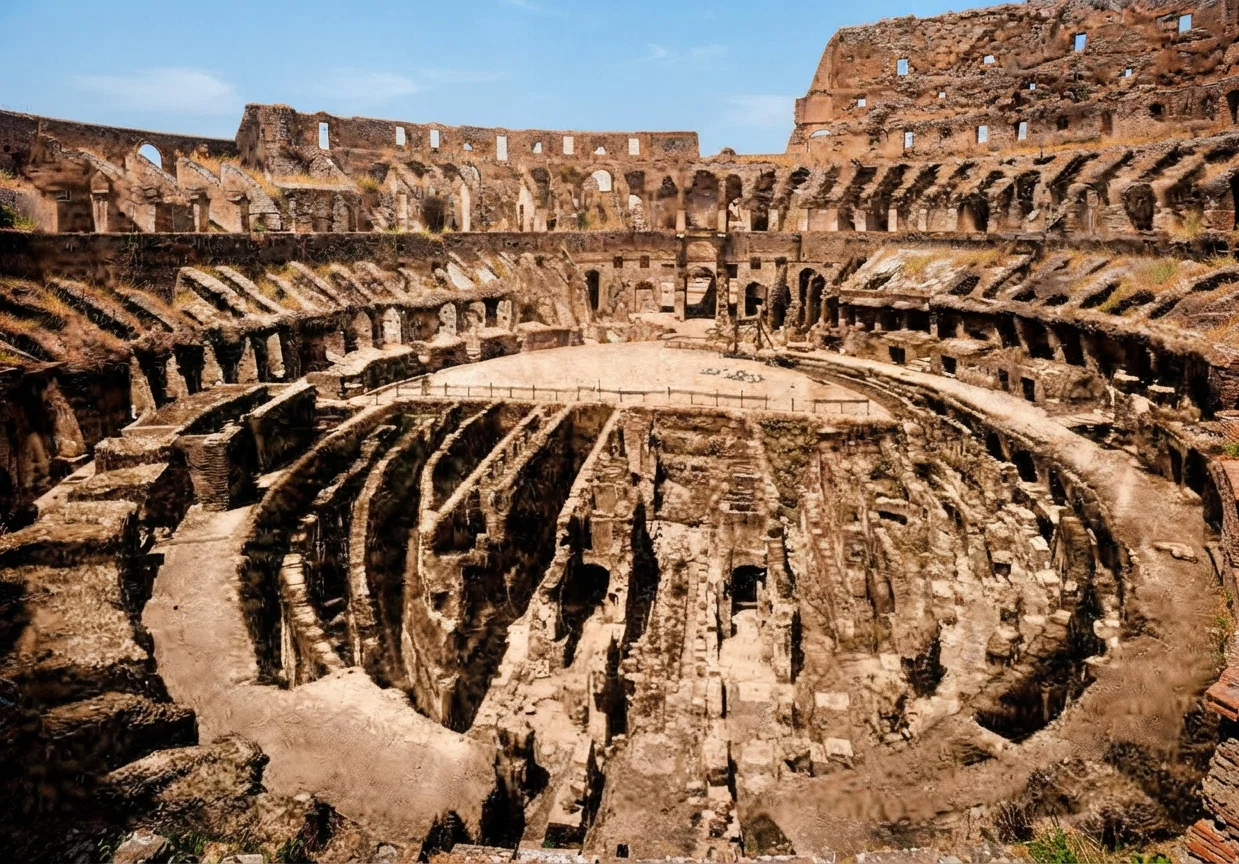
Ruins of the Amphitheater at Pompeii.
THE city was deluged first with cinder and small volcanic stones, on top of which was a deep covering of fine ashes. This top layer was eventually hardened by the action of water, and, in time, became a rich soil. So in 1748, when the discovery of the buried city was made, the region was covered with vineyards and mulberry grounds. Were it not known definitely when so great an accumulation of matter fell suddenly on that region, and the source whence it came, as also something of the history of the cities themselves, "geologists" would, no doubt, be computing millions of years for the changed condition, and classing the buried cities as older than Adam. But there is no reason why any other of the mysterious things of earth, supposed to be the work of untold millenniums, could not easily have come to pass within the six thousand years of history recorded in the Bible.
IT was not known when Mount Vesuvius had been in active eruption before this disastrous occurrence. Altho there were evidences of its being a volcanic mountain, it was supposed to be an extinct volcano, and the people in its vicinity never dreamed of danger from that source. There had been an earthquake sixteen years before this eruption, which had donemuch damage in Pompeii and other towns in that region; but the researches show that reconstruction and other extensive improvements were going on at the time of the eruption in a manner that indicated a feeling of perfect security. Like the antediluvians, and the people of Sodom, they were going on with business and pleasure, and "knew not" until their destruction came suddenly. So it will be to the wicked at the coming of the Lord "as a thief in the night." The Scripture tells us that "when they shall say, Peace and safety; then sudden destruction cometh upon them, as travail upon a woman with child; and they shall not escape."
THE sudden outburst of Vesuvius is an illustration of the pent-up forces in the earth, which the Lord may call forth at any time when, in His wisdom and in the progress of His purpose, judgment is called for in any locality or upon the whole earth. In the judgment of the antediluvian world the waters from beneath and from above united to fulfil His purpose. "All the fountains of the great deep were broken up, and the windows of heaven were opened." On Sodom and Gomorrah and the cities of the plain God rained fire and brimstone. And we learn from the New Testament that the earth as it is now is "reserved unto fire against the day of judgment and perdition of ungodly men." In the earth are reserves of fire and the various kinds of fuel in great abundance. These, lit up with the fire that comes "down from God out of heaven," will quickly put in motion the flames that will cause the elements to "melt with fervent heat."
THE illustration given herewith represents one of the theaters of Pompeii, capable of seating about five thousand people. History shows the theater to have been the outgrowth of wealth, luxury, idleness, and a general desire to be entertained. The drama, in all of its extremes and excesses, has always been at its height when kingdoms and empires fell into decay. The extent to which the theater is patronized is a fair gauge of the moral temperature of the populace, and, therefore, of the real power of the government. The rage for the fictitious, or the thrilling, or the debauchery of amusement, is always evidence of a loss of moral self-control, hence a loss of power. Just before the fall of the Roman Republic, Pompeii became a favorite resort for leading nobles of Rome, many of whom acquired villas in its neighborhood.
TACITUS says that in A. D. 59 (only twenty years before its destruction) "a tumult took place in the amphitheater of Pompeii between the citizens of the place and the visitors from the neighboring colony of Nuceria, which led to a violent affray, in which many persons were killed and wounded on both sides. The Pompeians were punished for this violent outbreak by the prohibition of all gladiatorial and theatrical exhibitions for ten years." A painting found on a wall in one of the houses by the excavators, gives a representation of this event.
ONE of the signs of popular corruption in our own day, in our own land, is the growing craze for "shows" of various kinds, especially for the cheap theater. It is to the grown people what the "dime novel" is to the boy—it lures them on and on. We have an illustration in our home city, whose people often boast of it as "the city of churches." Where two or three years ago there was but one "vaudeville" playhouse on the main business street, there are now four within a range of four blocks, and the last one is crowded to overflowing, even as the first. This is but a straw, showing the trend of popular taste in the matter of mental food and, therefore, of the lapse of moral power. The present outlook leaves no room for doubt as to the outcome,—"Evil men and seducers shall wax worse and worse, deceiving and being deceived."
W. N. GLENN.