ENGLISH NONCONFORMISTS IN COUNCIL, AND THE LONDON REVIVAL.
By M. Ellsworth Olsen
(By our British correspondent.)
TWO thousand delegates attended the recent Free Church Council at Manchester. This was the tenth annual meeting held by an organization of great power and influence, including all the nonconformist churches in Great Britain. "Purely spiritual work" was its watchword to begin with, but, like many similar bodies, it has developed on quite other lines, and has become, according to a prominent newspaper, "one of the most potent political agencies in the country."
The meetings on the present occasion were quite in harmony with the political character of the organization. Of course, religious matters received consideration, and some evangelical discourses were delivered; but political questions were very prominent, and aroused by far the most enthusiasm. One could not but feel that the one thing that lay nearest the hearts of the members was to defeat the Conservative government (which now holds the reins of power), and bring in a new Liberal régime. A good idea of the temper of the audience may be gathered from the following brief newspaper paragraph describing one of the political addresses:
The lively and fervent speech of Mr. — roused the fighting spirit of the Council, and the resolution was passed enthusiastically, with cheers.
Passive Resistance.
Naturally the Education Acts came in for considerable attention. Passive resistance, it should be remembered, is still a live thing; hundreds are suffering imprisonment, or distraint on their household goods, for refusing to pay the education rate, which, according to the late Act, is used in part for the instruction of school children in the doctrines of the State Church. Much enthusiasm was manifested in the discussion of this question in the council, and essentially the following action was taken:
The council reaffirmed its demand for a national system of education, co-ordinating all its branches under complete popular control, and entirely free from both theological and ecclesiastical tests, and from sectarian teaching.
The council once more expressed its deepest sympathy with the men and women who, on conscientious grounds, had deemed it their duty to refuse voluntarily to pay the denominational portion of the education rate, many of whom had suffered imprisonment, or additional and unnecessary hardship through the harsh, and in some cases illegal, action of the authorities. And the council declared that it would never consent to any proposal to introduce into state-paid schools, during official school hours, the services and sectarian dogmas of any denomination.
Here we have the principles of religious liberty, as applied to public education. Unfortunately, there is not sufficient evidence that the council is in harmony with these principles, as applied broadly. Thus we have one speaker saying, amid great applause, that they wanted to create Puritan politicians, and he hoped they would live to see a Puritan prime minister, and that they would see him at the Free Church Council meetings. Such little straws show which way the wind is blowing, and make one distrust somewhat the entire disinterestedness of the movement against the Education Act. After all, it appears to be strongly tinged with politics; one feels that it is secular, rather than religious, and proceeds in large part from a strong dislike of the party now in power.
The Laborer and the Church.
Labor interests occupied a large share of attention, the president, in his opening speech, essaying to answer the question why the workingmen so generally absented themselves from church and chapel. The preaching, in his opinion, was not "strong enough or concrete enough to win and to hold them."
Moreover, the church, as such, was holding itself too much aloof from the social questions which so largely concerned the welfare of the workingman. The homely, practical teaching of Christ was held up as a model. Mr. J. E. Rattenbury attacked the same subject even more vigorously, in a paper read later on in the meeting. Many of their Free Churches, he said, were simply limited liability companies, run in the interests of the middle-classes, by the middle-classes. The workingman was not wanted. The gifts to the church were supposed to be given to God, but they still muttered "Corban."
The Institutional Church
was the subject of a paper by Mr. C. Sylvester Horne, which took strong hold of the meeting. Mr. Horne, a year or so ago, took charge of the Whitfield Tabernacle, in the west of London, and has made it into a typical institutional church, with various branch organizations. It can not be denied that the institutional church embodies many popular
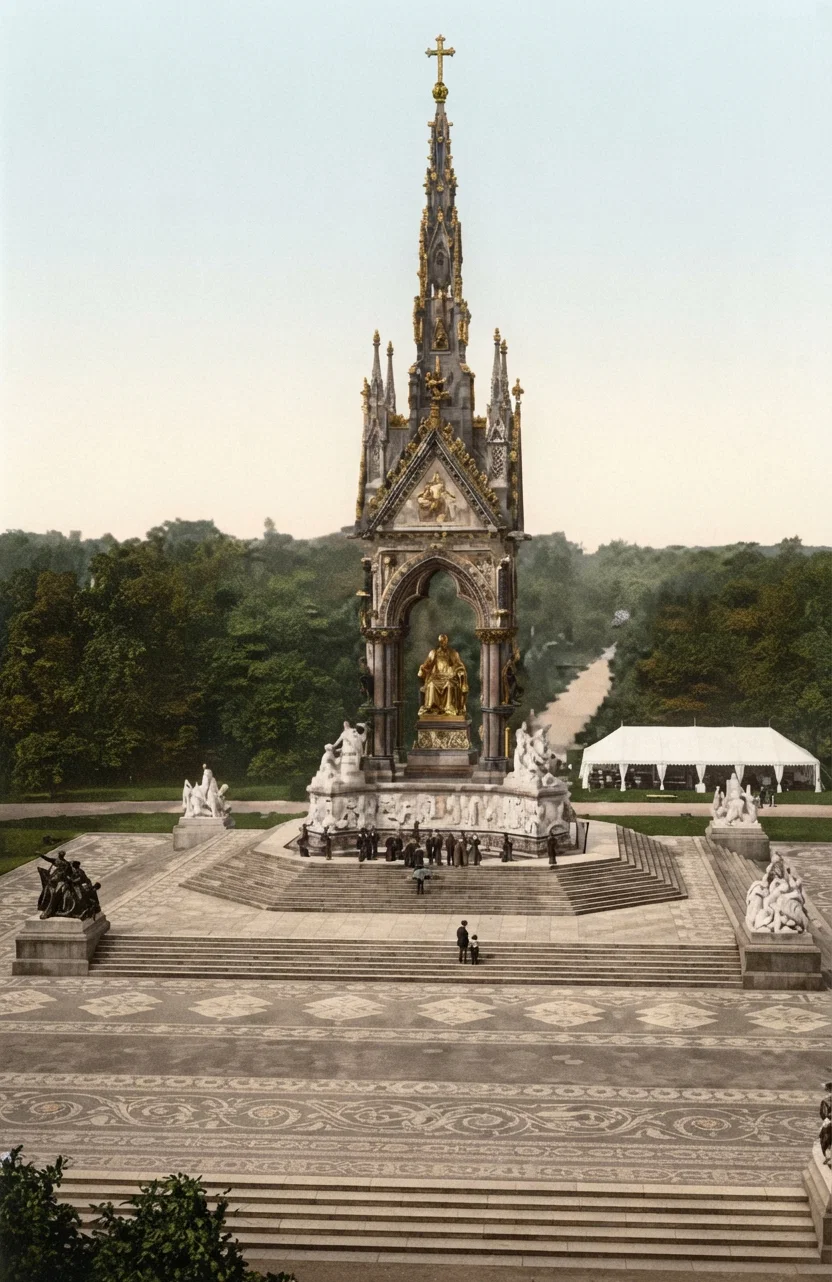
Albert Memorial near Royal Albert Hall.
features, some of which are most commendable, such as systematic visitation of the sick, efforts to secure work for the unemployed, and other philanthropic activities; but it has some distinctly downward tendencies. When the church takes upon itself to furnish amusement to its members, it is on debatable ground, and is pretty sure, sooner or later, to resort to methods which are the reverse of Christ-like, and to tear down with one hand what it is endeavoring to build up with the other. Pure religion and undefiled, can not pander to the modern rage for amusements.
Growth of Monastic Institutions.
A resolution was passed urging the government to institute an inquiry into the monastic and conventual institutions of the country, and the schools carried on by them. The discussion revealed some startling facts in regard to the growth of such establishments in the country within the last half century. Fifty years ago there were only fifty-two monasteries and convents in England; to-day there are no less than nine hundred and ninety, this being a greater number than when, as an intolerable nuisance, they were swept away by the Reformation. Many of these institutions, as I have before pointed out, have been transplanted to England in recent years, being driven out of France by the action of the French Government. They can hardly fail to exert a strong influence in the direction of rehabilitating Roman Catholicism in what has been one of the stanchest Protestant countries. It should be said that the foregoing figures refer to England alone, excluding Ireland, Scotland, and Wales.
The Revival in London.
Turning now to the revival services which Dr. Torrey and Mr. Alexander have been conducting in the West End of London, the question may be raised, What have they really accomplished? Meetings have been held day after day in the magnificent Albert Hall, and the nightly attendances have averaged close on to ten thousand people. About 4,500 are said to have passed through the inquiry-rooms at the hall; meetings for business men and other special services have been held in various parts of the city, with good attendances, and the daily papers, especially at the beginning, trumpeted the enterprise abroad with great gusto, as one of sensational importance. But, has anything at all in keeping with the enormous expenditure of labor and money been achieved in the forwarding of God's kingdom?—The answer must be an unequivocal—No. In the first place, the meetings have been attended almost exclusively by so-called church people, and these have come in large part, it must be feared, as a result of the reputation of the evangelists, and the somewhat spectacular character of the meetings. A trained choir of three thousand voices, under the direction of a skilled leader like Mr. Alexander, who has pronounced American ways, and is addicted to the telling of funny stories between the stanzas; then the uniqueness of conducting revival services in a fashionable resort such as the Albert Hall, and the large scale upon which everything was conceived—all this, together with the hearty co-operation of the London clergy, no doubt brought about the large attendance, and has given the color of an apparent success to the enterprise; but a revival in the true sense of the word, it can not be considered at all. The novelty of the thing having somewhat worn off, it is hardly likely that Dr. Torrey's further efforts in the south and northeast of London, will meet with quite so flattering a reception; still, he can not entirely fail while he enjoys such a hearty support from the clergy.
The revival in Wales is gradually coming to an end, tho not without leaving a considerable body of excellent results. Of course, the question, How lasting are these results to be? will depend largely upon what is done to follow up the work. The converts, of which there are said to be about 100,000, will naturally drift back to their old lives unless something is done to instruct them further in the Christian faith, and the elements of a daily walk with God. Some extravagance has tainted the movement in places, and fanaticism has not been wanting; but these must be regarded as excrescences, rather than so vitally connected with what, from all appearances, has been a remarkable manifestation of the divine power. M. ELLSWORTH OLSEN.