EVOLUTION AND GEOLOGY

3%

Pacific Press Publishing Company · Mountain View, California · Feb 15, 1905

FromSigns of the Times, Vol. 31, No. 7.

Read the full edition

EVOLUTION AND GEOLOGY

XI. SOME GEOLOGICAL DEFINITIONS.

HAVING now seen that Evolution has its stronghold in Geology, that, in fact, Geology furnishes ninety-nine per cent. of its supposed foundation, we must next undertake an investigation of this much misunderstood branch of science. And to prepare my non-scientific readers to understand the discussions which will follow in these papers, I must here explain some of the more common terms and expressions.
So brief a treatment of such an extensive subject must necessarily be somewhat obscure and incomplete. But I shall do the best I can to avoid these defects, and hope that those of my readers not already familiar with the science will preserve this article for future reference, so as better to understand the discussions which will follow.
Geology* is the science of the rocks. And the term "rock" is used in this science "to denote any naturally-formed mass of mineral matter, whether it be hard or soft, compact or loose. Hence, blown sand, mud, clay, gravel, and peat are, in the geological sense, 'rocks' quite as much as granite, sandstone, or limestone."

Classes of Rocks.

Rocks are broadly divided into two classes, igneous, or fire-formed, and aqueous, or water-formed rocks. Regarding the former class we shall have little to say, as they are only incidentally connected with the line of thought upon which we are working. They include, however, not only the trap, basalt, etc., of true volcanic origin, but also the slates, quartzites, gneisses, schists, and granites, which are sometimes called metamorphic or changed rocks, because produced, in some cases at least, from ordinary water-formed rocks by the action of a much more moderate degree of heat.
Aqueous rocks are also called sedimentary, because produced from a sediment deposited in water. They are also said to be stratified, because formed in successive strata or layers, one on top of another. Ordinary gravel, sand, and mud belong to this class; and these, when consolidated or hardened, become respectively conglomerate, sandstone, and shale. And they are said to be fossiliferous, when they contain fossils or remains of vegetables and animals embedded in their substance.
In regard to the age of a series of layers found in their natural condition, "those at the bottom must obviously be the oldest, because they must have been deposited before those lying above them. . . . In all such cases, the beds at the bottom are the oldest, and those at the top the newest. This arrangement of one bed or stratum above another, in the order in which they were laid down, is called the order of superposition."

As to the Time.

And yet, as it is almost solely in regard to time that the geologists make their blunders, i. e., in false notions and reasonings regarding the time or relative age of these various successive layers, we must right here be on our guard. When we find one bed or stratum lying above another, the lower one is of course the older of the two; but whether laid down ten minutes earlier or ten million years earlier, how are we to determine?—The common way is by the fossils they contain, as will be explained later; but as this method is based on a series of pure, unfounded assumptions, its results should have no weight whatever for us who want facts, not theories. Hence we are compelled to say that there is absolutely no way of telling how much longer the lower layer was deposited before the next succeeding, tho, if the two are conformable to one another in bedding, and the bottom one shows no evidence of erosion upon its surface before the other was deposited, the strong presumption is that no great time elapsed between the laying down of the two layers.
Another point to be noted here is that regarding the consolidation or hardening of strata. It not infrequently happens that the upper bed or beds may be much harder than those below them. This would not prove that the upper one was much the older of the lot; but would rather show that some strata harden or consolidate much more quickly than others. Indeed some substances, such as limestone, become hard or set almost immediately on being precipitated from water, and a mixture of fine sand and iron filings will, if exposed to the weather, quickly become a hard mass, not readily distinguishable from some of the "oldest" deposits on the globe. Hence the degree of solidification in a given series of beds is of very little use in determining their relative age.

The Earth's Crust.

Regarding the term "the earth's crust" Prof. A. Geikie says:
This name came into use when people supposed the inside of the planet to be an intensely-hot liquid mass, with a cool and comparatively thin crust outside. A great deal of dispute has arisen as to whether the main mass of the inside of the earth is liquid or solid; but those who dispute, whatever their views may be, agree to use this phrase, "the earth's crust," as meaning that part of the earth which men can observe, from the top of the highest mountain to as far below the deepest mine as they can reasonably infer what the rocks must be.
To this conventional definition we will all readily agree; tho, as we are informed by one of the highest-class scientific journals in the world, that "modern analysis tends to the conclusion that our globe is solid throughout" (Nature, Feb. 28, 1901, page 414), we may decline to admit that it is now, or has ever been in the past, a "pulsating crust," rising and falling ad libitum.
But one of the most marvelous, and, indeed, most perplexing, facts about the rocks remains yet to be noted. In almost every section of country we find examples,—perhaps extending over miles of the surface,—of strata, not lying in the horizontal position in which they were deposited, but squeezed, fractured, and crumpled up in such an astonishing manner that they may be standing on their edges or even completely overturned. I do not wish to convey the impression that ALL the cases of this nature, described in the text-books, are really of this character. As we shall find hereafter, some supposed examples of this nature are of such enormous magnitude, and rest on such doubtful evidence that it is not necessary to so understand them. But on a small scale we have numerous examples of this folding and crumpling of strata.
For a few important definitions pertaining to this subject, such as fault, dip, strike, outcrop, anticline, and syncline, I beg to refer the reader either to text-books on the subject, or to some good dictionary, such as the "Standard," where such terms will be found explained with more minuteness than I can employ here, perhaps also by means of illustrations, without which a mere verbal description is of little use.

A Faulty Treatment.

Regarding the way in which the strata are generally treated, in order to assign each to its proper "age" in the long-drawn-out past that the geologists have taught us to believe in, I give the following from Sir A. Geikie:
According to the law of superposition the undermost stratified rocks are the oldest. We can reach but a little way down into the earth. The deepest mines or borings descend but a very few thousand feet below the surface. If, therefore, these rocks still lay flat as they were deposited, we should be able to make ourselves acquainted only with those near the surface. But in consequence of the way in which the rocks have been bent, broken, and upheaved, we see, not only the topmost parts of the series, but even some of the oldest masses. Insteadof lying flat, the rocks are very commonly found to slope into the earth more or less steeply, and we can walk over their upturned edges, like the backs of so many rows of books. So far, therefore, from the bottom rocks being still buried under the thousands of feet of solid rock, beneath which they once lay, they are often found rising into the summits of lofty mountain ranges. The geologist, consequently, does not need to sink deep bores and pits to find out the order of the rocks under his feet. By making careful sections from what can be observed at the surface, he can usually determine that order with certainty, and, when he has done so, he knows which are the oldest parts of his chronicle, and which are the newest.—"Primer on Geology," pages 137, 138.
We may admit this last statement, in a kind of general way, for any particular and limited locality; but when the geologists, in their usual fashion, begin to compare the rocks in distant localities, and to affirm that the rocks in one country occurred chronologically, say, IN BETWEEN, two other sets of beds in some other country, where no trace of such rocks is to be found at all, we demur; for the evidence is wholly founded on assumptions and fanciful guesses, as we shall hereafter see.

Geological Formations.

But it is in this very way that the "formations," or sets of rocks, are pieced together from strata found here and there, and all together assigned to some imaginary "age" or period in "the dark backward and abysm of time." This idea is the hardest for the young student to grasp of any in the whole range of Geology; but, as no progress whatever can be made until this pons asinorum is crossed, it will be necessary to elucidate it as best we can. To do this, I quote from James Geikie:
The term "formation" is used very laxly by geologists. Sometimes it signifies a group of strata of inconsiderable or merely local importance, and occasionally the word is applied to a single stratum. Those writers, however, who are more careful in matters of terminology, restrict the term "formation" to those great groups of strata which are characterized by the presence of fossils having a facies [general aspect] so peculiar to themselves, that it not only serves to mark off the strata from overlying and underlying deposits, but to distinguish them wherever they occur throughout the globe. . . . By a "formation," then, it will be understood that we mean all the deposits . . . which accumulated over the surface of our globe . . . at a time when the world was characterized by the presence of some particular and peculiar fauna and flora.—"Historical Geology," pages 12, 13.
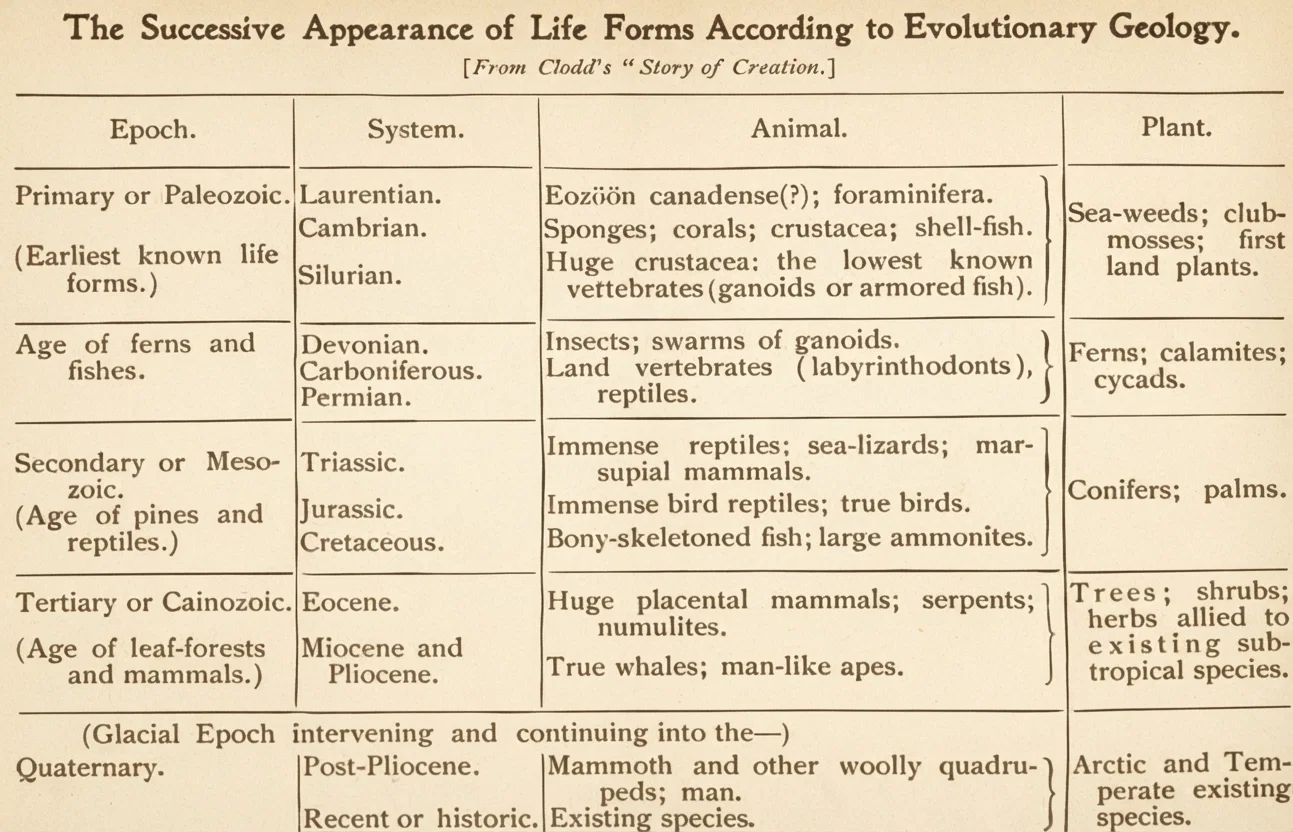
It will thus be seen that the "formations," or sets of rocks, are not found together in any one place in such relation that, by the law of superposition or stratigraphical evidence, one can be said to be older than another. Nor is a single "formation," perhaps, completely found together in any one place, but the rocks from perhaps half a dozen different countries are classed together to make the "formation" or "group" complete. But each of these groups or formations is assumed to represent a period of time; the various rocks over the globe having similar groups of fossils are classed together into one of these sets or formations, and are supposed to have been laid down contemporaneously, and then, according to the prearranged scheme of life,—succession from the low to the high,—these various groups are fitted into their appropriate places in the great hypothetical ladder of life; and the geologist will assure you that we have in this arrangement a correct history of our globe.
But, thank God, we have something surer than such crude guesswork.
["The Assumptions of Uniformity" is the title of the next article.]