1. THE menace of a Greek Church dominance in China is suddenly taken away. A few years ago it was beginning to gather blackness, like a portentous cloud. The intolerant spirit of Pobiedonostseff had shown an ambition to extend the power of the Greek Church. This spirit of propagandism was already displaying itself. What that meant to the Protestant faith can be learned from the persecution which the poor Stundists have suffered, and from the known intolerance of the Greek Church generally. It is furthermore known that it is a dream of the Greek Church to get hold of Jerusalem some day, and make it the center of Greek Christendom. Could that be accomplished, it would go far to settle in its own favor the long-standing controversy of the ages as to the supremacy between itself and the Church of Rome. If Russia had succeeded in forcing back Japan, all Manchuria would have become at once a field for Greek Church exploitation, and the northern provinces of China would soon have become the prey of the mighty.
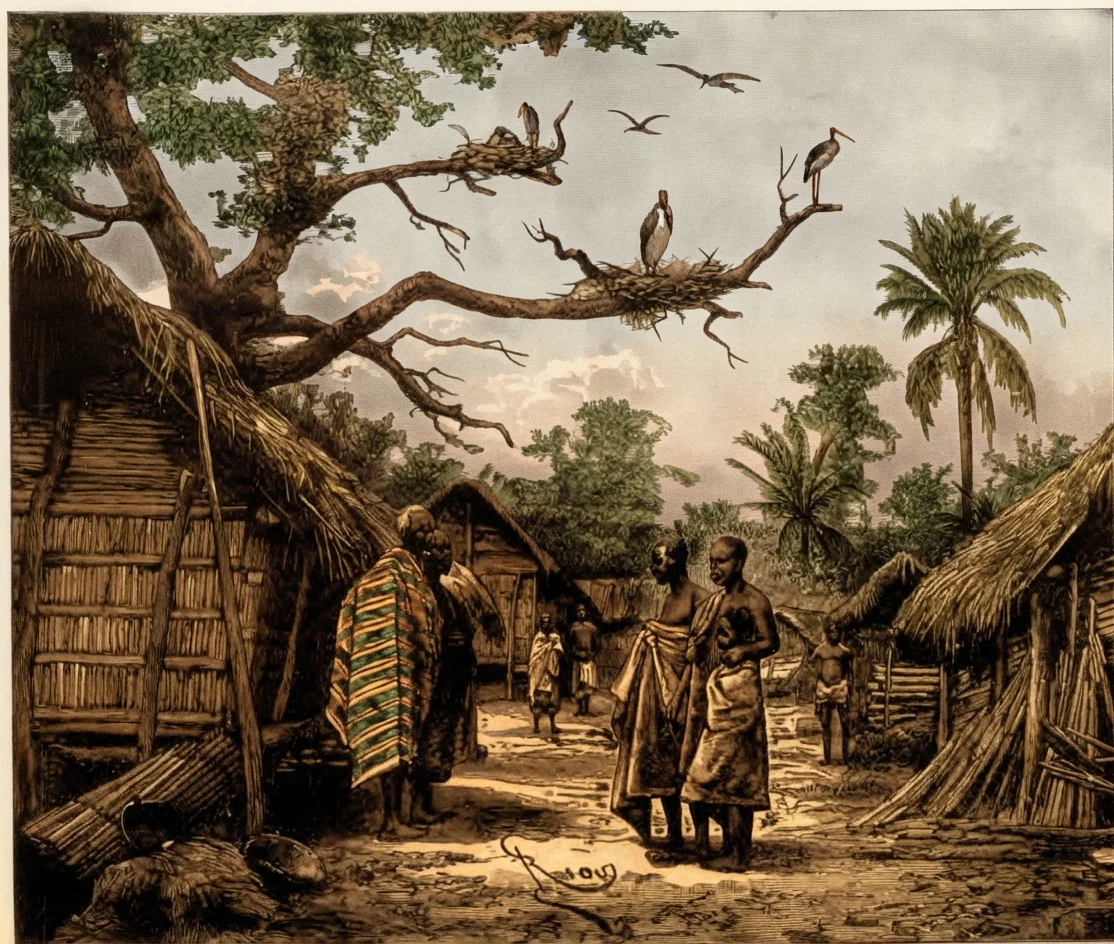
Waiting for the Gospel in Dark Africa.
2. The aggressiveness of political Romanism has received a setback. The old concordat between the Emperor Napoleon and the Vatican was continuing its sway in China long after its nerve-power was beginning to be paralyzed at home. The church was to back up the state, and the state was to back up the church. It has been well understood that France has been anxious to get more of a foothold in southern China, and was quite willing to use the priests and their converts for that purpose. The priests played into their hands by furnishing occasions for political intermeddling, and they, in turn, sustained the priests in quarrels with their neighbors. A serious crisis was rapidly hastening, which threatened to destroy friendly relations altogether. Chinese Roman Catholic converts often refused to obey their own magistrates altogether, unless told to do so by the priest. Of course, the magistrates were angry, and the people were angry, and there were collisions, riots, and bloodshed. A few of the magistrates had courage enough to resent this interference with their prerogatives, but the more timid ones were afraid, and put up with many indignities rather than come into collision with the powerful Romish priesthood; for behind the common Roman Catholic converts were the French priests, and behind the priests were the consuls, and behind the consuls was the minister at Pekin, and behind the minister at Pekin was the entire French Government, and at the elbow of the government was the pope and the Vatican.
In all these tumults the Protestants suffered heavily. The less intelligent of the Chinese officials were unable to discriminate between Protestants and Romanists; they were there, all parts of Christendom together, and the measure of hatred filled up to overflowing against Romanists, was dashed over Protestants as well. Now, however, China is being greatly stiffened against foreign influence by Japanese success, and Rome will be the loser.
Apprehension is felt that the success of Japan will put her in the place of mentor to China in confirmation of this, attention is directed to Chinese students in Japan, to the employment of so many Japanese teachers in China, and to the number of Japanese filling places of trust and emolument in the different centers of influence in China.—Wm. Ashmore, D.D., Baptist Missionary.
[It is safe to assume that any setbacks that Rome receives at the present time are but temporary. We are close upon the time when all the world will wonder after the beast, excepting a certain class (Rev. 13:3, 4, 8), and great political support will be given to that church for a short time before the coming of the Lord. Rev. 17:12-14.]