HEBER, THE FIRST-BORN

2%

Pacific Press Publishing Company · Mountain View, California · Nov 23, 1904

FromSigns of the Times, Vol. 30, No. 46.

Read the full edition

HEBER, THE FIRST-BORN

A Story of Israel's Deliverance

By HART HALL

CHAPTER V.

FOR many days the plague continued, then ceased as suddenly as it had begun. The king soon reappeared and assembled the court in its usual routine. The annoying Hebrews had not been seen, and, with a suavity fostered by hope that he was rid of them at last, the monarch presided over the affairs of the state.
The next day but one was appointed for devotions at the river, and with great pomp and ceremony the royal company repaired to their usual place of devotions. But, like a wraith or apparition of evil to the royal retinue, Moses and Aaron appeared for the second time at this place.
The king no longer ridiculed them or affected haughtiness, but dreaded and shrank from the judgments which he knew their appearance foretold. Fearlessly the prophet spoke: "Thus saith the Lord, Let My people go, that they may serve Me. Else, if thou wilt not let My people go, behold, I will send swarms of flies upon thee, and upon thy servants, and upon thy people, and into thy houses; and the houses of the Egyptians shall be full of swarms of flies, and also the ground whereon they are. And I will sever in that day the land of Goshen, in which My people dwell, that no swarms of flies shall be there; to the end thou mayest know that I am the Lord in the midst of the earth. . . . To-morrow shall this sign be."
The king called his wise men and philosophers in council, and unanimously they upheld him in resisting the divine mandate. After their idolatrous ceremonies had been performed, the return to the palace was made with great eclat.
On the morrow the Egyptians witnessed the fulfilment of the warning. Flies, or what is supposed was the great Egyptian beetle, scarabacus sacer, which is constantly represented in their sculpture, filled the land. The pest was a venomous creature with a painful bite, and besides being annoying and destructive was an object of worship. Thus were they scourged by their own superstitions.
The plagues that had been sent upon them hitherto had been a severe trial in their annoyance, but this visitation was a punishment that seemed intolerable, and like its predecessors afflicted high and low alike. Only in the land of Goshen the plague was not found.
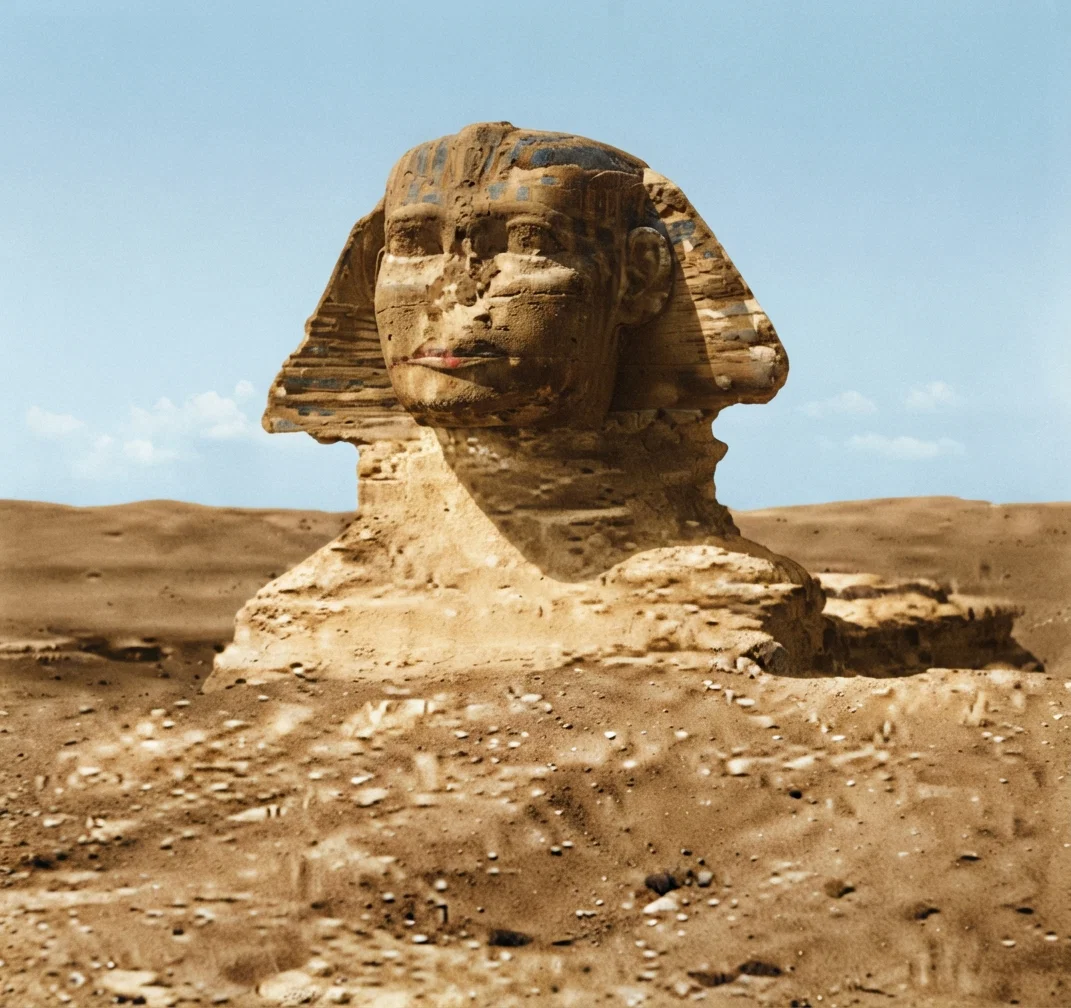
The Sphinx Which the Hebrews May Have Helped to Build.
In haste the monarch despatched Heber for Moses and Aaron, and when they arrived at the palace, he sternly commanded them, "Go ye, sacrifice to your God in the land." "It is not meet so to do," replied Moses, "for we shall sacrifice the abomination of the Egyptians . . . before their eyes, and will they not stone us?"
They would be required to sacrifice animals that the Egyptians held sacred, and such an insult to the gods would be an abomination, and would not be tolerated. To slay a sacred animal even accidentally was punishable with death.
Pharaoh replied, "I will let you go, that ye may sacrifice to the Lord your God in the wilderness; only ye shall not go very far away; entreat for me."
"Behold, I go out from thee," said Moses, "and I will entreat the Lord that the swarms of flies may depart from Pharaoh, from his servants, and from his people, to-morrow; but let not Pharaoh deal deceitfully any more in not letting the people go to sacrifice to the Lord."
The next day the flies departed as suddenly as they had appeared; there remained not one. But as soon as the air was free from the pest, Pharaoh's heart hardened. Stubbornly resisting all evidence, all promptings of the Spirit, all the testimony of the magicians, he continued in his determined course, supported by the priests and counselors.

CHAPTER VI.

The loss of a nation of bondmen was not to be considered, was not to be tolerated.
Again the prophets appeared with a warning message. A dreadful plague of murrain was threatened upon the Egyptian cattle, horses and camels, sacred animals, and beasts of burden. They were to be slain from one end of the land to the other, only the animals of the Israelites were to be exempt.
Time was given for consideration, but steadfastly the king persisted in his rebellion. So, swiftly, at the time specified, the plague appeared, and the beasts of the Egyptians, which were not only their property, but their deities as well, fell a prey to the wrath of God against their masters. Caravans of camels and asses fell under their burdens on the highways. The steeds of Pharaoh's hosts stiffened and died in their stalls, oxen at the cart and the furrow fell under the yoke, and from all over the land a great wail of despair went up.
Hosts of impoverished Copts waited on Pharaoh beseeching him to release the Hebrews, that the curse might be stayed. But the philosophers and the great men urged in reply that the disease was from natural causes. "Why," said they, "shall we give up the ones who are enriching the kingdom?"
To satisfy himself Pharaoh sent the messenger, Heber, with a letter of inquiry to the chief officer in Goshen, to ascertain whether or no the Israelites suffered with the rest.
With a glad heart the Hebrew had sped away for the land where he had spent his childhood, for was not his home hard-by on the way to the house of the chief magistrate? and, if not delayed, he might steal a moment to greet his parents. Many, many days had passed since his loving mother had sobingly clung to him in her despair at parting, kissing his fair cheeks and bidding him be true to his father's God at the king's palace, whatever happened to him. The tears welled up at the remembrance, blinding his eyes; but, brushing them away, he sped the faster, on and on.
Fortune favored him, for the officer promptly inscribed his report on a roll of papyrus, sealed it carefully, and bade him hasten. In a moment he was away like a flash, on his return; and, as he darted along, planned his movements carefully. Turning onto a side street he passed rows of houses, all squarely built of sun-dried brick laid in bitumen. They all looked the same with their flat roofs and large doorways, but he knew the one, and with a glad exclamation burst in upon his parents.
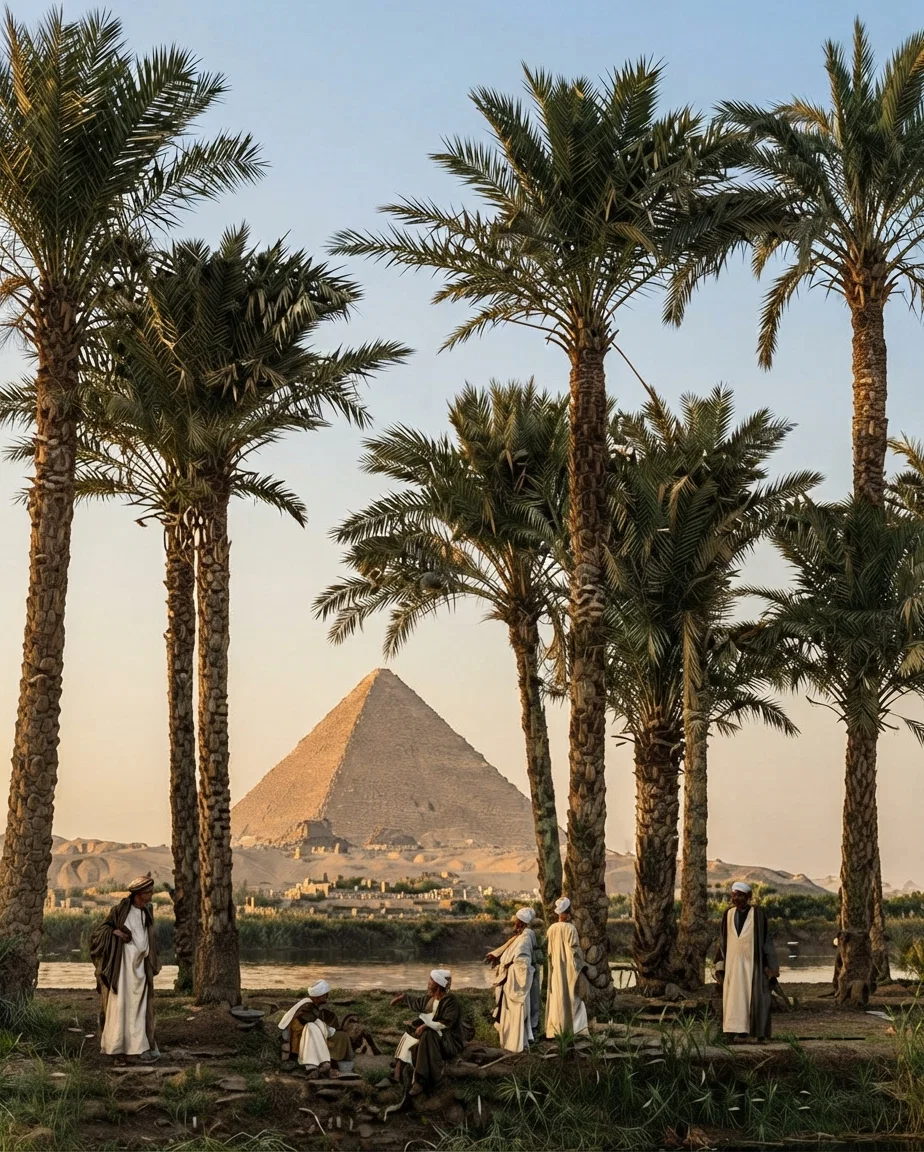
In Egypt's Land on the Nile.
Surprised beyond measure, they greeted him with a cry of joy, embracing him affectionately. His brothers and sisters crowded around in wondering bashfulness. After kissing them each in turn, he exclaimed, "I must hasten with the king's message. There are fearful things done in the land, have ye not heard?" "Yea," said the father, "the masters no longer beat the men as of yore. And the prophets are among us daily saying, Soon shall the deliverance come."
"Has aught of thy cattle died?" "None," was the reply. "I must hasten," again exclaimed Heber, "or the king will have my head," and with a farewell he was out and away.
Pharaoh received with stoical indifference the information of Goshen's immunity from the plague. Hardening his heart to the pleadings of his own people, he defied the judgments of the Almighty.
As he walked in the gardens early in the cool of the succeeding morning, he was again brought face to face with the prophets.
Not a word was spoken; but Moses, taking handfuls of ashes from his gathered tunic, scattered them high in air again and again many times. The king, with lowering brows, black with hate, watched the action, but understood none of its meaning. But it was deeply significant.

CHAPTER VII.

Four hundred years before, God had revealed to faithful Abraham, under the symbol of a burning lamp and a smoking furnace, the affliction and bondage of His people in Egypt. It was not His will that they should serve in bondage, but it was the result of their own apostasy from Him, occurring so many times in their later history. Sin, in all its phases, tends to deepest distress and bondage.
But now the years were fulfilled. He remembered His covenant with Abraham, Isaac, and Jacob, and would stretch forth His arm to save His heritage from the furnace of affliction. And as Moses scattered the ashes of the furnace the fine particles were carried by the winds over all Egypt, breaking forth in boils on man and beast. Only in Goshen the plague did not rest.
Pharaoh in his desperation called for the magicians again to see if they could imitate the plague; but they could not appear before him because the scourge rested on them also. Their vaunted powers only making them contemptible, no longer were they able to encourage the king in his stubbornness against the God of Israel.
Ordinarily the king of Egypt was a slave to the customs and duties of office. Every part of daily life was guarded by form; each moment something on the royal program awaited him. In the morning he must read communications and reports from different parts of his empire; then the kingly robes were donned; then an offering to gods by the priests in the name of the sovereign; after which they read to him out of the sacred books exhorting him to emulate their wisdom and virtue. He could go out, but must be accompanied, and must return at the prescribed moment; and so it went, year in and year out.
But with priests and courtiers tortured with the blains, unable to appear, Pharaoh was at absolute liberty. At any other time he would have enjoyed his vacation; but now he wandered aimlessly about the palace or in the beautiful gardens, plucking the rare blossoms, and meditating deeply over the turn affairs had taken.
It was here that Moses and Aaron found him again, and another fearful warning fell upon his ears: "Thus saith the Lord God of the Hebrews, Let My people go, that they may serve Me. For I will at this time send all My plagues upon thine heart, and upon thy servants, and upon thy people; that thou mayest know that there is none like Me in all the earth. For now I will stretch out My hand, that I may smite thee and thy people with pestilence; and thou shalt be cut off from the earth. And in very deed for this cause have I raised thee up, for to show in thee My power; and that My name may be declared throughout all the earth. As yet exaltest thou thyself against My people, that thou wilt not let them go? Behold, to-morrow about this time I will cause it to rain a very grievous hail, such as hath not been in Egypt since the foundation thereof even until now. Send therefore now, and gather thy cattle, and all that thou hast in the field; for upon every man and beast which shall be found in the field, and shall not be brought home, the hail shall come down upon them, and they shall die."
The report quickly spread throughout the land; but rain was a very unusual occurrence in Egypt, and the people were slow to believe. However, they had great reverence for Moses as the one who had power to remove the plagues, and many finally gathered the few beasts that remained to them from the plague of murrain, into their houses, as barns or stables were unknown among the common people in that warm climate. But those who believed not the word of the Lord left their animals in the fields and pastures.
The morning dawned with the eastern sky black and threatening. Heavy, low-ranging clouds rapidly filled the heavens, driven by a fierce wind that soon grew to a hurricane. Muttering thunder echoed in the distance, and streaks of vivid lightning shot across the sky.
Alarmed, the Egyptians hastened to the fields for their beasts, but ere they could return rain began falling in torrents, and with it great hail that struck down man and beast; it pounded the beautiful fields of barley and flax into the earth, stripped trees and vines of limbs and foliage, laying desolate the labor of years.
The thunder's crash grew fiercer and heavier as the lightning struck closer. Buildings were stripped of their parapets and roofs, burying the inhabitants beneath an avalanche of brick and stone. And above all, carried with the wind, came the cries of the people and the bellowing of beasts.
At the palace, terror reigned supreme. Caste and position were forgotten as prince and menial labored together to shield valuables from destruction, and to barricade windows and doors.
Pharaoh, fearing the result of the storm, haunted the halls, quaking as once and again a fearful detonating crash told the story of the lightning's havoc. Suddenly, he felt some one touch his arm, and turning, saw the slave messenger, Heber, standing before him.
"Wilt thou I go for the prophets?" he inquired. "Canst thou face the fury?" asked the king. The lad nodded. "Thou canst never reach Goshen," Pharaoh ejaculated in astonishment. "The prophets are abiding not far from the walls of the city, at the house of one of Pharaoh's officers." "Go, then; thy God save thee," commanded the king.
In a moment the lad was gone, and as he left the palace and met the force of the tempest he was carried off his feet, but the king at the window saw him rise again unharmed, seemingly unmindful of the falling, or rather, hurling, hail about him, and bending to meet the gale he struggled on, and was lost to view.
Pomona, Cal.
(To be continued.)