O THIS is a sad, sad world, despite its veneer of folly and fun. There is no city, town, or village but has its silent city close by, the inhabitants of which often number more than those of the living, throbbing town. Ever and anon the slow, mournful procession leaves the city of the dying for the city of the dead, bearing one or more silent sleepers to that bourne whence no traveler returns, the curtains of whose tents never outward swing. And so many of those who enter the dark portals of the tomb do so with no ray of hope to lighten or cheer their dying moments. What hope is there beyond? Is the silent city of the dead the last long home? Is the low bed beneath the cypress and the willow, under the green sod, the last resting-place? "If a man die, shall he live again?" asked the old Idumean emir, in his affliction. And men are asking it to-day. There is an answer.
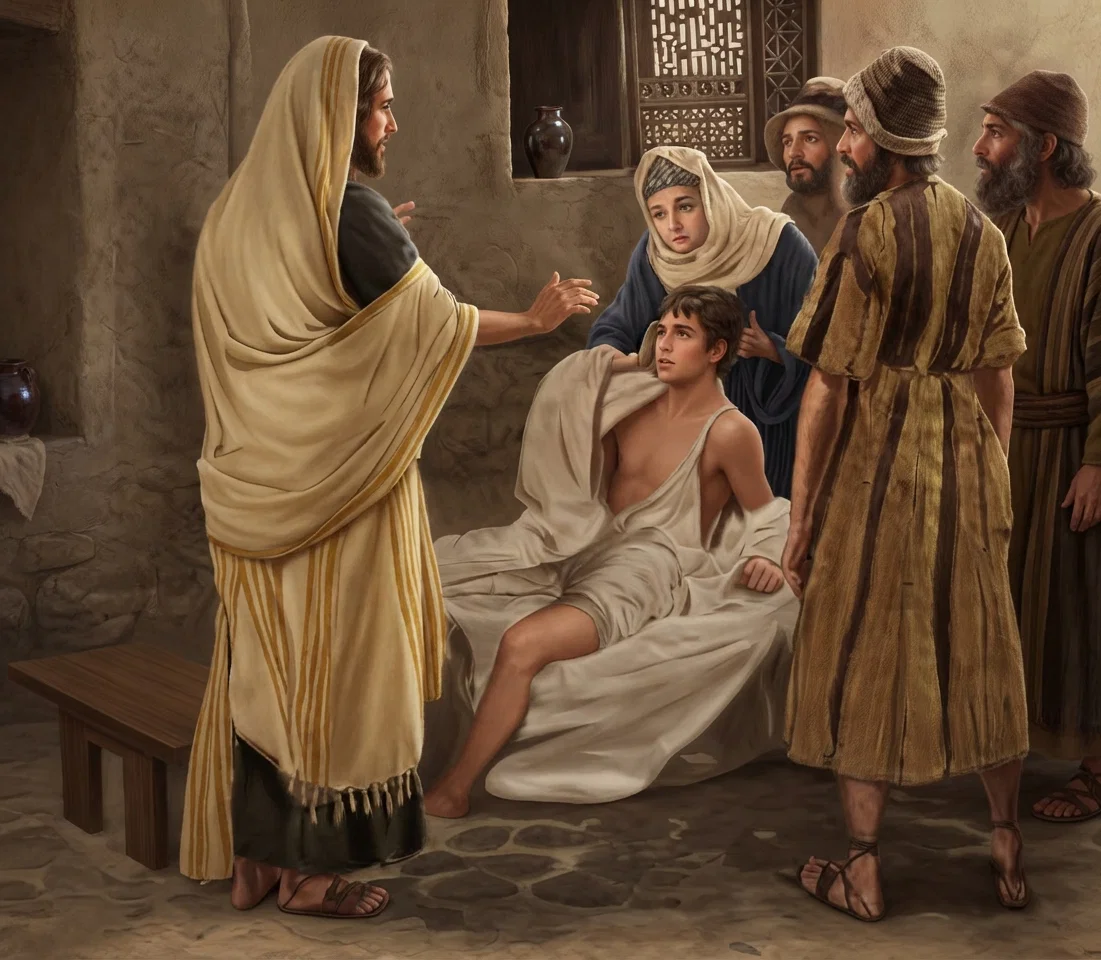
“I say unto thee, Arise. And he that was dead sat up, and began to speak.”
THIS is a world of pain and death and sorrow. There is scarcely a home of a score of years where Disease and Death have not entered, and in departing have left blanched faces, tearful eyes, breaking hearts, and crape upon the door. Sometimes Death's dread messenger robs the home of wife and mother, of father and husband, or of son and daughter. To some homes the awful messenger comes again and again, till the last earthly prop, the last hope, is gone, and heart and home are enshrouded in the pall-cloth of despair.
SUCH a sad heart and home, typical of many others, there was in the little city of Nain, nearly nineteen centuries ago. A home had been broken by death. The husband and father had been taken away, leaving the wife, with but one son, to meet life's battles alone. How she must have watched over her boy. How happy she must have been to see his development into manhood. How she solaced her heart that in her old age she would have a strong son on whom to lean. But Disease enters her humble home, and chills her very heart with his presence. Death soon follows him, and her only son, her hope, her joy, her pride, her earthly hope and stay, falls into the sleep which knows no human waking. She calls in his ear the terms of endearment she is wont to call him, but he heeds her not. She weeps and wails her grief, but he so quick to comfort before, remains silent.
KIND neighbors come in and dress the corpse for its last resting-place. Former companions of the boy are found, perhaps, to bear the bier, on which the body rests, to the sepulcher. The procession passed along the streets with a great company of people mourning with the bereaved widow. They reach the city gate, and meet a company of men, dusty and travel-worn, about to enter the city. According to the custom of the people, they should have turned back and accompanied the procession, out of respect to the dead and in sympathy with the mourning ones.
BUT this Man did nothing of the kind. His great heart is moved with compassion as He looked upon the bereaved mother. He saw in her the mourning mothers of centuries. With infinite tenderness He speaks, "Weep not," and then passes on to the bier, and touches it. The bearers stood still. And then occurred a marvelous thing; He speaks to the ears the mother had called to in vain: "Young man, I say unto thee, Arise. And he that was dead sat up, and began to speak. And He delivered him to his mother. And there came a fear on all; and they glorified God, saying, That a great prophet is risen up among us; and, That God hath visited His people."
"If a man die, shall he live again?"—Yea, he shall live. "As in Adam all die, even so in Christ shall all be made alive. But every man in his own order: Christ the first-fruits; afterward they that are Christ's at His coming." 1 Cor. 15:23. And they that are not Christ's shall wait till the close of the day of God, and then come forth to condemnation and death forevermore. Rev. 20:5; Acts 24:15. But the dead shall live in Christ Jesus. The Son of the eternal God became sin for us, that we might be made the righteousness of God in Him. 2 Cor. 5:21. He having no sin in Himself, it was not possible for the grave to hold Him. Acts 2:24. And every soul who goes down into the grave clothed in the righteousness of Christ Jesus, shall come forth at the Master's call, clothed with immortality. 1 Cor. 15:51-54. He has broken the bars of death. He has cleft the gloom-cloud which hangs over this world of sin, and lighted the pathway of life through all its dark valleys, even through the Valley of the Shadow of Death to the glorious Beyond. He who wept at the tomb of Lazarus and spoke him to life again; He who halted at the bier of the widow's son and gave him back to her alive; He has Himself passed that way and won for us the key of the grave. O sorrowing mothers, weep not, there is hope, all hope, in Christ Jesus our Lord, the same yesterday, to-day, and forever.