IT IS WRITTEN

9%

Pacific Press Publishing Company · Mountain View, California · Feb 28, 1906

FromSigns of the Times, Vol. 32, No. 9.

Read the full edition

"IT IS WRITTEN."

Divine Life Triumphant Over Physical Life.
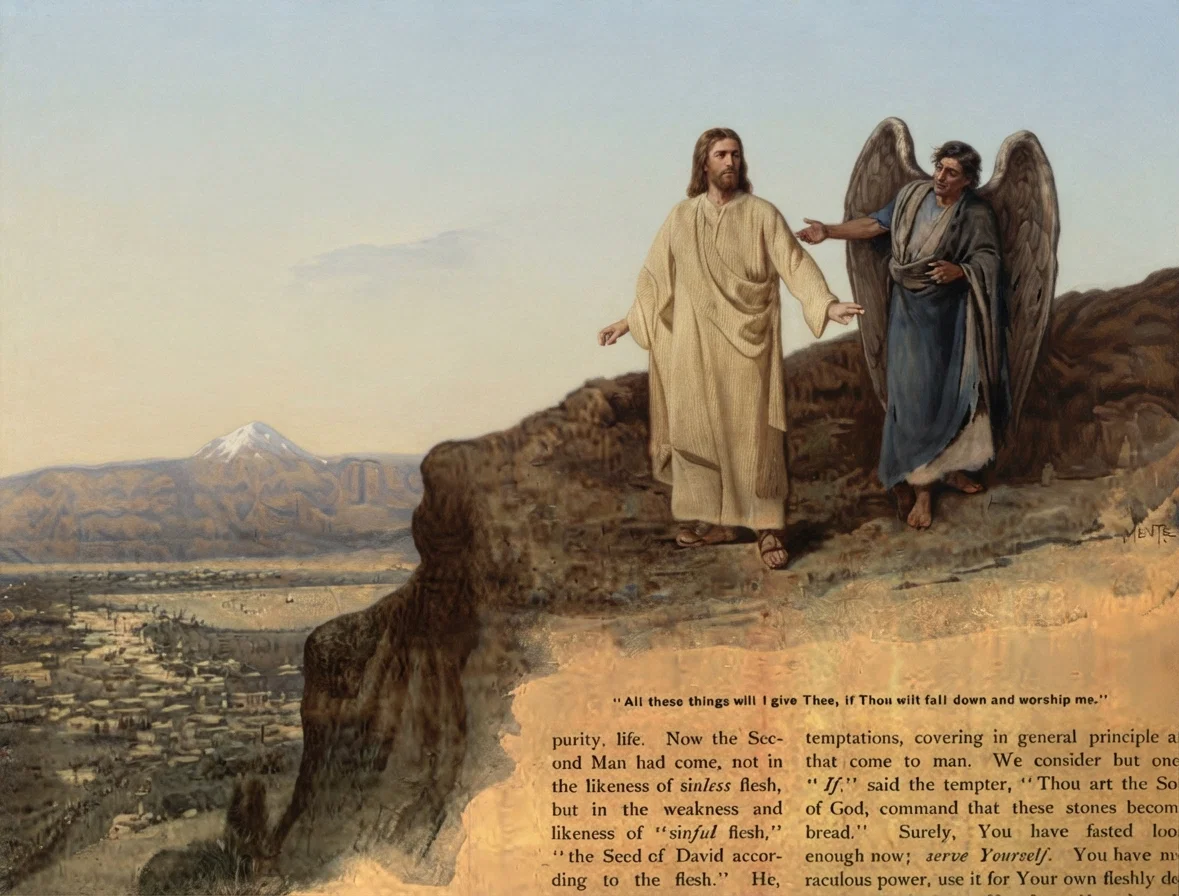
THUS Matthew speaks of the temptation of Jesus: "Then was Jesus led up of the Spirit into the wilderness to be tempted of the devil." Mark: "And straightway the Spirit driveth Him forth into the wilderness. And He was in the wilderness forty days tempted of Satan; and He was with the wild beasts." And thus Luke: "And Jesus, full of the Holy Spirit, returned from the Jordan, and was led in the Spirit in the wilderness during forty days, being tempted of the devil."
So OPENS another chapter in the life of Christ Jesus, in which it "became Him" to meet what man had met, and before which man had fallen, but which must be met successfully in order that man might have a part in the kingdom of God. Not all the temptations which Satan brought are recorded. We may well believe that every hellish art of which the adversary had been capable, which had been successful in the destruction of the souls of men in past ages, was plied as never before. For this time Satan had waited. Since the hour when God had pledged that the Seed of the woman should bruise the serpent's head, Satan had waited for that Seed. The first head of the human family had met the subtle devices of devilish art, and yielded—yielded liberty, dominion, righteousness, innocence, purity, life.
Now the Second Man had come, not in the likeness of sinless flesh, but in the weakness and likeness of "sinful flesh," "the Seed of David according to the flesh." He, too, in Satan's purpose, must fall, that all the hopes of the human might die with His fall, and the very throne of the universe might be disgraced.
“All these things will I give Thee, if Thou wilt fall down and worship me.”
AND therefore Jesus was driven to the conflict. Filled with the Spirit, with God's voice, "Thou art My beloved Son," sounding in His ears, He went forth to meet for man the inevitable conflict with the world, the flesh, the devil. What subtle, hypnotic influence the enemy used, what discouragements of a thankless, sinful race were placed before the Son of God, how the very temptations which he brought were made to seem the very cherished thoughts of the Tempted One Himself, we do not know, we can not fathom. But we do know that every means was employed which Satan could use to overthrow the Second Adam, and in Him all the human family, and that, too, when He was weakened, wasted, worn, harassed, by all the doubts and fears and weaknesses of the ancestry of "the seed of David."
THE three temptations given are typical temptations, covering in general principle all that come to man. We consider but one. "If," said the tempter, "Thou art the Son of God, command that these stones become bread." Surely, You have fasted long enough now; serve Yourself. You have miraculous power, use it for Your own fleshly desires. Feed Yourself. In self-service, in self-indulgence, lies destruction. To this our first mother yielded. For this Esau sold his blessed birthright. On this account thousands of Israel died in the wilderness when God gave them up to their own lust, but "sent leanness of soul" and all the consequences of their sin. To this lust Alexander yielded the will that had conquered the world, and died in a drunken debauch. We can not name theuntold millions who have in the past sold their birthright in God to appetite, nor the myriads, now who are selling it daily at the shrine of fleshly lusts, that the palate may be tickled, for instance, by the wine which "goeth down smoothly," but which at the last "biteth like a serpent, and stingeth like an adder." And then the myriads who are victims of appetite in some other way, who "dig their graves with their teeth," and by gluttonous and unwise eating and drinking have laid the foundation of incurable diseases and opened premature graves.
TO BREAK this power of appetite Christ came and was tempted. He did not enter upon His mission to serve self. The human soul could be saved, but the power of salvation was the Word of God. Therefore Jesus sought for that power, and however great His own flesh clamorings, He must not indulge them when greater considerations were at stake. Let the body become emaciated, the appetite clamor, He must know the greater power over life from the Word of God. And, therefore, He answered the enemy, "It is written, Man shall not live by bread alone, but by every word that proceedeth out of the mouth of God." Fifteen hundred years before, the Son of God had spoken the same words through Moses to Israel in the wilderness, to teach them that the life of God in His Word must be dominant over the perverted, fleshly life. Deut. 8:3. To teach this, God had given the daily manna. To teach it again, the Bread of Life came to the world and lived what before had been taught. The Word of God was potent to meet the enemy. "It is written" was mightier than a thousand temptations of the enemy. Jesus Christ taught it in this object-lesson as a continual, ever-present, living principle of life.
MAN in a large circle of the professed followers of Christ has thrown the sop of forty days of Lent to a remorseful conscience, and given the rest of the year to the indulgence of the flesh. Like all unbiblical things it takes the form of a fetish, the worship or adoration of which in observance is counted as so much good works to the credit of the soul, endeavoring to make it a partial offset, at least, to the year of indulgence. It started as a forty-hour fast, covering the period that Jesus was supposed to have been in the grave. Then the fasts of Moses and Elijah and Jesus were appealed to as precedents, and the forty-hour fast became a forty-day observance, beginning with Ash-Wednesday, this year February 28, excluding the Sundays, which still bear their original pagan stamp of being days of feasting, hence are called not "Sundays of Lent," but "Sundays in Lent."
BUT this device of man misses the great lesson. Jesus declared as the very foundation of discipleship, "If any man would come after Me, let him deny himself, and take up his cross daily, and follow Me." Luke 9:23. "I die daily," wrote Paul. Daily by faith the carnal man was placed upon the cross of Christ. Daily by faith the divine, eternal life of Christ came in to dominate and rule. And, therefore, the true Christian can say: "I am crucified with Christ; nevertheless I live; yet not I, but Christ liveth in me; and the life which I now live in the flesh I live by the faith of the Son of God, who loved me, and gave Himself for me." Gal. 2:20. "Therefore, brethren, we are debtors, not to the flesh, to live after the flesh. For if ye live after the flesh, ye shall die; but if ye through the Spirit [the life of God] do mortify [put to death] the deeds of the body, ye shall live." It is a daily, constant work, but the power of life in the Word of God will be found all-sufficient without any human devices. "It is written," day by day, is worth a forty years of Lent. Not by human device, but by the Word of God are we saved. "Concerning the works of men," says the psalmist, "by the word of Thy lips I have kept me from the paths of the destroyer." Ps. 17:4. "Thy Word have I hid in mine heart, that I might not sin against Thee." Ps. 119:11. If we would know Christ's triumph, we must take Christ's way.