FEDERATION OF CHURCHES

4%

Pacific Press Publishing Company · Mountain View, Cal. · Jan 24, 1906

FromSigns of the Times, Vol. 32, No. 4.

Read the full edition

FEDERATION OF CHURCHES

THE DANGER TO THE CHURCHES.

WE have considered the danger to the state, and to the people who are not of the churches, that inheres in the Federation that has been accomplished. There is also to the churches themselves a danger that is no less real and no less ruinous. And this danger to the churches only increases the danger to the state and to those who are not of the churches.
This danger to the churches is that which will arise from the flood of hypocrisy and cant that will be poured into them by means of the hosts of unconverted and wholly unworthy persons who will flock to the ranks of the churches just as soon as it becomes manifest that political preference and civic control are in the hand of the church-power as represented in this Federation.
It is impossible to deny that political preference and civic control will be in the power of this Federation. And it is equally impossible to deny that it is intended that political preference and civic control shall be in the power of this Federation. This purpose was too plainly expressed in too many of the addresses in the conference to leave any room for any denial or even any doubt.
In addition there is number IV. of the objects of the Federation, as adopted in the "Plan of Federation," which runs as follows:
IV. To secure a larger combined influence for the churches of Christ in all matters affecting the moral and social conditions of the people, so as to promote the application of the law of Christ in every relation of human life.
To any one who attended the conference throughout and listened to the discussions, there can be no room for denial or doubt that this number IV. includes political and civic relations as really as any other, and in some respects even more so. To any who listened to the addresses and studied the conference throughout, the wording of this number IV. is most telling—it means literally all that the words say.
Therefore note that it is the "combined influence" of the churches that is to be exerted in "all matters affecting the moral and social conditions of the people." And it is to be noted that the word "moral" as here used, and as almost invariably used in the conference, is moral in the current sense of the outward—the strictly civic—relations of men to each other and to the state; and not moral in its deep, true, spiritual sense of man's relation to God only. Thus it is manifestly intended that the Federation shall exert the "combined influence" of the churches literally
"in every relation of human life," civil as well as religious, political as well as spiritual.

Every Relation of Life.

The further wording of this number IV. itself excludes all possibility of denial or doubt in this matter, for it says in their own words that this "combined influence" of the churches is to be exerted in "all matters affecting the moral and social conditions of the people" "in every relation of human life," expressly "so as"—in order to, in this way, by this means—"to promote the application of the law of Christ in every relation of human life."
Parallel with this number IV., now read the following from an address of Dr. Dickey, Presbyterian, of Philadelphia:
I trust that one of the practical results of this conference will be the organization of a force that law-breakers and law-makers will respect and heed when great questions of morals are involved. . . . It is our province in the name of our supreme King, and seeking the good of mankind, to ask rulers to respect the code of our kingdom. Rulers may ignore sects, but they will respect the church. This Federation will compel an audience, and it will speak with power, if it will put aside its differences and make its agreement its argument.
Further in this connection must not be forgotten the resolution that was passed, in which the conference positively committed itself to the repudiation of the idea that "corporations have no souls," and the specific inculcation of the view that the "corporation," and so the state, "is a moral person."
It is therefore unquestionable that political preference and civic control will be, and is intended to be, under the hand of this Federation, in all matters concerning which the Federation shall choose to exert, the "combined influence" which it represents. And since this "combined influence" in "all matters affecting the moral and social conditions of the people" is to be exerted "so as to promote the application of the law of Christ in every relation of human life," it is difficult to conceive of any matter which the Federation would consider as outside its realm.

Its Effect on the Politician.

This being so, it is as certain as that two and two make four that the men who are ambitious of political favor, or civil power, will as early as possible make themselves sure of the recognition and the favor of this church influence. And since the surest possible way to obtain this is by being a church member, it lies in the nature of the case that they will become church members just as soon as their interest shall require it. Thus has it been always before, and thus will it certainly beagain; for "human nature has not changed."

A Parallel.

For this Federation is not the first movement of its kind in history. The proposition that this Federation makes in number IV. of its objects, as herein cited, to exert its "combined influence" "in all matters affecting the moral and social conditions of the people" "in every relation of human life"—this is not the first effort of the kind in the history of the world and the church. This identical course of federation was gone over to this same goal in the great apostasy of the second to the fourth centuries that developed the Papacy in all that the Papacy has ever been. And when through federation and confederation at that time the point had been reached where the "combined influence" of the churches could be exerted "in all matters affecting the moral and social conditions of the people," "in every relation of human life," then, of the situation thus created, the following is recorded:
It was far more easy to define that which did belong to the province of the church than that which did not. Religion asserts its authority, and endeavors to extend its influence over the whole sphere of moral action, which is, in fact over the whole of human life, its habit, manners, conduct. . . . And as the acknowledged teachers of Christianity, the clergy continued to draw within their sphere every part of human life in which man is actuated by moral or religious motives. The moral authority, therefore, of the religion, and consequently of the clergy, might appear legitimately to extend over every transaction of life, from the legislation of the sovereign, which ought in a Christian king to be guided by Christian motive, to the domestic duties of the peasant, which ought to be fulfilled on the principle of Christian love.—Milman.

The Effects of That Federation.

The consequence that resulted from that situation then was that every limit was overstepped and every barrier was broken down that separated the civil and ecclesiastical powers. The state as a body distinct from the church vanished. As a distinct system of law and government the state was destroyed; and its machinery existed only as the means by which the church would accomplish her arbitrary will and enforce her despotic and meddling decrees "in every relation of human life." Such was the only consequence that resulted from the situation then, and the like of it is the only consequence that can result from the like situation that is now being created here.
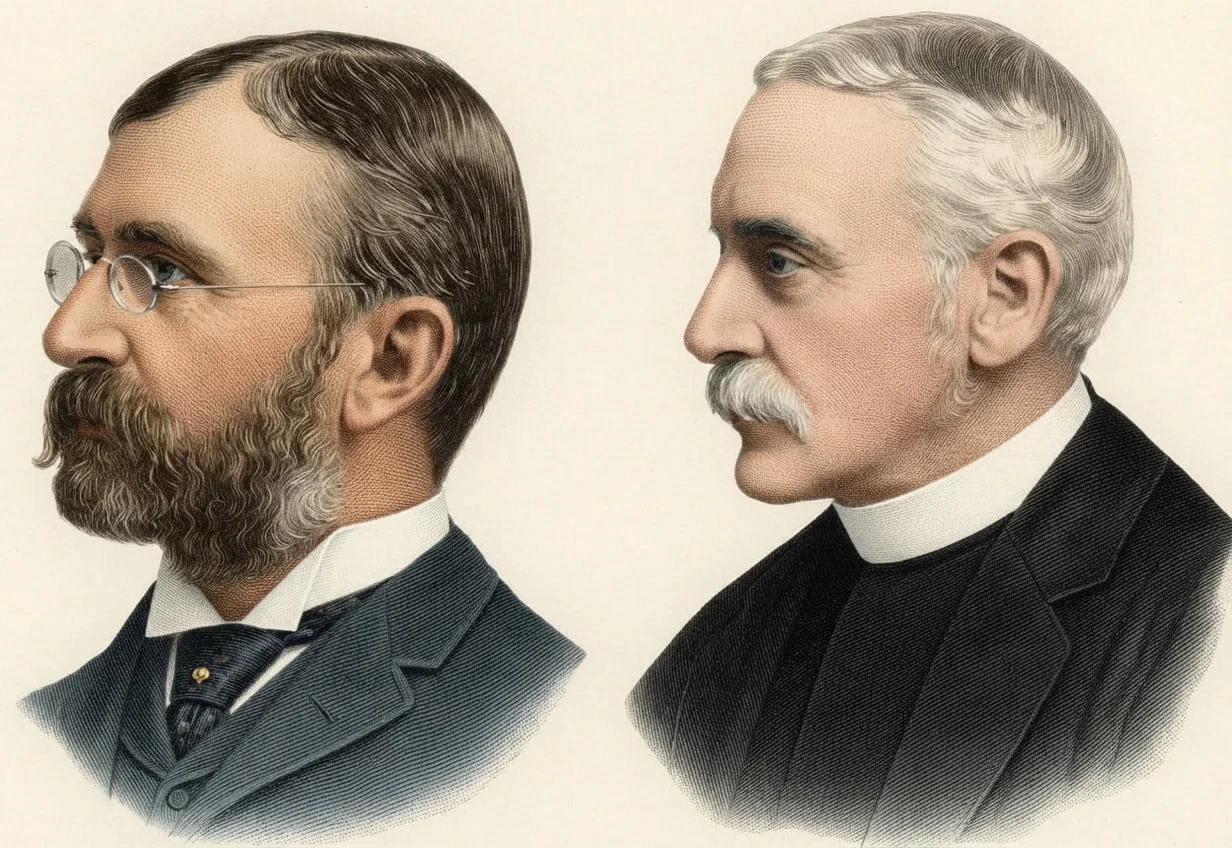
Hon. Charles A. Schieren. Rev. Henry A. Stimson, D.D.
But that which then most hastened the evil consequence to the state was the immediate effect upon the church, of her having attained the position of power and influence in state affairs that federation gave to her. For since at that time and in that federated situation, political preference and civic control were in the hand of the church-power; since the church was the recipient of imperial recognition and state favors; the result was that multitudes, with no change of either character or conviction, entered into church relations. And "the vast numbers who, from external considerations, without any inward call, joined themselves to the Christian communities, served to introduce into the church all the corruptions of the heathen world. Pagan vices, pagan delusions, pagan superstition, took the garb and name of Christianity, and were thus enabled to exert a more corrupting influence on the Christian life. Such were those who, without any real interest
whatever in the concerns of religion, living half in Paganism and half in an outward show of Christianity, composed the crowds that thronged the churches on the festivals of the Christians, and the theaters on the festivals of the pagans. Such were those who accounted themselves Christians, if they but attended church once or twice in a year, while, without a thought of any higher life, they abandoned themselves to every species of worldly pursuit and pleasure."—Neander.
And that thing will now be repeated here; for the identical course that was then taken by the "combined influence" of the church, is now being followed here. That thing at that time caused the church to become "Babylon the Great, the mother" of many and varied elements of confusion. And this thing now will cause this combined body in this Federation to become, first, Babylon the daughters, "a hold of every foul spirit, and a cage of every unclean and hateful bird," and finally one of the three principal elements of confusion in the great threefold combination of all apostasy, of which, as the ultimate "Babylon," is written: "A mighty angel took up a stone like a great millstone, and cast it into the sea, saying, Thus with violence shall that great city Babylon be thrown down, and shall be found no more at all."
The state can never afford what this Federation means; for it means the complete subversion of the state. The people can never afford it; for it means the despotism of a meddling, persecuting hierarchy. And most of all, the churches themselves can not afford it; for it means, first, that they will be made the "cage of every unclean and hateful bird," and lastly, that they will be sunk in everlasting ruin.