EVOLUTION AND GEOLOGY

3%

Pacific Press Publishing Company · Mountain View, California · Mar 15, 1905

FromSigns of the Times, Vol. 31, No. 11.

Read the full edition

EVOLUTION AND GEOLOGY

By Geo. McCready Price

XV. THE SUCCESSIVE AGES. (Concluded.)

BUT let us proceed. There is another way of testing the rationality of this life-succession idea. If certain fossils are not necessarily "older" than certain others, one might reasonably expect that we would now and then find them reversed as to position, i. e. with the "younger" below and the "older" above. Accordingly we have the following very necessary caution from Prof. H. Alleyne Nicholson:
It may even be said that in any case where there should appear to be a clear and decisive discordance between the physical and the "paleontological [fossil] evidence as to the age of a given series of beds, it is the former that is to be distrusted rather than the latter."—"Ancient Life History of the Earth," page 40.

"Pioneer Colonies," "Faults," etc.

To meet all ordinary cases of this character, where the differences involve only a few formations representing only a few "ages" or a few million years, the period of pioneer "colonies" was invented by Barrande in 1852. But for extreme cases, say where Silurian or Cambrian fossils occur above Jurassic or Cretaceous, there is in such a predicament always an anxious search made for faults and displacements; or gigantic "thrust faults" are described, many miles in horizontal displacement, and it may be one or two miles in vertical displacement—inventions which, as I have already suggested, deserve
to rank with the famous "epicycles" of Ptolemy, and will do so some day.
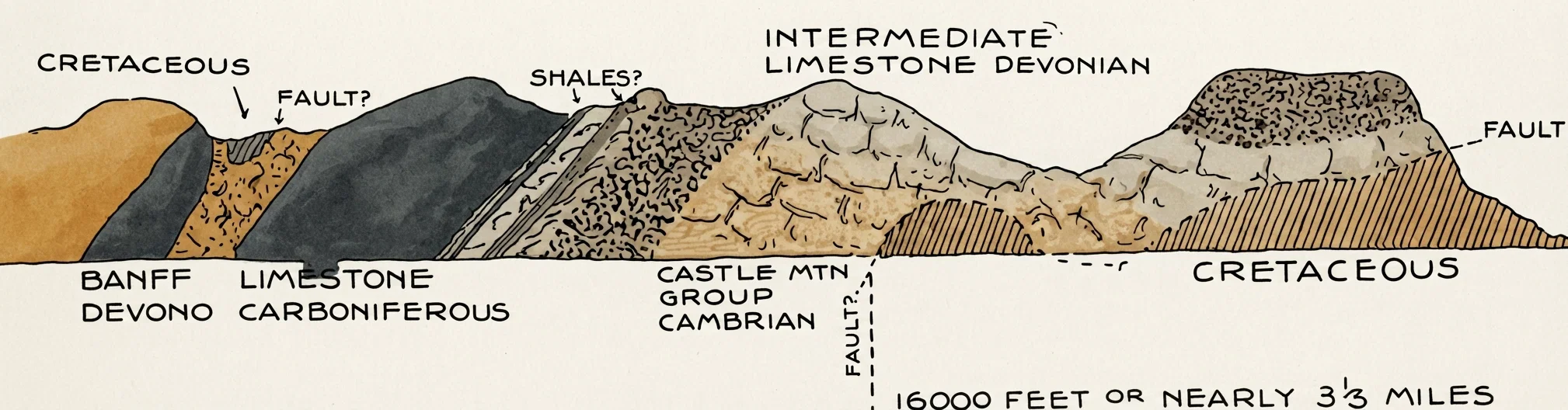
One or two examples are as good as a dozen. In the part of Alberta east of the Rockies already referred to, is a large portion of country of about fourteen square miles at least—and we know not how much more—where Cambrian fossils are found above Cretaceous, and the inevitable "thrust fault" is thus described by R. G. McConnell—one of the officers of the Canadian Geological Survey. He has just been speaking of "a series" of these "gigantic thrust faults"—
One of the largest and most important of these occurs along the eastern base of the chain, and brings the Cambrian limestones of the Castle Mountain group over the Cretaceous of the foot-hills. This fault has a vertical displacement of more than 15,000 feet [three miles?], and an estimated horizontal displacement of the Cambrian beds of about seven miles in an easterly section. The actually observed overlap as shown on section D-C (fig. 1.) amounts to nearly two miles. The angle of inclination of its plane to the horizon is very low, and in consequence of this its outcrop follows a very sinuous line along the base of the mountains, and acts exactly like the line of contact of two nearly horizontal formations.
The best places for examining this fault are at the gaps of Bow [river] and of the south fork of the
Ghost River. At the former place the cretaceous shales form the floor of the bay which the Bow has cut in the eastern wall of the range, and rise to a considerable height in the surrounding slopes. Their line of contact with the massive gray limestones of the overlying Castle Mountain group is well seen near the entrance of the gap in the hills to the north. The fault plane here is nearly horizontal, and the two formations, viewed from the valley, appear to succeed one another conformably. The line of junction can be traced westward for about half a mile, but toward the upper part of the gap becomes concealed, and soon afterward the Cretaceous rocks bend down and are carried below the surface by a westerly dip. This undulation in the fault plane must indicate a period of disturbance subsequent to that in which the main faulting was produced.
The Cretaceous shales are bent sharply toward the east in a number of places, but with this exception have suffered little by the sliding of the limestone over them, and their comparatively undisturbed condition seems hardly compatible with the extreme faulting which was necessary to bring them into their present inferior position. They are, however, very soft, and doubtless owe their immunity to this fact. It is otherwise with the overlying limestones, which have been strongly corrugated in many places, and are often whitened and cracked in the vicinity of the fault plane, the cracks having been subsequently filled with calc-spar. Enclosed argillaceous beds have also been turned into schists, and the banded appearance of much of the limestone is, no doubt, due to the shearing caused by the thrust.
The Banff Limestone, Devono-carboniferous, ought to be above the Intermediate Limestone, and both of them above the Castle Mountain and Bow River groups; that is, the whole arrangement is upside down, according to the theory.
At the gap of the south fork of the Ghost River, where the fault was next examined, the Cretaceous shales, after dipping below the surface, rise again about a mile further up the valley, and remain exposed for some distance before they finally disappear. The Castle Mountain group here is reduced to a mere tongue, only a few hundred feet thick, separating the Intermediate Limestone from the Cretaceous, but as it thickens out greatly when traced westwards, its faulted character is very evident. The section at this point has a further interest in the fact that a number of Benton fossils [characteristic of middle Cretaceous] were found in the shales directly under the limestone, while a couple of miles north, along the strike of the beds, the overlying limestone yielded Cambrian fossils. [Italics supplied.]—"Annual Report," New Series, Vol. II., Part D. pp. 33, 34.
I have quoted this description at length that no one may charge me with perverting the facts. The accompanying illustrations are taken from the beautifully drawn and colored sections which accompany the report. But it will, I think, be perfectly clear to most of my readers that there is nothing here at all to indicate a real "fault" save that some poor "Benton fossils" (cretaceous) happened to be deposited here over several miles of country
before others classed as "Cambrian;" but as almost the entire geological series and untold millions of years lie in between the Cambrian and the middle Cretaceous, such a state precluded the idea of pioneer "colonies" of the latter in the former, or any similar explanation, and the invention of this incredible "thrust fault" was the only remaining alternative, for their venerable theory could not possibly be wrong.

Similar Structures.

This author quotes Professor Salford's "Geology of Tennessee" (page 190), to show that in the eastern part of that state the Appalachian Chain "presents an almost identical structure;" and he also refers to a similar state of things in the Highlands of Scotland. Dana, in the last edition of his "Manual," (page 359), refers to this report of Mr. McConnell and reproduces his figures; and, on another page, in speaking of this similar example in the Scottish Highlands, says that "a mass of the oldest crystalline rocks, many miles in length from north to south, was thrust at least ten miles westward over younger rocks, part of the latter fossiliferous;" and further declares that "the thrust planes look like planes of bedding, and were long so considered."—"Manual," pp. 111, 534.
Mountains along South Fork of Ghost River.
In addition I find something from the Alps on the same subject. Some three years ago, Dr. M. Ogilvie-Gordon, herself a noted geologist, gave in Nature a review of the two books then recently issued by Prof. A. Rothpletz on the problems presented in these mountains, and she quotes him as describing several gigantic "over-thrusts" from the district about Glarus. Of one of these she says he "concludes from his observations that the whole of this 'Glarus thrust-mass' had traveled from east to west, a distance of about twenty-five miles from the Rhine Valley to the Linth."—Nature, Jan. 24, 1901, p. 294.
Of another example she says: "Professor Rothpletz proves that the rocks of the Rhätikon Chain rest on a basal mass which is the natural continuation of the Glarus thrust-mass eastward, and he concludes that the Rhätikon Mountain mass traveled from Montafon Valley to the Rhine Valley, about nineteen miles from east to west."—Id.
Now while this outline in Nature does not give us positive proof that these truly awful "thrust-masses" are necessitated by and described from fossil evidence only, yet I feel sure that such is the case; for we can imagine no physical evidence competent to form a foundation for such ideas, nor do I know of anything save their precious scheme of life-succession for which geologists will thus freely sacrifice their common sense. Of course there are such things as faults, perhaps even "thrust-faults" in a small way; but I decline to believe such incredible fairy tales as these are shown to be without more substantialevidence than the exigencies of an out-of-date theory.

Story of the Rivers.

The last point which I need to make in this connection to illustrate the antagonism between the facts of the rocks and this theory of life-succession, is that rivers, in cutting across the country, act in precisely such a manner as if they knew nothing of the varying ages of the rocks, but on the contrary treat them all alike as if they were of the same age, and as if they began sawing at them all at the same time. Of course it is, evidently, in only a few cases where we can get at such facts, that is, in the case of rivers with steep rocky gorges, or those that cut through mountain ranges; but there are several such rivers in the world, and they all seem to tell the same story.
The famous Colorado River is a good example. It flows from "younger" strata into "older" in its deep cutting across the Arizona plateau. Its companion, the Green River, saws through the Uinta Range in the same manner. Similar conditions are said to occur on the Danube, and in the river-courses of the Himalayas and elsewhere. I regret that I have not the details at hand, and Zittel's "History of Geology" (pp. 210, 211), from which I get these outline facts, is very tantalizing in its completeness. The general fact however, is evident enough, viz., that they pass "from younger strata into older," and thus treat all as if they were of the same age, and as if their work of erosion was begun on all at the same time. In the case of the Colorado, Zittel says that—
Powell's explanation of the apparent enigma is that after the river had eroded its channel rocks were uplifted at one portion of its course, but so slow was the rate of uplift that the river was enabled to deepen its channel, either proportionately or more rapidly, so that it was never diverted from its former course.—"Hist. of Geol.," etc., pp. 210, 211.
I think I have now produced evidence to absolutely demonstrate several very remarkable principles about the rocks, and I think that this is the first time that these facts have ever been brought together in this way. I repeat the two given in last week's article:
  1. The "broad fact" as stated by Zittel that any kind of rocks, whatever, i. e., containing any kinds of fossils, may rest on the Archaean, and may themselves be metamorphosed and crystalline.
  2. That any kind of beds may rest in such perfect conformability on any other so-called "older" beds over vast stretches of country that, "were it not for fossil evidence, one would naturally suppose that a single formation was being dealt with," while "the vast interval of time intervening is unrepresented either by deposition or erosion."
  3. That in very many cases, and over many square miles of country these conditions are exactly reversed, and such very "ancient" rocks as Cambrian limestones are on top of the comparatively "young" Cretaceous, while the line between them "acts exactly like the line of contact of two nearly horizontal formations," and in a natural section made by a river the two "appear to succeed one another conformably."
  4. That the rivers of the world, in cutting across the country, completely ignore the varying ages of the rocks in the different parts of their channels, and act precisely as if they began sawing at them all at the same time.
Now I know not what single additional fact can be demanded or imagined to complete the demonstration that this succession-of-life idea is a most monstrous, unscientific assumption, invented a hundred years or so ago in a little corner of Europe to explain some local phenomena, and in ignorance, or at least insular disregard of the strata of the rest of the world, and now followed out to the bitter end in spite of its being at war with a thousand facts.