Halley's Comet

9%

Pacific Press Publishing Association · Mountain View, California · Apr 19, 1910

FromSigns of the Times, Vol. 37, No. 15.

Read the full edition

Halley's Comet

INTEREST in Halley's comet still continues, and it may be of help to our readers to state a few facts concerning it. There has been a great deal said of an alarming nature which has no particular basis in science. Some have thought that the cyanogen gas connected with the comet's tail would mingle with the gases of this earth and so poison the people. This has been suggested by some scientists. It has been stated as a fact by sensational newspaper writers. Another astronomer suggests that it may not be any connection which the comet may have with the earth that will cause us trouble, but that the comet may act as a projectile fired into the sun or near the sun, and so cause tremendous explosions in the sun itself, and the earth be affected thereby; and suggests that the peculiar meteorical or weather conditions through which we have been passing the last few months may have been caused by this; that there are many other forms of energy sent out by the sun besides light and heat, such as magnetism, electricity, etc., that may be affected by the comet. This of course is also pure speculation.
Prof. W. W. Campbell, the director of Lick Observatory, writes much more calmly and judicially. He declares, in a recent article, that "the tail of the comet, 14,000,000 miles from the nucleus, or head, is so extremely attenuated that there is not the slightest chance of deleterious effects upon terrestrial life. This aspect of the question may be dismissed without further thought. Statements to the contrary must be attributed to the ignorance of their authors or to purposes difficult to fathom."
Professor Mitchell declares that if a cubic mile of the comet's tail were compressed into a beaker, it would be difficult for scientists to find a trace of cyanogen gas.
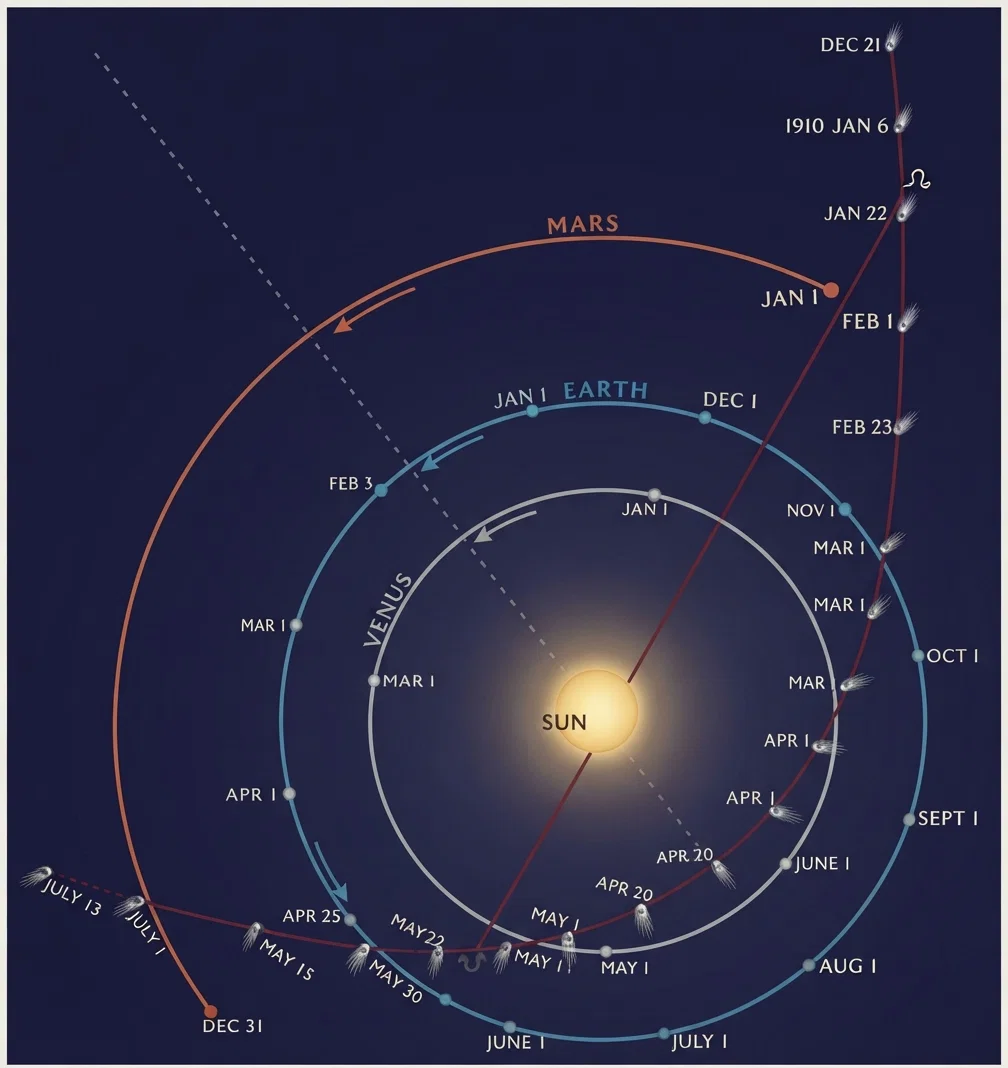
When the comet was first discovered, in September, it was 300,000,000 miles from the sun. It is very much nearer now. March 31 it was 158,000,000 miles away from the earth; April 16 it will be 124,000,000 miles; April 24, 69,000,000; May 10, 41,000,000; May 20, 14,500,000, its nearest approach; May 30, 41,000,000. When first discovered, it was not even visible to the most powerful telescopes, but the camera caught it. It has been almost visible to the naked eye.
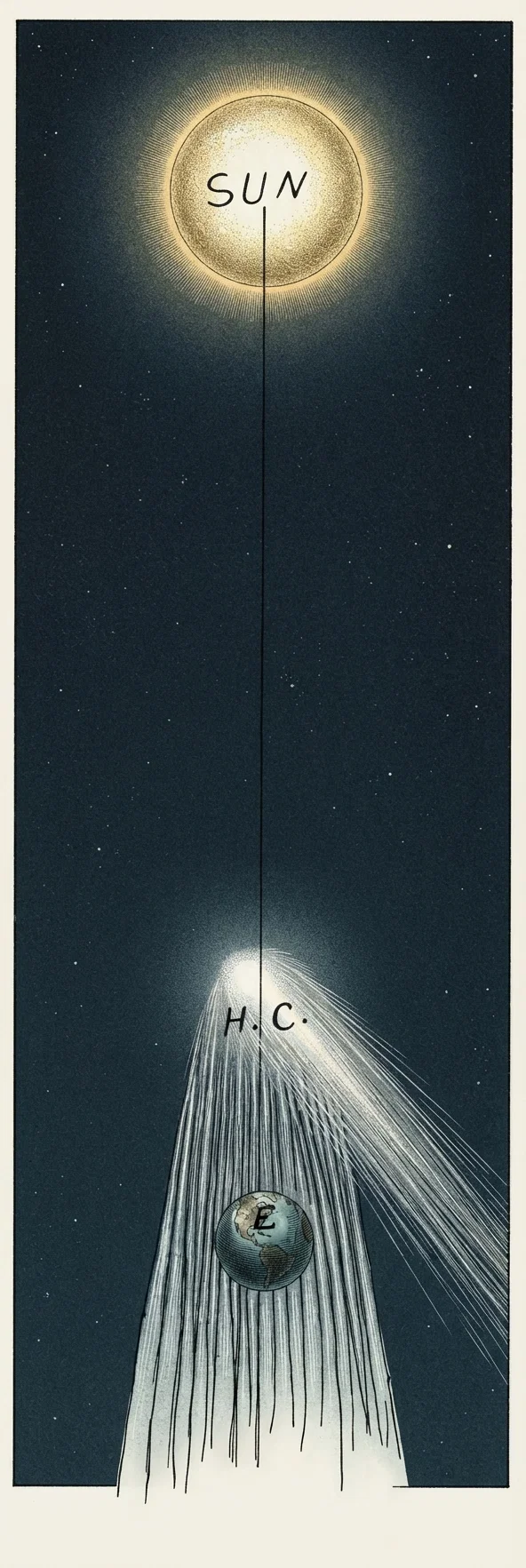
The comet is at this writing, April 3, so close to the sun that it is not visible. It will come directly between the earth and the sun at 6:22 P. M., Pacific standard time, on the evening of May 18, and will pass out of this space at 7:00 o'clock and 22 minutes, or one hour later. But this probably will not be seen here, as the sun is too low on the horizon at the time. Stations far west of California will be in a much better position to observe the passing of the comet across the sun's disk. On April 8 the comet will arise an hour and four minutes before sunrise. Professor Campbell says that while it is never safe to predict how bright a comet is going to be, it is expected that the head and perhaps a little of the tail will be visible to the naked eye about that date. It will be six or eight degrees north of directly east. On April 18 it will be 54,000,000 miles from the sun — the nearest point to that body. Still it will be farther from the earth than the sun is; but on May 18, when it passes directly between the earth and the sun, it will be 76,000,000 miles from the sun and about 14,000,000 from the earth. "Late in April and early in May the comet should be fairly seen in the low eastern sky at the break of dawn." After May 18 the comet will again be an evening object, and because of its nearness to earth, Professor Campbell declares, should be conspicuous; but he continues, "The brightness of a comet can not be safely predicted." They vary greatly in brightness. Sometimes a periodic comet is very bright at one return, and very disappointing at the next. The tail has been predicted by some to be many million miles in length, extending, at the time when it is nearest to the earth, some 60,000,000 miles beyond the earth, the earth passing through it 14,000,000 miles from the comet; but he declares that it is not certain that the tail will be as long as the distance from the comet to the earth. Here are some of the times that it may be seen:
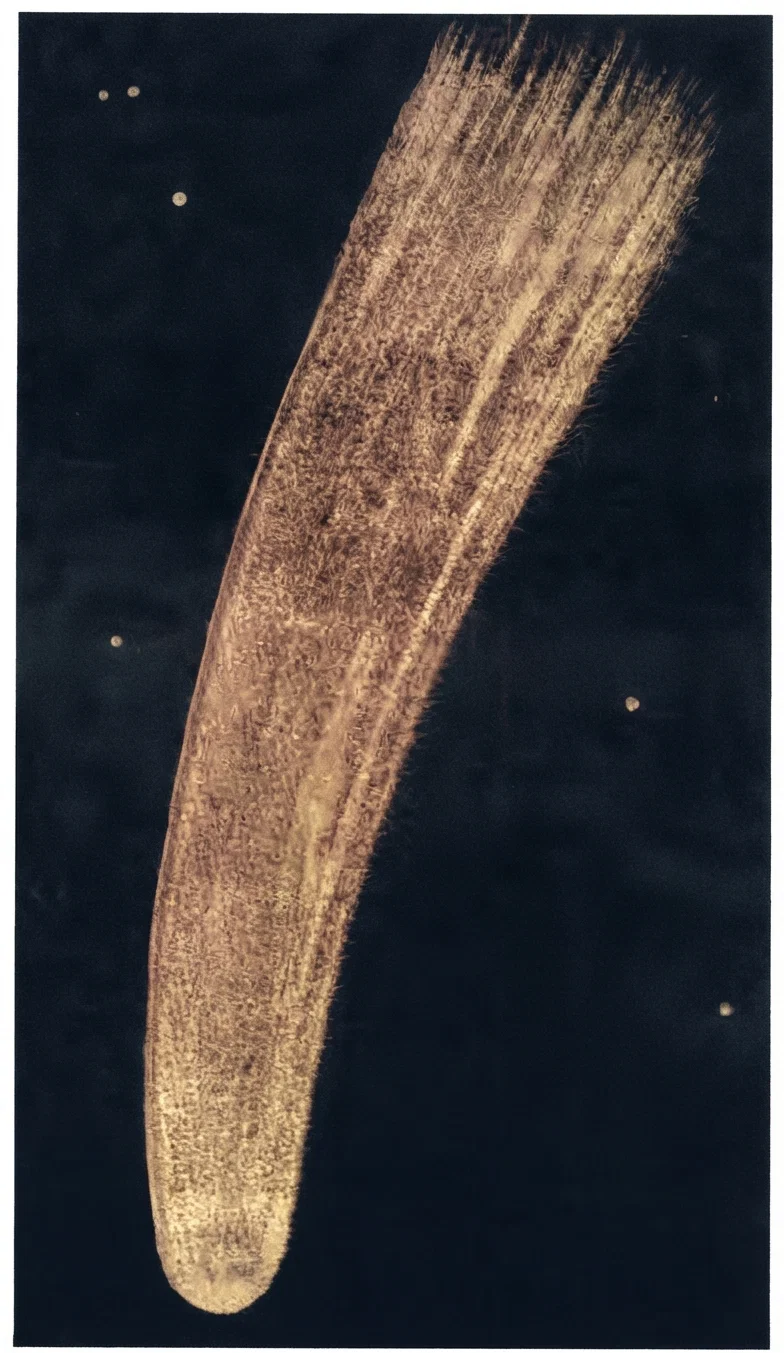
A sketch of Halley's Comet as it appeared in 1835, made by the Danish astronomer F. G. W. Struve. Doubtless somewhat exaggerated.
April 8, it rises one hour and four minutes before sunrise; April 24, one hour and fifty-nine minutes before sunrise; May 10, two hours and twenty-three minutes before sunrise. May 20 it sets one hour and 17 minutes after sunset, gradually increasing up to May 30, setting four hours and sixteen minutes after sunset.
The path of Halley's Comet in its present visit through the solar system, from "Review of Reviews."
It will be a great question, however, whether people are not much disappointed in its brightness as compared with the comet of 1861 or 1882.