JOB

9%

Pacific Press Publishing Company · Mountain View, California · Sep 21, 1904

FromSigns of the Times, Vol. 30, No. 37.

Read the full edition

SEARCH THE SCRIPTURE

JOB.

THIS, the first of the so-called poetical books of the Bible, has a special and peculiar interest for the student of Holy Writ. It seems to have been written in the patriarchal age, probably by Moses. That Job was a real person, and that the history we have concerning him is not, as some consider it to be, a fiction, but a truthful account, we have proof in both the Old and New Testaments. In Eze. 14:14, 20, he is mentioned as being as veritably an actual person as were Noah and Daniel. “Tho these three men, Noah, Daniel, and Job, were in it, they should deliver but their own souls by their righteousness, saith the Lord.” So, as surely as there was a Noah who built an ark, and a Daniel who was in the lion’s den, just so surely there was a man in the land of Uz whose name was Job.
The testimony of James is no less positive. “Ye have heard of the patience of Job, and have seen the end of the Lord; that the Lord is very pitiful, and of tender mercy.” James 5:11. We see by this that not only did such a man as Job live, but also that the history concerning him is correct. We see also the purpose of the book. It is to show the mercy of God, and the patience of His servant Job, a noted example indeed.
In the study of this book we have one of the best of opportunities for putting in practise the directions, found in 2 Tim. 2:15, “rightly dividing the Word of truth.” Serious errors are sometimes adopted, because persons fail to observe this rule. We want to divide the Word along the line of authorship. There are over a half dozen different speakers whose words are recorded in this book. These speakers are the Lord Himself, Job, Eliphaz, Zophar, Bildad, Elihu, Job’s wife, and Satan. Consequently the statements found in the book will be of different degrees of reliability. If we should indiscriminately take passages from this book, without regard to the author or speaker, we might make some serious blunders. This book is not one homogenous mass of utterances, but a compilation of statements from different sources. But the Lord has not left us in ignorance in the matter, so that we need make any mistake. In his reproof administered to Eliphaz and his two friends, the Lord said: “Ye have not spoken of Me the thing that is right, as My servant Job hath. . . . My servant Job shall pray for you; for him will I accept; lest I deal with you after your folly, in that ye have not spoken of Me the thing which is right, like My servant Job.” Ch. 42:7, 8.
The Septuagint reads in verse 8, “Ye have not spoken the truth against My servant Job.” So those men failed to tell the truth about God, and also about Job. Shall we then take their words as reliable, when God has told us they are not reliable, not the truth? If they did not come any nearer telling the truth about God than they did about Job, they must have missed the mark very far. Notice what they say about this perfect man in ch. 22:5-9: “Is not thy wickedness great? and thine iniquities infinite? For thou hast taken a pledge from thy brother for nought, and stripped the naked of their clothing. Thou hast not given water to the weary to drink, and thou hast withholden bread from the hungry. . . . Thou hast sent widows away empty, and the arms of the fatherless have been broken.” As a rejoinder to this calumny, the accused patriarch feels compelled to vindicate his character in the following words, which set forth the real truth in the matter: “I delivered the poor that cried, and the fatherless, and him that had none to help him. The blessing of him that was ready to perish came upon me; and I caused the widow’s heart to sing for joy. . . . I was eyes to the blind, and feet was I to the lame. I was a father to the poor; and the cause which I knew not I searched out.” Ch. 29:12-16.
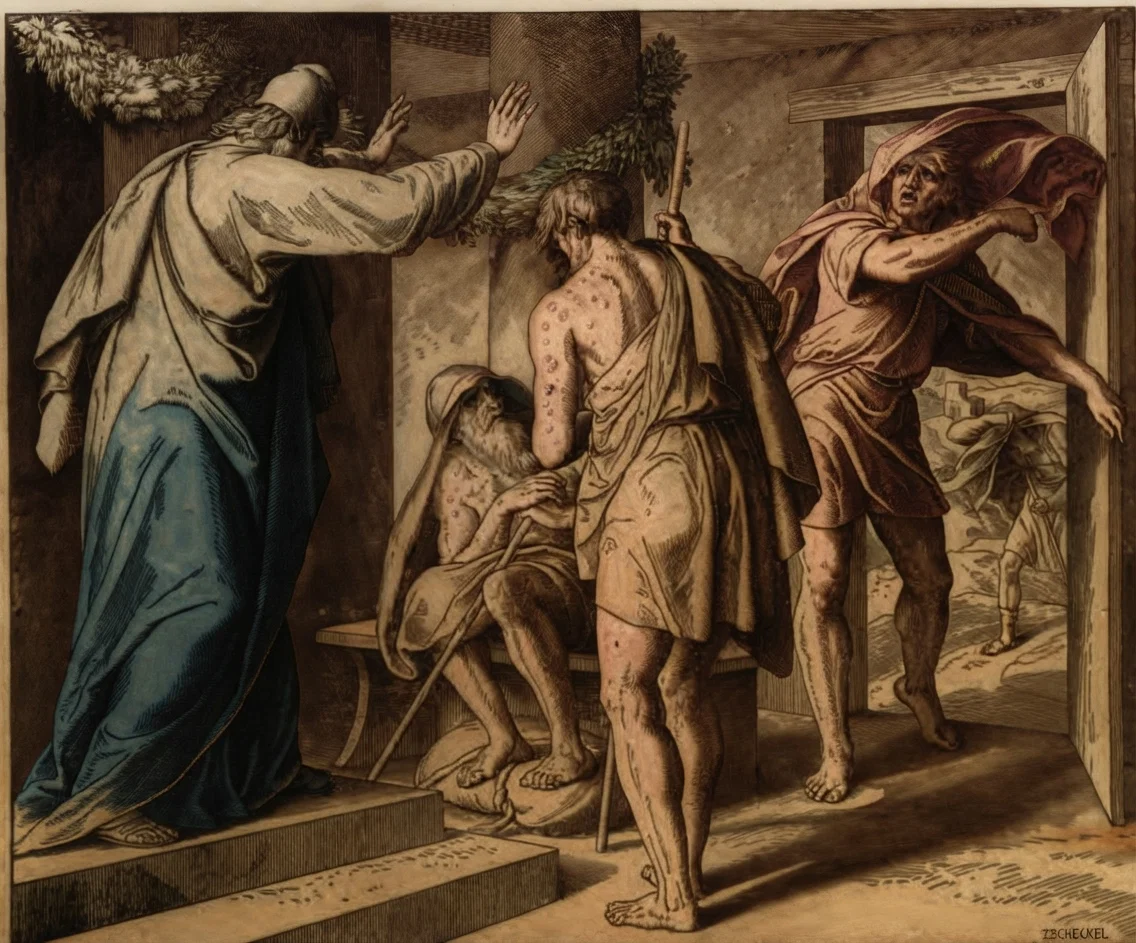
Job and His Three Comforters.
Thus does this upright man vindicate himself against the base misrepresentations of his so-called friends. For one to take the statements of Eliphaz concerning Job and treat them as being correct and reliable, would not be rightly dividing the Word. Neither would it be any more correct for one to take the statements he made concerning God as being correct, unless we find them sustained by inspired declarations given through God’s servants. For instance, one takes the words following close after Eliphaz’s libel on Job, in which he sets forth the results of a change in Job’s conduct, and these words are considered as being a correct representation of the case in hand: “Then shalt thou lay up gold as dust, and the gold of Ophir as the stones of the brooks. Yea, the Almighty shall be thy defense, and thou shalt have plenty of silver.” Who is the author of this pharisaical doctrine that the result of God’s favor is increase in worldly goods, and plenty of gold and silver? It seems that Peter and John had not found it out when Peter said, “Silver and gold have I none.” The long list of the faithful brought to view in Hebrews 11, seem to have been strangers to this experience; for many of them “wandered about in sheepskins and goatskins; being destitute, afflicted, tormented.” The chapters in which are found the declamations of these misguided men are 4, 5, 8, 11, 15, 18, 20, 22, and 25. As the Lord has told us that they had not spoken the truth about Him or about Job, we will need to take heed to rightly divide the book in this respect. They, of course, said some very good things, but these are to be compared with other portions of the Bible to see if they are sustained.
As Elihu seems to have taken very much the same line of argument as the other three speakers, we are to consider carefully the statements he has made also to ascertain if they are correct. It was by inspiration that their words were put on record, tho, like Satan’s first lie in Eden, “Thou shalt not surely die” the words of these so-called wise men are not to be considered as verity and truth when they contradict the teachings of the Scriptures.
The subject of the resurrection is beautifully treated by Job in this book. “I know that my Redeemer liveth,” is the key-note of the book. “He shall stand at the latter day [now soon to come] upon the earth.” How many of us will be prepared to unite with Job when he is called forth from his dusty bed?
The use of the term tartaro, a form of which is rendered “hell” in 2 Peter 2:4, may be seen by a reference to Job 40:20, where the same word occurs in the Septuagint, and is rendered “field” in our version. It means a level or low place, and is located here on earth.