LETTER FROM TRINIDAD

9%

Pacific Press Publishing Company · Mountain View, California · Sep 21, 1904

FromSigns of the Times, Vol. 30, No. 37.

Read the full edition

LETTER FROM TRINIDAD.

I HAVE just returned from a three-weeks' trip to British Guiana, via Barbados, St. Vincent, Granada, and Tobago. I had the happy privilege of spending two more Sabbaths with the friends in Barbados, where we labored for two and a half years before coming to Trinidad. The boats of the Royal Mail Company stop at Bridgetown from Sabbath morning till Monday evening, which gave me the opportunity to spend the Sabbath there, both going and coming. Our recent conference in Barbados, of which I wrote in my last letter, greatly strengthened our work there. Our church at Bridgetown holds only about four hundred, when church and school room is full, and is not large enough to accommodate the increased interest; so the opera house, in which our conference evening services were held (seating eight hundred), has been secured for Sunday afternoon and evening services. Fruit of the seed sown there is continually being gathered, and a more abundant harvest is developing.
I accompanied Elder Haysmer to British Guiana to attend a council meeting with the workers there, as they were hindered from attending the conference by quarantine restrictions, as a few cases of smallpox still exist there. The Guianas are a large, populous, important, and promising part of our conference territory. Probably our next conference will be held there, as an experience similar to our recent session in Barbados would greatly help and strengthen the cause there.
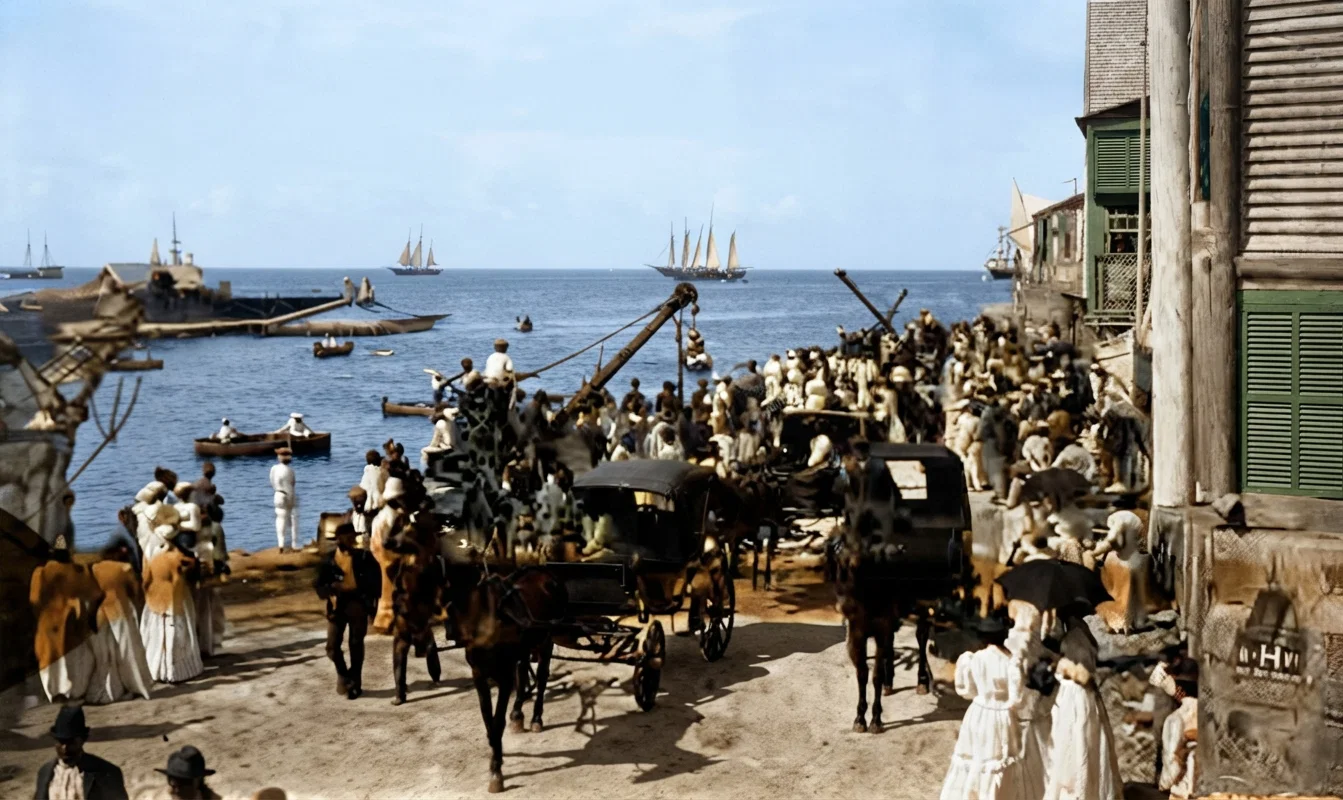
Wharf Scene in Bridgetown, Barbados.
Our work here in Arima has been broken into a number of times by these trips to other parts of the field, but the Lord has blessed our efforts with an encouraging measure of success. About fifteen are now walking in the light, and many more are interested, or convinced, a number of whom we expect will soon decide to obey. We are now wrestling with the problem of building a place of worship, which, for numerous reasons, is an absolute necessity to the stability of the work in this field. Our buildings here consist of a framework of poles, filled in with a mixture of mud and grass, which, when plastered and whitewashed on both sides, makes a beautiful and substantial wall. We can procure and furnish the poles, the mud, and the grass, and the muscle to put it together, but it takes money to buy the lumber for the rafters, windows, doors, trimmings, and seats; iron for the roof; lime and cement for the floor and walls; paint, hardware, etc.
Building material costs three or four times as much here as in the States, besides our people are poor, and money is scarce. All our church buildings in this field are almost wholly the product of the means and muscle of the missionaries. Our time, means, and energy are wholly given to this work, but it often falls far short of meeting the needs. We feel moved to pledge $100 to this building, believing that by careful economy we can save that amount by the time the material must be paid for. We hope to raise $100 more locally, as our people will gladly give all they can, and interested friends not in the message will help some. But it will take at least $300 in cash to build this church, so we are praying God to send us some help from abroad.
We do not forget Europe, Asia, Africa, South America, and the other great, needy fields; nor the work in Washington, which the Lord says should be our first interest. On the contrary, we try to help a little in each of these enterprises, despite the needs of our own field, for when we invest in an enterprise we shall share in its results. We would not divert one dollar from any of these great enterprises, but we shall be very thankful if some, after giving liberally to the general cause, and to specific enterprises, can still scatter a few crumbs this way.
After all, this is a large and important field. Our conference includes British, French, and Dutch Guiana and Venezuela on the mainland, and all the Windward and Leeward Islands, to and including St. Thomas. The population is made up of English, French, Dutch, German, Spanish, Danish, East Indian, and aboriginal natives. We have four unfinished church buildings in Trinidad, that should and must be completed soon, in order that the cause be not reproached. Then we are straining every nerve to procure our printing plant for the publication of the Caribbean Watchman, and tracts and leaflets for the various nationalities within our borders.
Aside from Brother Wellman, who is tied up in the office, we have no experienced help in the work of warning the large island of Trinidad, to say nothing of completing these buildings, and caring for the eight churches and companies. However, we are of good courage, and hope by God's help to have the work here done by the time it is finished elsewhere.
The Signs has been to us such "a present help in time of trouble," that we naturally turn to it when in need. A simple statement in its columns of a just and needy cause always brings the right results. We note with deepest interest your removal from Oakland. Would that every institution and individual in our ranks might ever thus heed the directions of the Wonderful Counselor. May the Lord abundantly bless the Signs with the success and prosperity it so richly deserves.
Yours in fellowship of service, W. A. SWEANY. 9 St. Joseph Street, Arima, Trinidad.