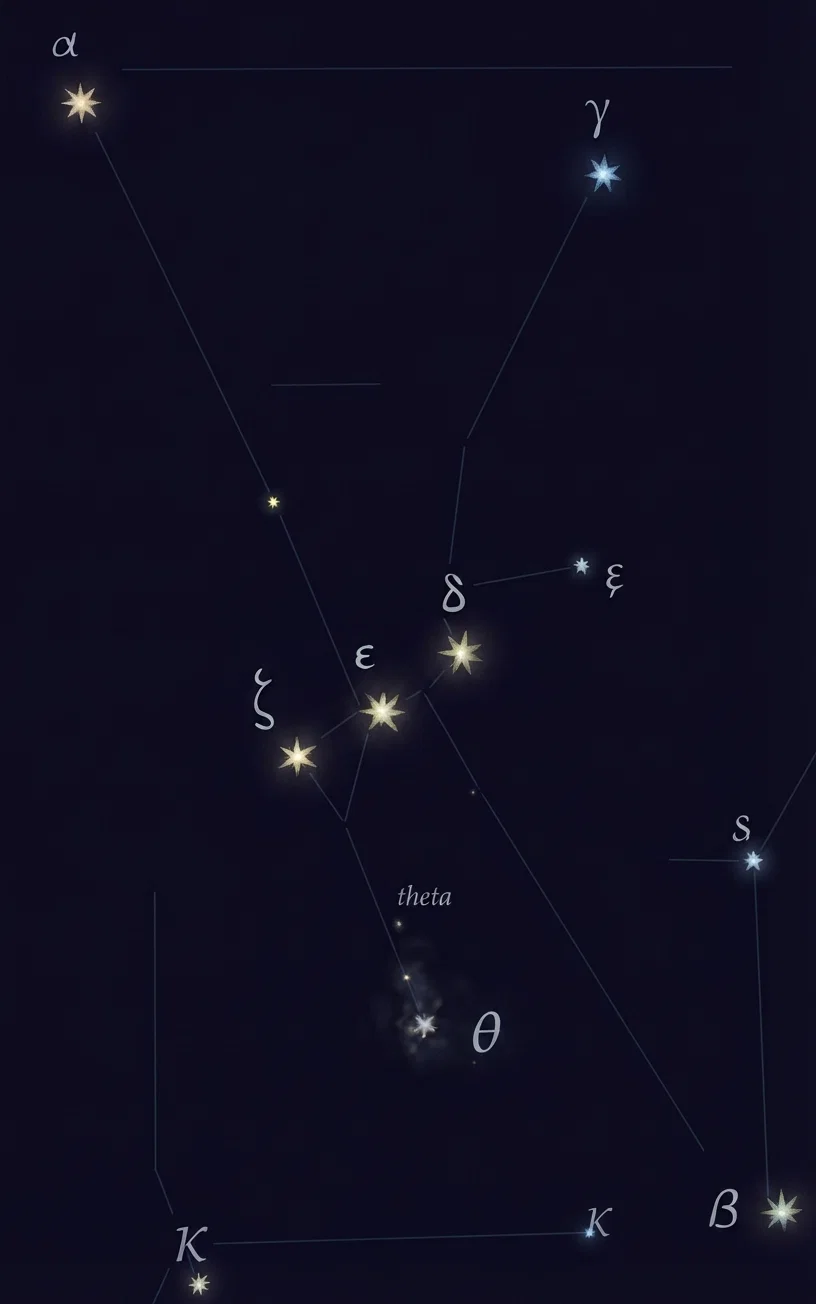
A FEW evenings since, I was watching with a friend the matchless spectacle of Orion advancing to the meridian, when my companion suddenly turned to me and remarked:
"Is there not some vast mystery concealed in that part of the heavens? To me, at least, it seems so, for I can never shake off the impression that the creative power which made the universe lavished its richest gifts upon the locality in and surrounding Orion."
The same thought has doubtless occurred to hundreds of others while gazing upon that star-bedight region. The heavens are not everywhere alike, any more than is the face of the earth. One of the greatest charms that draws the star-gazer to his nightly entertainment is the astonishing diversity of the views in various directions.
On earth we do not find diamonds or rubies in all countries. They are confined to certain localities, such as the diamond fields of South Africa and the gravels of Burmah. In a similar way there are particular localities in space where not only do specially brilliant stars throng together, but where those stars possess peculiarities of their own which serve to rank them by themselves.
The region about Orion is, perhaps, the most wonderful of these apparently favored places. Spectroscopic analysis, as well as the general appearance of the lucid stars in that part of the sky, warrants their being thus set apart under the specific denomination of "the Orion stars."
One may easily imagine that the creative forces found there a more generous supply of materials to work upon. It is the part of the visible universe to which one would most willingly pay a visit, if human personality could quit this little earth, just as we are drawn to that side of a garden where the magnificence of the flowers shows that the soil is richer and its products more abundant and splendid than elsewhere.
The Constellation of Orion.
This be-gemmed portion of the sky is roughly delimited by seven or eight of the finest stars in the heavens, all of the first magnitude, and marking the corners of an immense irregular hexagon, with Orion situated not far from its center.
It is a spectacle well worth looking at, and one that requires the use of no optical instrument whatever.
The northernmost point of the great hexagon is indicated by the beautiful milk-white star Capella in the constellation Auriga. At the northwest corner shines the rose-red Aldebaran, in the Hyades, on the forehead of Taurus. The southwest corner is illuminated by Rigel, the gleaming white star in the foot of Orion. Then, over in the southeast blazes and scintillates the imperial Sirius. Above Sirius is Procyon, slightly yellowish white, and above Procyon, at the northeast corner, are the Twins, Castor and Pollux, which, altho individually inferior in brightness to the others, reinforce one another by their appearance of companionship. Not far from the center of the hexagon shines the orange-colored star Betelgeuse, in Orion's shoulder, and below that, in the direction of Rigel, appears the row of three equal stars in Orion's belt, as attractive to the eye as so many brilliant diamonds set at regular distances apart upon the golden bar of a brooch.
Photography has shown that the middle portion of this region, including the whole constellation of Orion, is enmeshed with mysterious loops and laces of nebulous cloud. For the possessor of a telescope, there is here intellectual entertainment for many an evening, while those who look with the naked eye alone, find the display magnificent beyond description. There is not one of the great stars that have just been named that is not incomparably mightier than our sun. It is an education to gaze and meditate upon that Golconda of the heavens.