IT is hard to be believed that the Queen City of the Golden West, which yesterday was reigning in glory, in voluptuousness, in wealth, in pride, is to-day laid low in the dust.
Yesterday, like Babylon of old, she was the glory of cities, and the beauty of California's excellency. Her magnificent public buildings, her gilded palaces, her beautiful and extensive parks with their evergreen foliage, their ever-blooming flowers, vied with the famed gold-covered palaces and hanging gardens of the city of nations of old. And like Babylon's king of old, her merchant and mining and marine princes said, "Is not this great San Francisco, which we have built by the might of our power for the honor of our name?" forgetting God, who ruleth over the kingdoms of men.
Like Tyre of old she was a "merchant city," aye, the "merchant city" of the West; like Tyre, she dwelt at "the entry of the sea," "the merchant of the people unto many isles," and to her, as to Tyre, came a multitude of all kinds of merchandise and riches. Her bank clearings exceeded that of all the great combined cities of the West, to Salt Lake City and Helena. The value of her buildings erected yearly increased from $6,300,000 in 1900 to $21,900,000 in 1905. Her increase in shipping the last five years was in imports more than $4,900,000; in exports, $23,500,000; in tonnage 972,000.
All the state was dependent upon her. A little town might be as near Stockton or Sacramento as San Francisco, the chances were that it ordered all its flour from San Francisco.
For all large orders local merchants depended on her wholesale houses. It was the great central market, the emporium, the trade center of the West. When the awful blow fell upon our modern Tyre, California north of Tehachipi was for several days paralyzed.
But the city,
"the Pride of the Pacific" is laid low. Mortal pen will never tell the story of the day and the night which followed that awful shock of Wednesday morning. Read the words of one who passed through the fearful agony, Mr. Fred J. Hewitt, quoted by Mr. Hibbard in another column.
Noted Buildings.
The City Hall which cost $6,000,000 is a wreck, and the after heat of the fire of the city, which poured its inferno over the mighty pile, cracked the granite fence next to the sidewalk near no consumable material save green grass, till it peeled like poor plaster from a wall.
The Emporium and Hale's, the great stores of the city, stand as empty walls, wreck and ruin peering out of the eye-holes of windows and doors.
The walls of the Call Building, the Palace Hotel, the Flood Building, the New Chronicle Building, and some others still stand seemingly uninjured, but everything consumable burned on the inside.
But such are few. Gray, smoky desolation marks
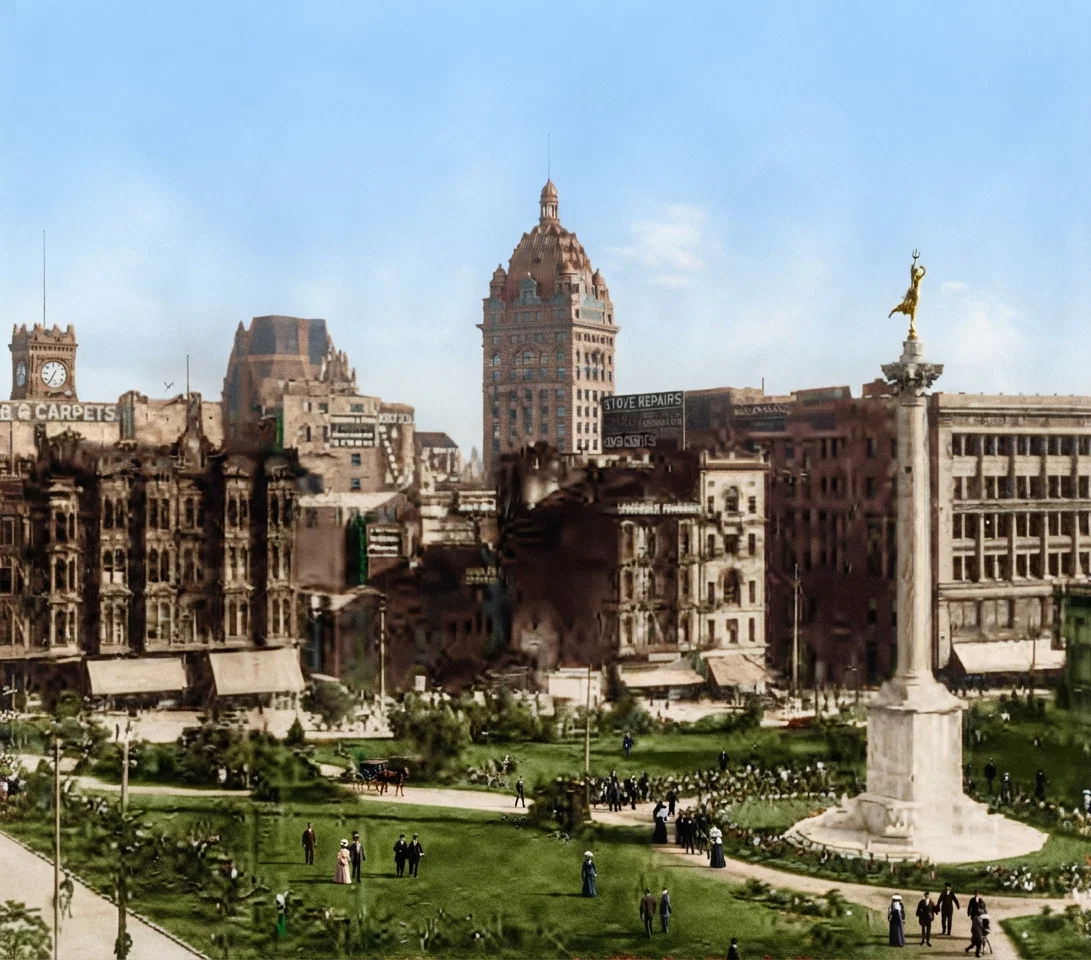
A view in San Francisco from Union Square, taken before the fire. The high building on the left with the clock tower is the Chronicle Building. In the center stands the tall Call Building. The high building between hides the Examiner Building shown on the opposite page.
Seven or More Square Miles
in the city part of the Tyre of the West. Acres and acres and acres are completely stripped of everything standing save occasional chimney stacks and iron telegraph poles.
Sometimes a ruined wall, all that is left of a noble pile, faces you like a gaunt, drear relic of an age past and gone. Street-car tracks were twisted, cable slots were open and shut, streets dropped from inches to feet, and rails were bent and twisted as one would bend a copper wire.
The Loss in Dollars?
No one knows. It has been estimated at $100,000,000; at $500,000,000; at $1,000,000,000. Insurance men say $300,000,000, with probable insurance at $175,000,000. It is thought that most of this will be paid.
The Loss of Life?
Nor can any one tell this. Not till God's judgment books their records unfold will we know the number who perished as the result of that awful cataclysm. San Francisco papers persist in placing the list at not over 500. But their own records indicate more. For instance, in the awful holocaust of Telegraph and Russian Hills, which the fire encircled so quickly that all hope of escape was cut off, it is said that more than 150 perished. For instance, 200 bodies were found in the Potrero district south of Channel Street, and were cremated. For instance, forty bodies were taken from a house, 119 Fifth Street, a four-story wood building. Again and again we are told that hundreds and hundreds must have perished in the instant wrecks of big lodging houses, hotels, etc.
The dead must have numbered from 1,000 to 1,500. God alone knows, He only can tell the number.
The Power of the Earthquake
is incredibly awful. Now a fair, great growing city; in twenty-eight seconds it is a wreck! Mighty walls of brick and stone crumble like sand; great steel girders are twisted and broken like straws; streets heave and swell and fall and rise; the half-minute is over; the city is an appalling wreck, hundreds are dead and dying, the greatest earthquake of modern history, measured in gold, is over; and men stare and cry and gaze stunned and broken and helpless before such dynamic forces, the coming and going and power of which none ever measured.
Was It "an Avenging God?"
Rather, was it not the fruit of awful wickedness and the mercy of God which brought the awful catastrophe? Like Babylon and Tyre in their preliminary punishments, was not this modern proud and beautiful Babylon and modern thrifty Tyre meeting the fate that her open, flaunting, God-defying wickedness invited?
A young Baptist man, said that he told his wife that some great judgment would come on San Francisco on account of the awful, open wickedness practised, and they must get out. They did so a few weeks ago; and he remarked when the first shock came that San Francisco was sunken or ruined. Who warned him?
Not Alone for San Francisco.
Not to San Francisco alone comes the warning. It has come many times from godly men,5but they were laughed at. It so came to Babylon unheeded until the hand of fire wrote her doom upon the palace wall, "Weighed, and wanting." Read, fellow pilgrim of earth, Isaiah 13; Jeremiah 51 and 52; and Ezekiel 26 and 27. These are lessons for us, for New York, for Chicago, for every other place forgetting and defying God.
Will the lesson, the fear, awaken only impulse to do better, or the principle to do right?