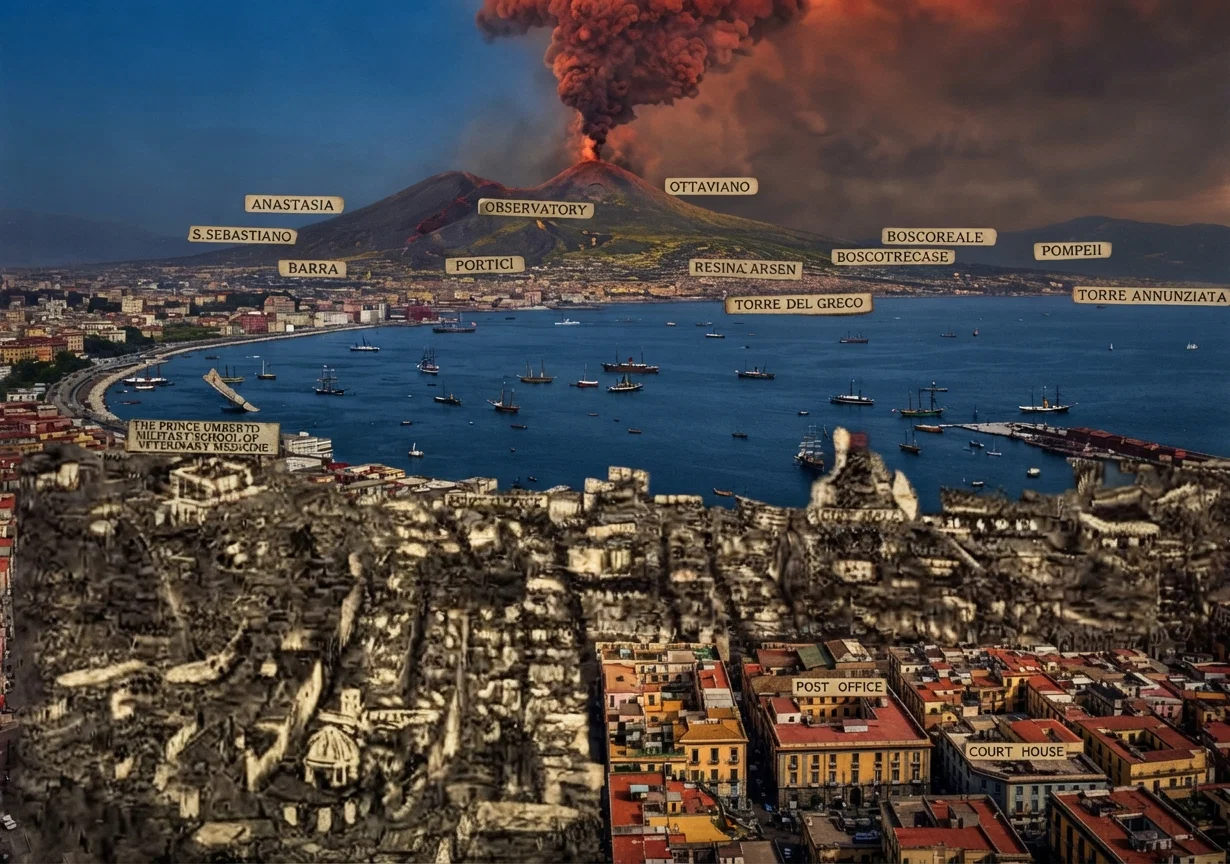
A birdseye view of Vesuvius, with surrounding towns, looking from Naples.
VESUVIUS IN ACTION AGAIN.
THE latest eruption of Mount Vesuvius will pass down in history along with the destructive eruptions of A.D. 79 and 1631. In the first of these Pompeii and Herculaneum were buried, and in the second about 18,000 persons lost their lives. The destruction of property during the present eruption is far greater than that which followed any previous one. The lava streams and showers of sand and ashes have spread over a much larger area.
Populous towns and villages clustering around the base of the famous volcano have been depopulated and destroyed. Several of them have been buried in the ashes which for many days have been emitted from the throat of the crater; and streams of lava have poured down the mountain on all sides, destroying orchards and vineyards in their course.
Over the wasted towns and the stricken country the great funnel of angry-colored smoke goes up by day and night, or bends now this way and now that, like a mighty sword of vengeance. Vesuvius stands like a great rapid-fire gun pouring an endless rain of projectiles into the sky, which fall on all sides in a perfect rain of death. It has been likened to a great forge, to a mammoth caldron, to a huge, flaming brazier, and still words are incapable of conveying to the mind an adequate description of what has been going on there. Vesuvius had been grumbling for a long time at irregular intervals; but the people had become accustomed to these, and had planted their vineyards and orchards well up the treacherous slopes, and towns were builded far inside the danger line.
With little warning the outburst came, and the hungry lava began a resistless flow down upon dwellings and towns, and the falling ashes buried everything in a pall of gray. In the midst of it all the stricken people moved about, some half-dazed, others nearly frantic with grief over the loss of homes and loved ones. The crippled, the aged, and the children found it in many places impossible to wade through the ever-deepening mulch of loose sand and ashes, and many of these were lost. There was heroic work done by peasants and soldiers to protect lives; cavalrymen drove their horses forward through ashes up to their horses' flanks to rescue those in danger of perishing. In one case, carts laden with children became blocked, and the little ones, fearing they were to be abandoned, scattered in every direction in the darkness and could not be found again.
In certain places where churches and market places were crowded with people, these collapsed from the weight of ashes, and hundreds were killed. The superstitious vainly carried about with them the images of saints to insure the protection of their lives, or placed such images in the paths of lava streams in futile endeavors to stay the flow.
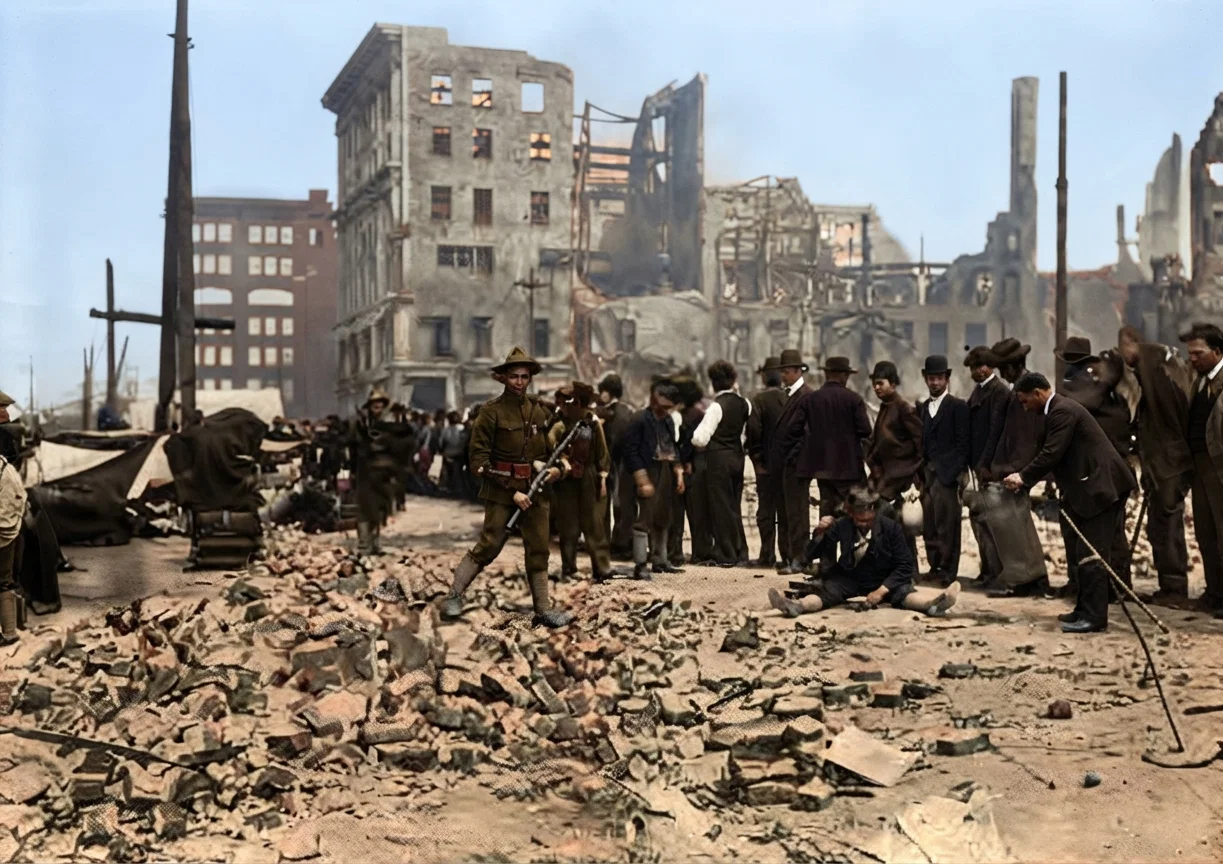
A view in San Francisco showing the reign of martial law and the needs of the survivors of the awful calamity. The men with muskets are soldiers standing guard over a typical bread line, men in rank receiving bread as it is dispensed at one of the many temporary commissary departments. Such ruins as these may be seen everywhere in the burnt district.
Thousands of the refugees fled to the city of Naples; but this city, too, was deluged with the volcanic rain till its streets and roof tops were covered with ashes to a depth of several feet. In this city two hundred persons were killed by the collapse of the market place.
Boscotrecaz was destroyed by a stream of glowing lava that approached and flowed over the place soon after midnight, leaving but a few landmarks to show where it stood.
There have been various estimates of the number of lives lost, but the exact number will probably never be known. It is placed as high as two thousand; and the immediate property loss is said to be $20,000,000, while the continued loss from year to year from the untillable nature of the land will be very great. After the eruption of 1872, it was ten years before the ash-covered land would produce crops of any kind. It will probably be longer than that before these devastated vineyards and orchards will be planted again, and these years will give Vesuvius ample opportunity to replenish her arsenal for another mighty demonstration. S.