1. "Was not the Comforter, the Holy Ghost, in the earth before Jesus ascended to His Father?"
2. "If so, why does John say that 'the Spirit was not yet given'?" John 7:39.
TO the first question I answer, As the Comforter, no; as the Spirit of truth, or Holy Ghost, yes. The expression, "this spake He of the Spirit," is qualified by the words, "which they that believed on Him were to receive," and refers to the promise of the Father mentioned in Acts 1:4, 5, "Which, said He, ye heard from Me. For . . . ye shall be baptized in the Holy Spirit not many days hence." This is the Spirit to which John referred as being not yet given, and gives as a reason that Jesus was not yet glorified. Peter, speaking of this event, says (Acts 2:33): "Being therefore at the right hand of God exalted [glorified], and having received of the Father the promise of the Holy Spirit, He hath poured forth this which ye see and hear."
This leads to the inquiry in the light of John 14—
What Constitutes the Comforter?
Jesus says, in verses 16, 17: "I will pray the Father, and He shall give you another Comforter, . . . even the Spirit of truth; whom the world can not receive; for it beholdeth7Him not, neither knoweth Him; ye know Him; for He abideth with you, and shall be in you." Jesus is speaking to men with whom the Holy Ghost dwelt, and teaching them about the coming Comforter. Note the present tense, dwelleth with, and the future tense of the promise, "shall be in you."
So in chapter 15:26, we read, "But when the Comforter is come, whom I will send unto you." Again, in chapter 14:26, we have the promise, "But the Comforter, . . . whom the Father will send;" and in chapter 16:13, "When He, the Spirit of truth, is come." So that same Spirit of truth which already dwelt with the disciples, in a future fuller coming was to be the Comforter.
Now in the light of Isa. 57:15 and John 14:17, the fact of the Holy Spirit dwelling with a person does not warrant him in saying the Comforter has come to me; for He had been with the disciples three years or more, after which time Jesus points to the coming of the Spirit of truth as the Comforter as being yet in the future.
That we may understand what manner of coming of the Holy Spirit constitutes Him the Comforter, let us note some phases of His work in connection with fallen humanity. In Gen. 6:3 the Lord says, "My Spirit shall not always strive with man." Of the Jewish council, Stephen said, "Ye do always resist the Holy Spirit." There the Spirit is revealed as striving with those who resist until, as in the case of Ephraim, the fiat goes forth that he "is joined to his idols, let him alone." In Isa. 57:15 we read, "I dwell . . . with him also that is of a contrite and humble spirit."
Jesus declared that such was the relation which the Holy Spirit bore to His disciples after all His teaching. "He dwelleth with you." John 14:17. His work in this relation is said to be "to revive the spirit of the humble . . . and the heart of the contrite" (Isa. 57:15), simply because they have so related themselves to Him that that work can be done for them. While in this spiritual condition, Jesus said to His disciples, "I have yet many things to say unto you, but ye can not bear them now. Howbeit when He, the Spirit of truth, is come [as I have received the promise of My Father, Acts 1:4] He shall guide you into all the truth." John 16:12, 13. Here a future and fuller relation of the Holy Spirit was intimated agreeing with the promises, "He shall be in you," and "ye shall be baptized in the Holy Spirit not many days hence."
In the days which followed Christ's ascension, in the quiet of their abiding-place, these disciples "all with one accord continued steadfastly in prayer." In sorrow they recalled the words of the Master when He sought to teach them the things that were about to take place in Jerusalem, but which they could not bear to hear. Their own vain hopes of temporal advantages in this kingdom, which they so fondly cherished, had so filled their minds that Peter, when the Lord would teach them of His coming death, began to rebuke Him, saying, "This be far from Thee, Lord." But Jesus replied, "Get thee behind Me, Satan; . . . for thou mindest not the things of God, but the things of men." Matt. 16:23.
In the ten days of heart-humbling and prayer that followed Christ's ascension, the disciples learned more fully what He meant when He said, "If any man would come after Me, let him deny himself," and the morning of the Pentecost found them all emptied of self, awaiting the Comforter who should dwell in them. "And suddenly there came from heaven a sound as of the rushing of a mighty wind, and it filled all the house where they were sitting." Acts 2:2. There was the baptism in the Holy Spirit promised in Acts 1:5, "And they were all filled with the Holy Spirit." Here was fulfilled the Saviour's words concerning the Spirit of truth as a Comforter, "He shall be in you."
In the above study, we find (1) that the Holy Spirit strives with those who are heedlessly going on in the way of their own heart; and (2) that He dwelleth with those who heed His striving and turn to walk heavenward; (3) that when we fully realize that in ourselves dwells no good thing, that in our own nature we are children of wrath, we will seek that baptism of the Holy Spirit which unites us to the mystic body of Christ (1 Cor. 12:13) so that before God we are accounted severally members thereof; thus partaking of the divinenature, the active principle of which is love, and which is shed abroad in emptied hearts by the Holy Ghost. Rom. 5:5.
This indwelling, this partaking of the divine nature, this earnest of our inheritance, by the receiving of His fulness to the utter emptying of self, constitutes, I believe, the Comforter, of whom it is written: "Repent ye, and be baptized every one of you, in the name of Jesus Christ unto the remission of your sins; and ye shall receive the gift of the Holy Spirit; for to you is the promise, and to your children, and to all that are afar off, even as many as the Lord our God shall call unto Him."
Of the union of divine and human nature Christ has said, "I am the Vine; ye are the branches." "The root sends its nourishment through the branch." "Such is the true believer's relation to Christ," which can be established only by the exercise of personal faith. Of this faith, one of deep experience has written these words: "Our will must be wholly yielded to the divine will, our feelings, desires, interests, and honor, identified with the prosperity of Christ's kingdom." "When the intimacy of communion is formed, our sins are laid upon Christ, His righteousness is imputed to us;" but until it is formed, we have no assurance that this is true of our experiences. Hence the wise and foolish virgins, the rocky and sandy foundations.
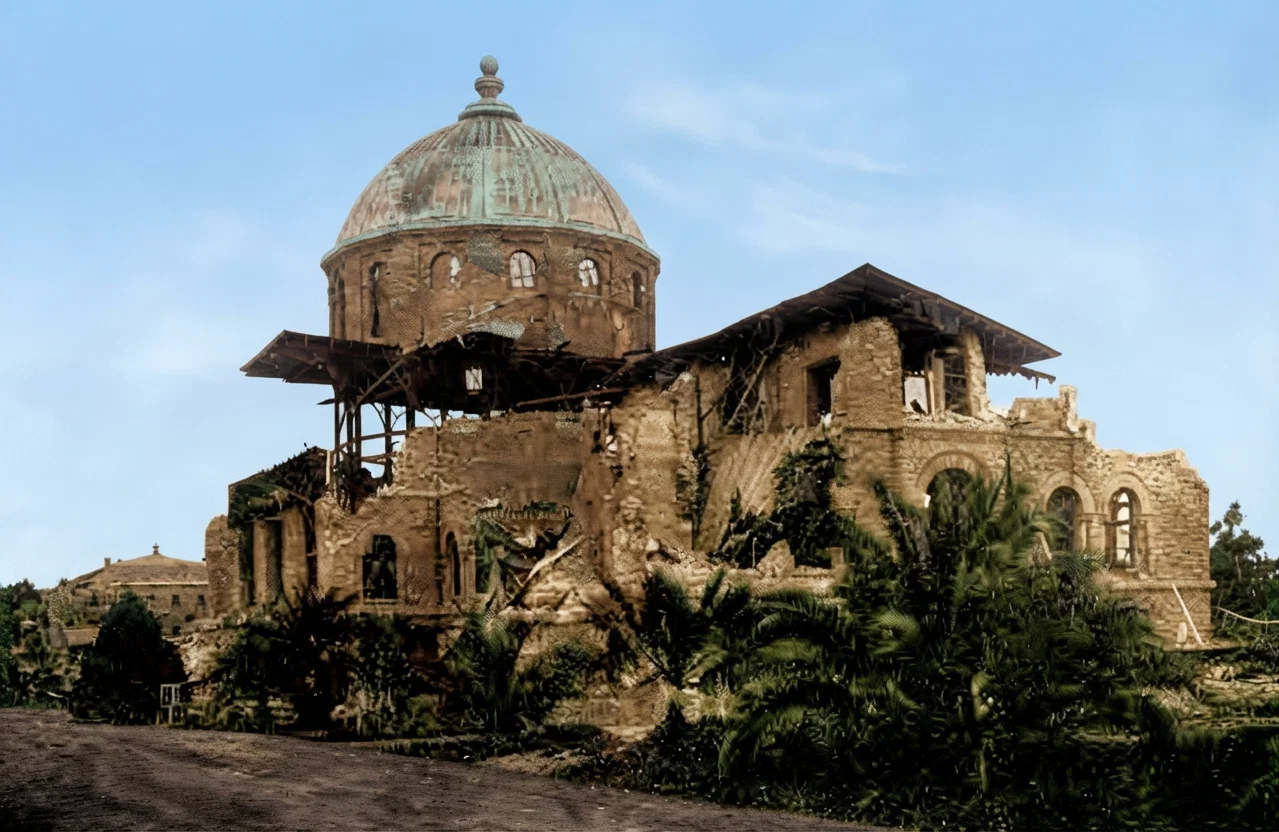
The wreck of the unfinished Library Building at Stanford University, Palo Alto, Cal., by the earthquake of April 18.