WITH the defeat of Arianism the church of Rome had no longer a rival in the religious world that could endanger her claims to the spiritual supremacy. And consequently the fight henceforward waged in the Catholic camp was not directly against the Papacy as an institution, but rather against certain prelates and popes. Not until the time of the Reformation was a mighty blow directed against the Papacy itself. And therefore we find that from 538 onward the development of the Papacy was very rapid toward a domineering position among the nations.
With the advantage thus gained, Gregory I. (590-604), who was a pope of some genius in political affairs, strengthened and confirmed the concessions already acquired, and largely developed them to their logical conclusion, as the following citation will show. Gregory, therefore, was certainly the first one that comprehended the true power of the church and developed the Catholic principle in the true meaning of the word; and, raising the spiritual authority of the Papacy to its highest grade, he prepared the way of sovereignty to his successors.
Not only in the city of Rome, but in other parts of Italy, Gregory caused his power to be recognized; and he even went so far as "to attribute to himself a power superior to that of the first officers of the state." "Gregory was held in so great esteem also outside of Rome that the Lombards considered him independent of the empire."
Shortly after Gregory, Boniface III. ascended the papal throne. He induced Phocas, emperor of the East, to make a decree recognizing the pope of Rome as the head of Christendom. But this decree amounted simply to a confirmation of the power already conferred upon the pope by the famous decree of Justinian, for Justinian was the greatest emperor that ever reigned over the Eastern Empire, while Phocas was a usurper of the throne of Constantinople. Then Justinian not only made a decree making the pope "the head of all the holy churches," but destroyed two great nations to put that decree into effect. Furthermore, the priority in time of the decree of Justinian gives it the first place, and makes the decree of Phocas simply a confirmation of that of Justinian. And if we study carefully the history of the Papacy, we shall discover that it has ever been the policy of the popes to confirm with new decrees the grants already obtained.
War against the Images.
In 726 Leo, emperor of Constantinople, began a war against the sacred images of the church, with the idea, as he expressed it, of banishing idolatry from Christianity. But the enforcing of his decree against the images was opposed in a fierce-fought contest waged by
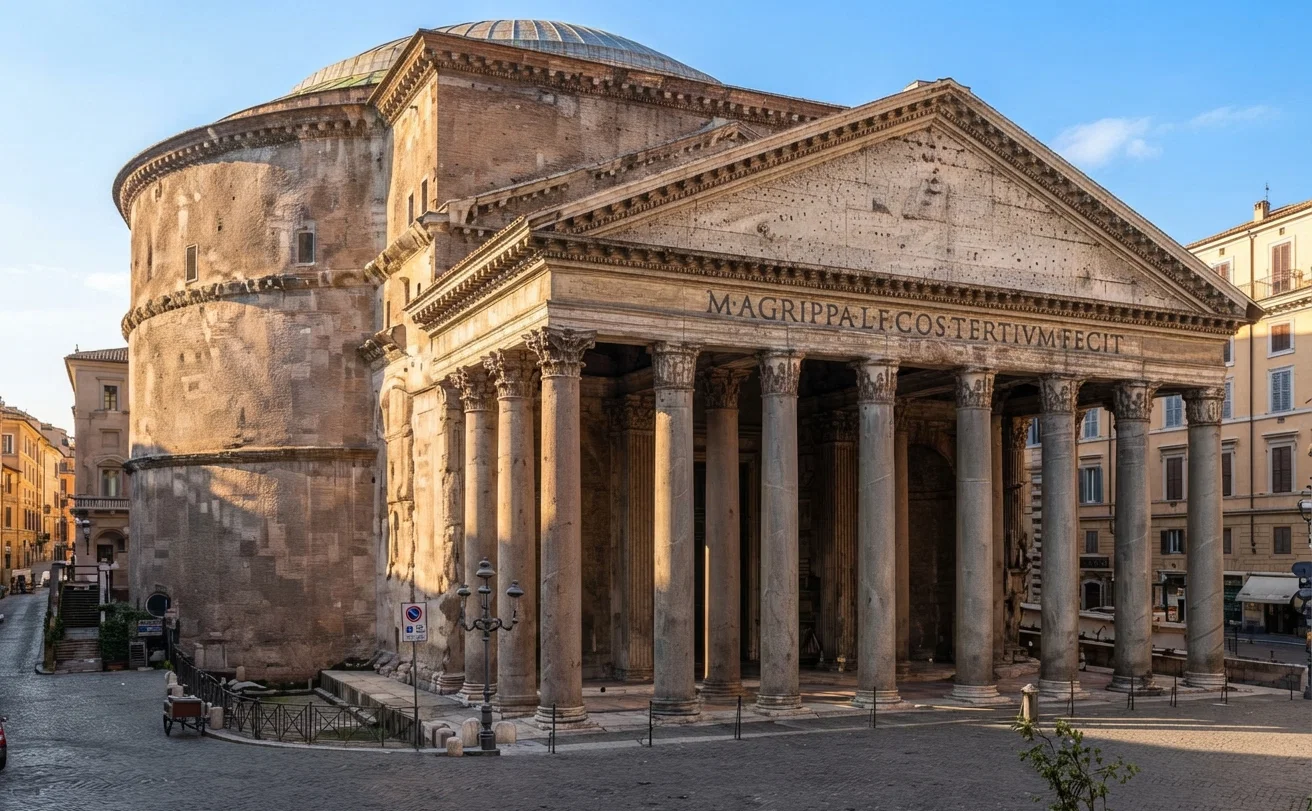
Pantheon of Agrippa, Rome.
Pope Gregory II. The people likewise rose in rebellion against the decree, so that the various factions in Italy stood together in defense of the sacred images and the pope. The pope entered upon the fight with great energy, and wrote a fierce and threatening letter to the emperor. The Romans took advantage of the controversy and proclaimed a republic at Rome with the pope as the head of the government. The emperor, desirous of punishing the rebellious Romans, and still intent on enforcing his decree against the images, sent a strong fleet against the city of Rome. But this fleet was shipwrecked on the way, and therefore he abandoned the attempt, and becoming occupied in more serious affairs in the East, he left the pope and Rome unmolested.
Grants Under Pepin.
Shortly after this time Luitprand, king of the Lombards, decided to conquer all Italy and make it subject to the Lombard rule. With this object in view, he advanced quickly against the Roman duchy; and the pope, finding himself opposed by a strong enemy, and without means of defense, appealed to Charles Martel, king of the Franks. While Charles Martel did not take up arms against the Lombards, yet he assisted in establishing a treaty of peace between them and the pope whereby the pope acquired new territory. But under Pope Zaccharias (741-752), hostilities broke out anew; for Astolf, king of the Lombards, again attempted the conquest of Rome. The pope appealed to Pepin, king of the Franks and successor of Charles Martel. Pepin descended in Italy and compelled the Lombards to make a treaty of peace with the pope, and to concede to the pope the Exarchate of Ravenna, Pentapoli, and the Duchy of Urbino. But as soon as Pepin had left Italy and returned to France, the Lombards renewed hostilities and besieged Rome, and again threatened the papal rule. Again responding to an urgent request of the pope, Pepin returned to Italy and compelled the Lombards to withdraw from papal territory and maintain the treaty made with the pope. At this time he also added another city to the papal territory. "And it is certain that as a consequence of this fact, the popes of Rome began to rule as sovereigns, and to be recognized as such by all, and from that time onward they ceased to place in their letters the date of the reign of the emperors as they were previously accustomed to do."
Charlemagne and the Church.
"When the Lombard tooth began to gnaw at the holy church, Charlemagne defeating them, under his wings gave her aid." In these words Dante speaks of the descent of Charlemagne in Italy in defense of the church. The Lombard king, Desiderius, in order to avenge some outrages committed against his friends by the papal power, and with the view of extending his dominions, marched against the city of Rome. Pope Hadrian I. fortified the city and at the same time sent messengers praying Charlemagne to come to his aid. The Lombard king, when he learned of the coming of Charlemagne, hastily withdrew from Rome and returned to his own kingdom. In the year 774, Charlemagne marched against the Lombards, but finding it impossible to cross the well-fortified passes in the mountains, was on the point of returning, when a priest offered his aid, and guided the Franks through in safety. And thus the Lombards were defeated, having a religious traitor in the camp. "Therefore from very remote times, in the bosom of the priest has reposed the spirit of political parricide and treason." Charlemagne immediately went on to Rome where he was received with great pomp and ceremony by the pope. At this time Hadrian asked Charlemagne to ratify the donations of territory made to the Papacy by Pepin; this he unhesitatingly did, adding also other territory, and signing it on the tomb of St. Peter. He then proceeded to the complete destruction of the Lombard power, which he shortly accomplished, and assumed the title of king of the Lombards.9"The Lombards were a people in advance of their times in civilization, and their laws and customs as compared with other parts of Italy and other nations, were far superior, and therefore, if it had not been for the pope's insatiable desire to domineer, Italy might have enjoyed peace and prosperity under the Lombard rule." But the popes of those times were the most crafty and ambitious of men." And, as says the poet, "Understand that the ambitious man is a cruel man."