WALKING WITH JESUS

11%

Pacific Press Publishing Company · Mountain View, California · Apr 25, 1906

FromSigns of the Times, Vol. 32, No. 17.

Read the full edition

WALKING WITH JESUS.

HOW many times and in how many ways God manifests His love and presence to us, and we know it not, see it not! His blessings may come in seeming affliction, and we like Jacob mourn, "All these things are against me." We lie down in the desert night feeling utterly alone, and not until the night vision of the messengers of God and the shining stairway to heaven is in the past do we recognize that God was in the place and we knew it not. How much better it would have been to have builded our Beth-el in the evening. He sends His angel to deliver us, and we struggle with Him till the break of day as an enemy. We start like Joshua with an untrained force against a walled city with thousands of foes beyond, and do not recognize as a friend the Captain of God's host who comes to help us, and without whose aid our mightiest effort would spell failure.
How frequently we meet with such paradoxes in the life and experiences of our Lord and His disciples. How the people longed that He should be their King,—He whose right it was. But He sends them back to their every-day life, to the Roman yoke, and to bitter disappointment, and He retires to pray. Did they but know it, He was working out for them in His refusal a more glorious kingdom than earth ever knew. When He died upon the cross, so soon after His triumphal entry into Jerusalem with a multitude singing His praises, the last hope of the disciples seemed forever crushed; but by the means of His death He was destroying even him that had the power of death, the devil, and delivering all who desired deliverance from the devil's thraldom. His humility, His suffering, ever issued in exaltation and glory.
WALK TO EMMAUS.
WALK TO EMMAUS.
THAT first first-day after the resurrection of our Lord was a day of disappointments and surprises, darkest in the morning, but at evening time, light. According to the record, only the women saw Jesus that morning. Later in the day He appeared unto Peter. But when Mary told the disciples "that He was alive, and had been seen of her, [they] disbelieved."
Mark 16: 11. Luke tells us that the words of the women who told the apostles seemed to them "in their sight as idle talk; and they disbelieved them." Luke 24: 11. And after the first excitement of the day was over, the disciples went to their own home (Acts 1: 13), not understanding that Christ should rise from the dead (John 20: 9, 10).
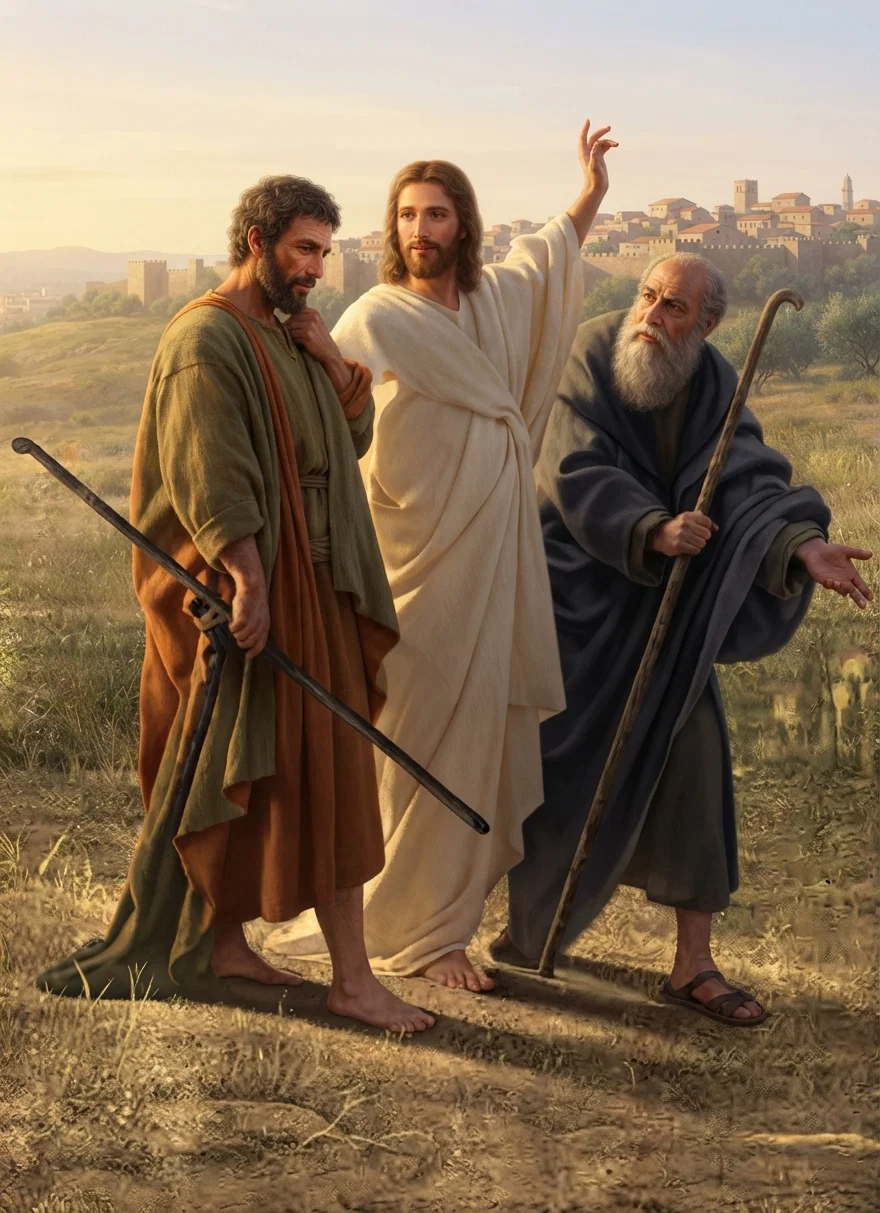
STILL another experience met two humble disciples who went on that day to Emmaus, a little town between seven and eight miles from Jerusalem. Their hearts were full of the events of the past few days. They had been among His devoted followers. They loved Him and His teaching. Therefore their conversation was upon Him and His character and their disappointment. A stranger, as they suppose, joins them and inquires as to their thoughts, and they reply in half reproof as tho there could be any other subject to engross attention save that "concerning Jesus the Nazarene, who was a prophet mighty in deed and word before God and all the people." And they tell of His death and their blasted hopes; also of the empty tomb and the angel's story. And then the Master reveals to them how slow they were to believe the prophets and to see that all those things were necessary in the experience of the Messiah. And He opened their eyes to the Word of God; and still they knew Him not. That His words of reproof and instruction were acceptable to them was shown in their earnest invitation, "Abide with us." They spread before Him their frugal repast, and He blessed and brake the bread and gave to them; and they knew Him. The simplest deed of hospitality revealed to them the Master, and then their eyes were again holden, and they saw Him not.
O HOW full were their hearts now! How they recalled the pleasure by the way as they listened to His soul-stirring words. "Was not our heart burning within us, while He spake to us in the way, while He opened to us the Scriptures?" Their weariness is now gone. What matters it if the day is well nigh spent; they must return to Jerusalem and tell the glad news. After partaking of the bread blessed by the Master, they start the same hour, ending their journey in the light of the moon. They find the disciples at home, with doors closed for fear of the Jews; but they, too, are talking of Jesus' appearance to Simon. While they converse, their eyes are opened, and they see Jesus in their midst; but they are affrighted, thinking Him to be a phantom, till He eats before them. He is "the same Jesus," and His rich blessing, "Peace be unto you," settled down upon their storm-tossed soul as the soft lullaby of the mother soothes her weary child. Their Lord was risen indeed.
EVEN so does the Master long to walk with us in the way, and to open to us His Word. He will not do it, He can not do it, if our hearts are full of the light, the trifling, the foolish, the vain things of this world. He can not walk with us if our hearts are proud and self-sufficient. "Humble thyself to walk with thy God," is the unfailing rule. "For thus saith the High and Lofty One that inhabiteth eternity, whose name is Holy: I dwell in the high and holy place, with him also that is of a contrite and humble spirit, to revive the spirit of the humble, and to revive the heart of the contrite ones." Christ walking with us, Christ abiding in us, Christ opening to us the Scriptures—that is the privilege of every soul.