WHEN we consider India's millions, we are dealing in numbers almost beyond our grasp. Next to China, it is the most populous country on the globe. The census returns for 1901 give the population as 294,361,056, which is nearly four times that of the United States and equals one fifth of the inhabitants of the globe. To number so many people under circumstances so peculiar as in India, is a large undertaking, yet we are told that it took but one brief month to obtain the last census.
The people of India are not of one race nor one language, but of many races and languages. Authorities differ as to the exact number of tongues spoken in India, but it is safe to say there are more than one hundred, tho not more than a score of languages are spoken by above a million people. Of these the Hindi, Bengali, Telegu, Marathi, Punjabi, and Tamiel are most common.
To the newcomer, the people of India may all appear alike, and it is true they have a general resemblance; yet there is a remarkable difference in races both in temperament and physique. There are the weak and timid people of the plains and the strong and warlike men of the hills. They differ in language, constitution, and intellect. The Siphs, who are the giants of India and from a physical standpoint the most manly men, are in intellect inferior to the weak yet brainy Bengali Babus of Bengal. The Siphs are chosen by the British Government as soldiers. Nearly all are six feet and over in height. The body-guard of the viceroy are Siphs, every one considerably over six feet tall. With their red coats, white belts, and huge head-dress, they make an imposing appearance.
Some of the hill people perform remarkable feats of strength. It is not unusual in the vicinity of Darjeeling to see women with loads from one to three hundred pounds upon their backs. We often have seen a woman with such a burden carrying a little one in her arms, at the same time plying her knitting-needles as she merrily trudged up the mountainside. The residents of Darjeeling affirm that a coolie woman on a wager carried a piano on her back from the railway station to a music depot a full quarter of a mile farther up the mountainside.
The great difference in Indian races is brought about largely by the climate. On the plains, the long hot season begins in March and continues until November. So many months of heat have an enervating effect even upon the natives, and especially is this true along the coasts where the humidity is great. It is remarkable how foreigners are able to endure so high a temperature as prevails for many months each year, yet many do, and that without much change. The majority, however, find it necessary every few years to spend a year in a northern climate. The late Dr. John Murdock, one of India's most noted missionaries, lived to see his eighty-fifth birthday, after having spent full threescore years in labor in India.
There is a difference in the mental development of East Indians which is more noticeable than their difference in physique. On the one hand are the poor coolies, many of whom hardly know their right hand from the left, and on the other are the brainy Brahmans, some of whom possess rare gifts of mental ability. We get our algebra from the Hindus through the Arabs. Our decimal system of notation and Arabic numerals came west from India during the Brahmanic period.
England has met the Indian's thirst for knowledge in a practical way by supplying schools. Much has also been done by various missionary societies in providing educational advantages. There are in India, according to latest statistics, 160 colleges granting degrees, with 18,000 students. In the Calcutta University alone there are 3,000 on an average every year who enter the university for degree. It has been said, and is probably true, that more degrees are granted yearly in India than in England. In fact, in literary pursuits there are more men than needed. In Madras a man holding a B.A. degree will often accept an appointment at some clerical work at a salary of fifteen rupees (about five dollars) a month, while a carpenter or mason receives double that amount.
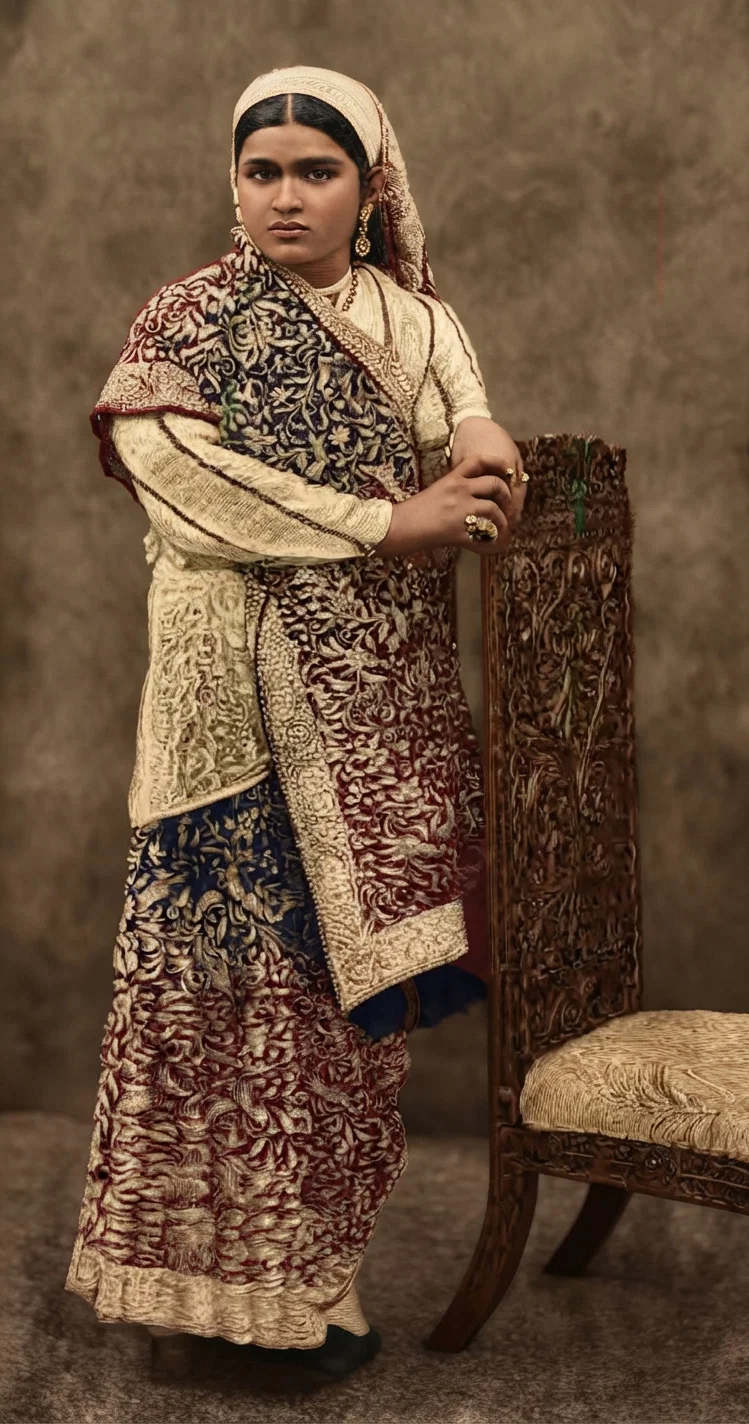
A High Caste Lady of India.
There is a broad field for missionary effort among the educated classes. An educated Hindu said, "We educated men are tossed on an ocean of doubt; we do not know what to believe; we have no light to guide us, no anchor to hold us." Many minds are in a state of transition. The platform on which Hinduism rests is slowly being undermined, and inquiring minds are turning toward the West for light and truth. This question has come to us many times, Shall these people accept the teachings of western infidels whose literature is being sown broadcast, or shall they anchor their faith to the firm rock of Christianity?
The food of India's millions is simple. Rice and dahl are the chief food in Bengal. Farther up in the northwest, wheat is used extensively. The red variety of dahl which is used so extensively is probably the same as the red pottage for which Esau sold his birthright. Tho not palatable to many foreigners at first, most people become fond of it after a time.
Just now a famine is on in Madras. It has been many months since rain to any appreciable extent has fallen. Many of the poor people have been without food for months, their bodies have become weak and emaciated, and many will die in spite of all that is done for them. We in Christian lands know little of the want and hunger of India's sons. Hungry, helpless, hopeless, they die without hope and without God.
Yet great as may seem the want of bread in India, the need of Christ is greater still, for it is their estrangement from God that is responsible largely for the caste and superstition which hold them in such poverty. India is like a great ship at sea without chart or compass. In the deadly night of sin, its millions are going down to Christless graves. While the second hand works its circuit on the dial face, twenty men and women die in India; and for the greater share they are unknowing and unwarned. If Hindus, they are burned; if Mohammedans, buried; and if Parsees, their bodies are given to the birds of the air. As individuals, the natural and practical questions come, What will we give and what can we do to help these helpless sons of India?