WHEN Jesus was apprehended in the Garden, all the disciples "forsook Him and fled." A certain young man, probably Mark, "followed with Him," but as they sought to take Him, he fled. Then, Jesus, alone with His enemies, was bound—an utterly needless precaution—and taken to Annas, the former high priest, and father-in-law to Caiaphas who then held the office. The leaders in the plot against Jesus sought to allay all jealousy, and unite all possible against Him.
SIMON PETER, still smarting under the Master's rebuke in his use of the sword, could not forget his Lord. He could not leave Him. There might be an opportunity for him to fight for Christ still. The Master might assert the authority Peter had seen Him use in the cleansing of the temple, and then He would know how valiant was Peter's heart and how strong his right hand. So little had he learned of the spirit of the Master and the principles of the kingdom! Even so now there are many who profess His name, who would seek to promote and advance His kingdom by means that are carnal. All these profit nothing. All they that take the sword shall perish with the sword.
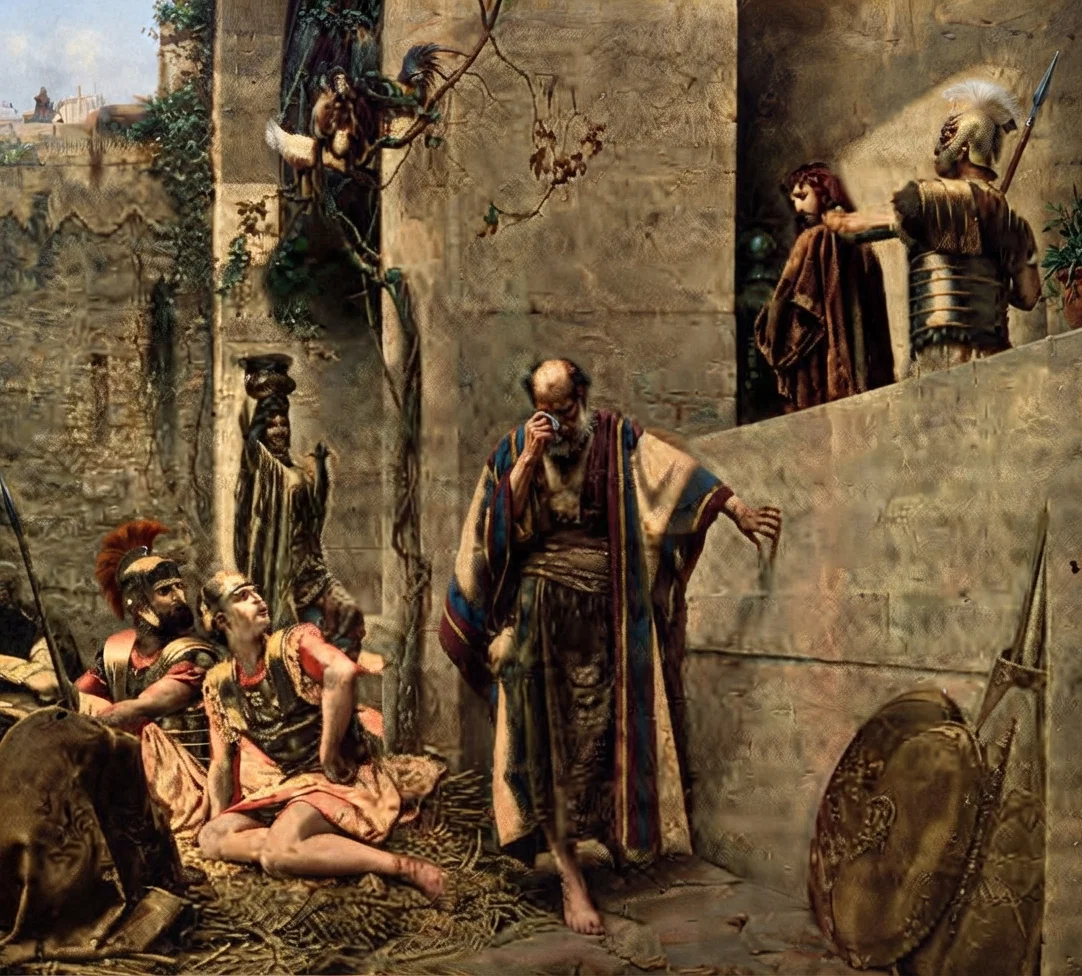
PETER followed, but he followed "afar off." The cause of the Nazarene was unpopular just now. A few days before the whole city seemed to go wild with joy in welcoming Him as king. It was a proud thing then to have been His disciple. Now there were none to do Him honor, and Peter did not wish to meet their sneers and persecution, or suffer with the Master. John also returned, and the high priest knowing him, he entered into the court with Jesus, none forbidding. All knew where he stood. None needed to question him. His nearness to the Master, his clearly-evinced interest, were testimony sufficient. Knowing that Peter wished to see the outcome of the arrest, John spoke to the maid at the door and brought in Peter. As he passed in, he betrayed his anxiety, and the sharp-eyed doormaid, with pert inquisitiveness, asked, "Art thou also one of this Man's disciples? But he denied, saying, Woman, I know Him not." He had taken the first step in wrong and compromise as the result of following "afar off."
“And he went out and wept bitterly.”
HAVING taken the first step in the wrong way, his pride demanded that he should pursue it. Seeing a brazier of burning coals around which were gathered the officers and servants in the cool, spring night, Peter walked over among them, and stood "warming himself," yet listening, keenly attent, to all that was taking place concerning Jesus. The cock crew, but he gave little heed. He heard the Master's calm words. He saw an officer with no provocation smite Him in the face. Perhaps the fisherman's eyes flashed and his muscles knotted as he saw the cruel act. He wanted to seem to be indifferent, but he betrayed his anxiety, so that various ones asked him, "Art thou also one of His disciples?" He denied with an oath, and said, "I am not." The second step had been taken. Peter was rapidly losing all that he seemed to have gained, and he was nearing rapidly the low, coarse level of his old fisher life.
AN hour passes by. The fisherman's mind is still in tumult of conflicting emotions. His heart is still boiling, and he is angry that his Lord will submit to the mock trial He is receiving. Another servant gets a clearer view of the fisherman's rugged face. That servant was with the party which arrested Jesus. He also had a kinsman, perhaps a brother, there. That kinsman was wounded in the garden, and also healed. The servant remembered the incident. He saw many of the faces around Jesus. Some motion on Peter's part told him that he had seen Peter in the Garden. Therefore He asks Peter, "Did not I see thee in the Garden with Him?" And as Peter was about to deny, he presses home the charge: "Of a truth thou art also one of them; for thy speech betrayeth thee; for thou art a Galilean." Peter became so desperate that all self-control vanished, "and he began to curse and to swear, I know not the Man of whom ye speak." He fell back to the old life level and habits. Such men have ever done when they let go of Jesus Christ. We can read Peter's old habits in his backsliding. Like many other fishermen of all ages, he was a rough, profane man; and when control of self was gone, he fell to his old level, and cursed and swore. And then the cock crew again. "And Peter called to mind the word, how that Jesus said unto him, Before the cock crow twice, thou shalt deny Me thrice. And when he had thought thereon, he went out and wept bitterly."4How many, many Peters there are to-day who are following "afar off." Piqued or offended because of imaginary grievances, wounded in their selfish pride, making mistakes, but too proud to acknowledge them, they soon come to deny the One who redeemed them and suffered and is suffering in their behalf. Many, unlike Peter, will not weep at the climax of their rebellion and denial, but with ever-harder heart will push on to destruction.
But many, rash and foolish tho they be, will turn from the sin to the Saviour, will see the wrong in self, not in others; will remember the words of warning from friends whom they denied and hated and maligned, because they hated the words of reproof needed. For such the Master waits. For such time the Master waits. And not till such time comes can He help them. Then, while they weep and wonder and wait, the Master's messenger will say, "Go, tell His disciples and Peter" (Mark 16:7), their Lord lives, and would still lead them on out of self, into more blessed fields.
WOULD you never deny the Master? Never follow "afar off." Follow with Him. Keep close to Him under all circumstances, as well in the judgment hall or toiling up Calvary, as on the Mount of Transfiguration or in the triumphal entry. "Better fire-walled hell with Him than golden-gated Paradise without."