ROME had been reduced to a duchy, and was subject at this time to the emperor of Constantinople. But, as we have already noticed, the pope in this duchy was practically the supreme authority “because the Romans, rather than see themselves subject to a duke nominated by a distant court and one that did not favor their municipal interests, preferred to obey the great priest elected by the people, who for a long time had given attention to the interests of the people, not only spiritually, but materially as well.” And besides this, the pope possessed a great authority as legal administrator of the vast estates of the church, which had assumed enormous proportions. An idea of the vastness of these possessions is indicated by the following:
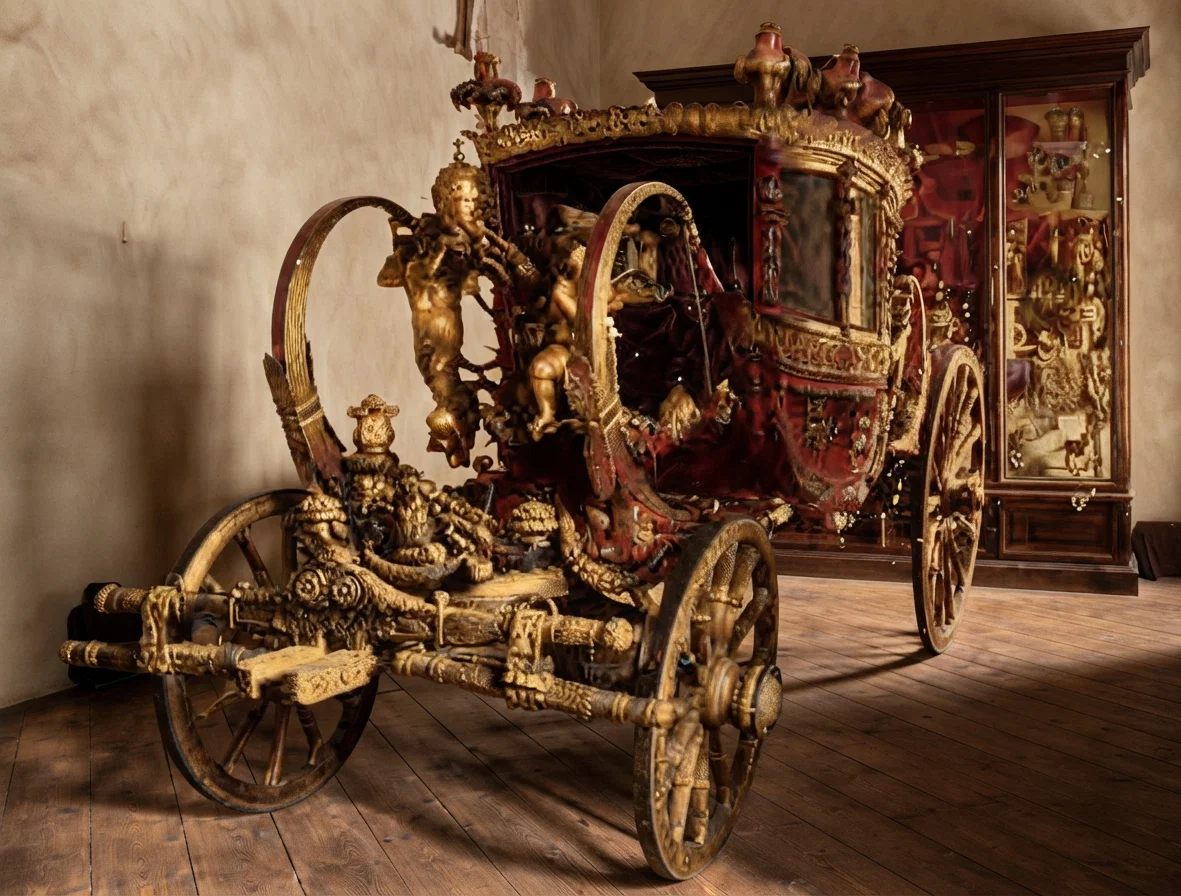
The Magnificent Carriage of the Pope Used on Great Occasions Before the Fall of His Temporal Power.
“The church of Rome had large possessions, not only around Rome itself, but in the territory of Naples, and even in southern France and Illyricum, and especially in Sicily and northern Italy.” And therefore, as administrator of these vast estates, and as spiritual head of the people, and with the great influence that he held at Rome, the pope exercised a mighty authority. And while the pope was not formally and legally independent of the emperor of the East, yet he was virtually so. But with the famous decree of Justinian, who was the greatest emperor that ever occupied the throne of the Eastern Empire, the Papacy entered upon a new era of development with more definite recognition from the emperor of the East. For that decree contemplated the settling of some very important questions.
In the first place, in the fiercely-fought struggle that had been waged for years between Arianism and Catholicism, Justinian decided the contest in favor of the latter system, and, suppressing all opposition, made Catholicism the universal religion. Secondly, in the Catholic camp itself he swept aside the claims of the patriarchs of Alexandria and Constantinople to ecclesiastical supremacy, and declared the authority of the pope of Rome supreme in the East as well as the West, and “the head of all the holy churches.”
But “the full establishment of the Catholic Church devolved upon Justinian the necessity of destroying Arianism, the only real rival that the Catholic Church had to the ecclesiastical supremacy of the world. And under the successful arms of Belisarius, the Vandal and Gothic nations, the bulwark of Arianism, fell, and “the Arian sect was from this time dispersed, and could never after recover any strength.” As is well known, the Vandal nation was destroyed in 534, while the Gothic power fell in 538; and with it perished the last vestige of state-supported Arianism.
Does 538 Mark the Beginning?
At this point we might raise the question, Does, therefore, 538 mark the beginning of the temporal power of the Papacy? In this article space forbids a full discussion of this point, and I shall have to leave that for a later article; but I shall touch lightly upon it at this writing. For some time before 538, as we have seen, the pope was practically supreme at Rome, and lacked only the sanction of the emperor of the East in order that he might enter legally upon the exercise of the authority that he already held. And the sanction given by the decree of Justinian, emperor of the East, could be considered sufficient to legally recognize the claims of the Papacy in civil affairs. However, from the view-point of prophecy, it does not appear to me to be an absolute necessity to establish 538 as the beginning of the temporal power of the Papacy.
The prophecy of Daniel, chapter seven, simply says that the saints “shall be given into his hand for a time, times, and a dividing of time.” This expression contemplates that during the period commencing with 538 the Papacy would exercise a power of correcting heretics, and freely persecute all who might oppose themselves to the Catholic religion or ecclesiastical supremacy. While Arianism remained, it was not possible for the Catholic Church to exercise this persecuting power, as the Arians were in a position to retaliate by in turn persecuting the Catholics. And as long as the capital of Catholicism continued to be surrounded by an Arian nation, there was no possibility that the Papacy could freely exercise its power of correcting heretics.
Spiritual Domination.
For this reason, the destruction of the Gothic nation, and with it the last vestige of state-supported Arianism, is not so important in marking the setting up of the temporal power of the Papacy as its power to freely destroy all opposition by persecution. For in fact we know that the Papacy has not depended upon its own temporal dominion so much in exercising this power as upon the other nations which were ever ready to fulfil her commands. Then the end of the period allotted to the Papacy does not necessarily mark the fall of the temporal dominion, but rather the taking away of the church’s great domineering power over the nations, and thus preparing the way for the total destruction of the temporal power in 1870.
As the Franks (French), under Clovis, turned the tide in favor of Catholicism in the beginning, giving a mighty impulse to the church of Rome toward its spiritual and civil supremacy, so the French, in 1798, inflicted upon the Papacy a mortal wound that laid the foundation of the complete destruction of the temporal dominion that culminated in the fall of Rome in 1870.