EUROPEAN LETTER

5%

Pacific Press Publishing Company · Mountain View, Cal. · Jun 13, 1906

FromSigns of the Times, Vol. 32, No. 23.

Read the full edition

EUROPEAN LETTER.

The “Father-in-law of Europe.”

THE European powers have one well-known, tho peculiar, feature, that is, they constitute really but one family, notwithstanding the fact that they form ten or a dozen different and rival nations. The ancient custom, already practised by Solomon, of marrying some princess of royal blood, is one of the most stringent rules of good conduct in reigning families. To depart from it is a sufficient indication that one has forfeited the throne. Such is the case with Oscar Bernadotte, son of Oscar II. of Sweden, who has taken, and is still taking, a personal part in mission work at home and abroad.
The fact just mentioned is vividly illustrated by the family of Christian IX., the good old king of Denmark, who died recently at the age of 88, and who was known as the “father-in-law of Europe.” One of his daughters is the wife of Edward VII., king of England; another was the wife of Czar Alexander III.; one of his sons is king of Greece; one of his grandsons recently ascended the throne of Norway, while another is sitting on the tottering throne of Russia.
This very fact is one of the leading features which identifies the kingdoms of modern Europe with the “ten kings” mentioned in the prophecy of Daniel as the last link of universal history before the establishment of the eternal reign of Christ on earth: “And whereas thou sawest the iron mixed with miry clay, they shall mingle themselves with the seed of men; but they shall not cleave one to another, even as iron is not mixed with clay.” Dan. 2:43; 7:24.

Affairs in Russia.

The most unfortunate of European monarchs at present is no doubt the grandson of this deceased king, the czar. “The internal situation of Russia,” says the Bibliothèque Universelle, “is not growing better. On the one hand, there is no more safety for persons or property. The police are powerless in repressing the many cases of assassination, especially of government officials, occurring daily in all parts of the empire. Cases of robbery are more numerous still, most of the robbers being allowed to escape unpunished. On the other hand, the political reaction is complete. The autocracy of the czar is being affirmed and confirmed more than ever. Elections for the Douma (Congress) are vitiated by the interference of the police, and many men that are likely to be elected, and whose influence the government has reason to fear, are sent to jail.” What will be the end of this would-be movement for liberty in Russia? and how soon will a similar state of anarchy ripen in more favored lands?

Bad Symptoms in France?

The great disaster at Courriere, which has thrown 1,200 French miners into a sudden and horrible death, has shown that there are sympathetic hearts for suffering humanity. Perhaps the most touching case was that of the German miners’ rescue band who came, uncalled, to lend a helping hand to an unfriendly but afflicted neighbor. On the other hand, a Paris journalist remarks with surprise and sadness that no signs of sorrow could be detected on the public showing of a national cause for mourning. The eventful quarter which France has just passed through, he says, has left no serious impression on the minds or faces of the people. The frightful misfortune at Courriere was, however, laid to the separation of church and state, by the Catholics, the same as was done by the pagans against the early Christians when some earthquake or famine occurred.

Churches Learning Self-Support.

Since the first of January, both Protestant and Catholic churches are trying hard to look calmly into the new situation made for them and to learn self-support. What a pity that these self-styled churches of Jesus Christ should have waited to be forcibly cast out by their worldly consort, instead of asserting with joy their God-given liberty to rule and support themselves! Rich Catholic parishes have but little to do to adjust themselves to their new situation. Accustomed as they are to make charges for many church ceremonies, such as baptisms, funeral services, etc., some of them raise as much yearly as 60,000 and 100,000 francs; whereas each parish was entitled only to 900 to 1,200 francs. But this paltry sum was the main support of poor country priests. Special funds are being created to help these. The diocese of Paris has just decided to establish a system of proportional taxes in all rich parishes with that end in view. This new era into which Protestant and Catholic churches are entering is well calculated to infuse a new life into their dormant energies. Will it be a life from above or below? The future will show.

Riots in Churches. What Shall the Future Be?

The wild scenes which accompanied the inventories of church property made by the government during the last few months would seem to indicate on the part of Catholics a spirit of blind hatred. These inventories were a simple and necessary measure. They were but a consequence of the law and a part of it. The separation having put an end to all public church establishments, their property is to pass into the hands of new church organizations provided for by the law, and to be organized immediately upon its enforcement. While these new church societies are being formed, this property, some of which has great artistic value, is liable to loss or ruin. In view of this, the law asked the government to extend over these church valuables a paternal protection. Hence the inventories. Catholics and their political leaders took advantage of the unpopularity of the new law to raise the cry of robbery and persecution. Of course there was no lack of fanatics who were ready to fight for their faith. But this was not all, this opposition was successful in causing the fall of the cabinet.
The new cabinet is as decidedly anti-Catholic as the former; but how long will it last? This depends on the kind of majority brought as the Palais Bourbon by coming elections. Will it be clerical or anti-clerical? This is the question which politicians are asking themselves with great concern. The anti-clericals have now enjoyed a long reign. They have well improved their time. They have decatholicized the French Government and disestablished the Catholic Church. And they fear lest they may not enjoy their triumph very long. The elections! universal suffrage! Here is where the Roman church can take her avenge. Here is the means whereby she can hope again to rule the realm of politics and then undo all that has been done against her in the past. The church herself boasts of this. Careful lookers-on see it, and call this possibility “a great disaster” which would “make the future of France look dark and threatening.” One writer speaks of the coming elections as follows:
“Never, perhaps, have the French people been called upon to decide questions so vital as to its future.” Who knows but we are to see the pendulum take its swing backward, and “the earth and them which dwell therein,” France included, “worship the first beast, whose deadly wound was healed”? Rev. 13:12.

Algeciras and the European Conflagration.
The famous conference has come and gone. It succeeded in forestalling a European war. But the situation is only patched over for a little while; the causes of conflict have not been removed at all. France has decided to wait for better days, when her cherished plans on Morocco can be carried out; and Germany has received little comfort and no real help for her distressed situation. Under the significant title, “Frenchmen, Englishmen, and Germans Facing the European War,” an able writer in the Revue of Paris says some startlingthings which seem quite self-evident. He shows that Germany's world's colonial policy—which seems to her a necessity for its economic prosperity and even its very existence as a nation—has been recently brought to a stop through two political coalitions, the secret Anglo-French alliance, and the open Anglo-Japanese alliance. Germany is thus confronted with the dire dilemma of ruin or war. And this war can only be a “starvation war” (hunger-krieg). This is the outlook as the kaiser considers it.
One year ago at this time, when he threw his gauntlet at France by his visit to the sultan of Morocco, the German nation was not ready to follow its emperor. The people did not see the reason for a desperate fight for bread. Since that time, the education of the nation has been going on, and the fears entertained by the most patriotic of rulers have become the fears of his people. And when all are agreed that the time has come to choose either one of two horns of this lamentable dilemma, there is little room for doubt as to which choice will seem more in accordance with the temperament and pride of the great Teutonic nation. At any rate, William II. has made his choice—war before hunger.
“The imperial policy,” adds the writer quoted above, “considered from the standpoint of German national welfare, has been logical, tho, so far, unpopular. Historical reasons drive that policy toward the general conflagration. . . . Notwithstanding the clamors of the peace-loving multitudes, the inexorable course of events seems to lead us toward bloody adjustments of affairs.”
And here again we are confronted with prophetic fulfilments which belong to the final consummation, and the ushering in of the glorious reign of our Lord Jesus Christ. Rev. 16:12-16. May we be among the happy lot who shall be found looking for His coming! JEAN VUILLEUMIER. Gland, Switzerland, April 20, 1906.
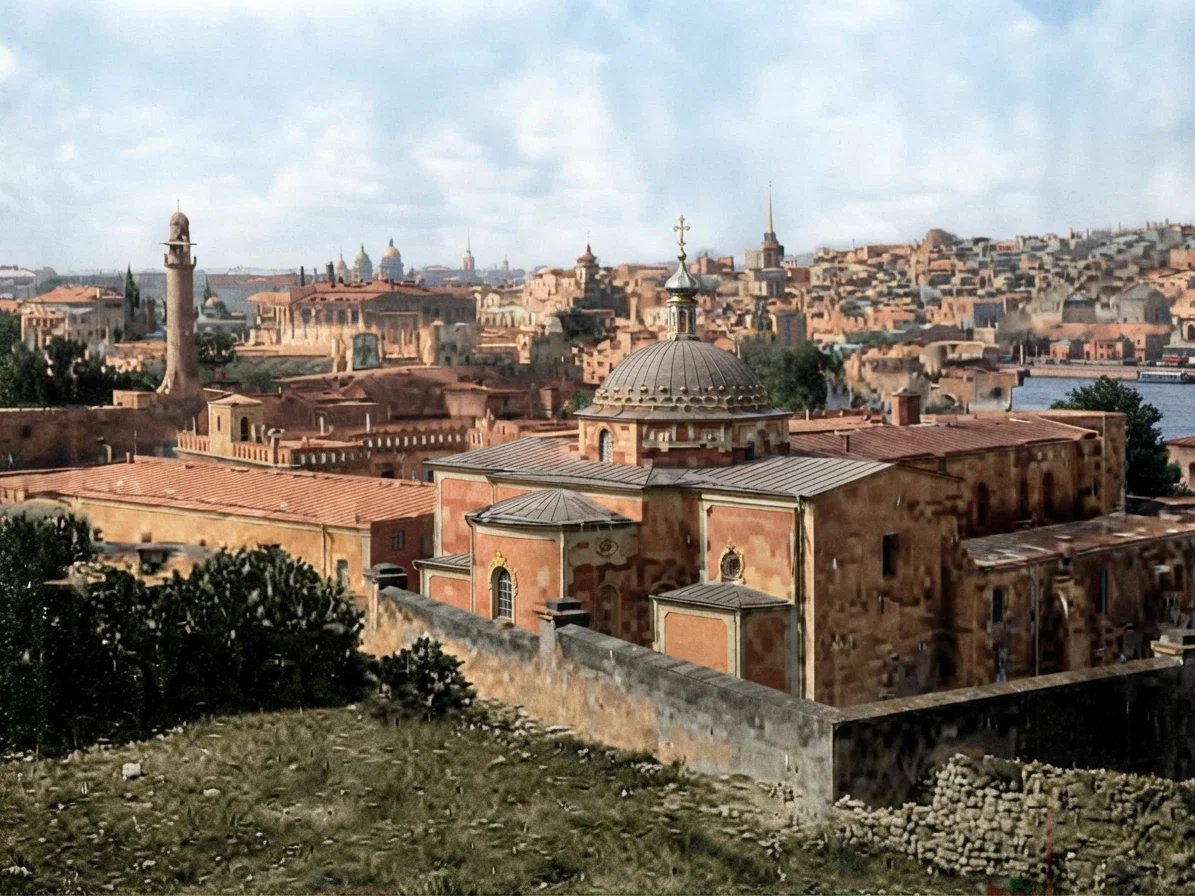
Palace of Paul I, Czar of Russia, Assassinated 1801.