How to Live a Century

6%

Pacific Press Publishing Company · Oakland, California · Mar 8, 1899

FromSigns of the Times, Vol. 25, No. 10.

Read the full edition

How to Live a Century

HOW TO LIVE A CENTURY. No. 6.
MAN is an animal, and is constituted with the same physiological powers, and upon the same great physiological principles, as the ox or horse and other animals; take from the ox the plain and simple food, and feed him on substances that are not natural to him, then mark the rapid deterioration that takes place in his constitution and nature; man is affected and changed in the same way. The plainer, and simpler, and more natural the food is, the more perfectly will the laws relating to the body be fulfilled and the more vigorous, healthy, and long-lived will the man be.
Every part of this wonderful living machinery should be carefully studied and understood. It is the duty of every person to study the laws that govern the house in which he lives, and then comply with them; for he who violates one of them, tho it be through ignorance, must pay the penalty.
Among the fruits, grains, nuts, and vegetables, man finds a perfect food which is especially adapted to him, and the more entirely he subsists on them, the more perfectly he fulfils the laws of his nature, and the greater will be his reward.
Fifty years ago Dr. Sylvester Graham said: "After having carefully and minutely examined all the anatomical and all the physiological evidences in relation to the natural dietetic character of man, we perceive that there is not the slightest reason for considering man an omnivorous animal, but that every jot and tittle both of anatomical and physiological, and I may add of psychological evidence relevant to the question, go to prove most clearly and conclusively that man is naturally a frugivorous and granivorous, or a fruit and vegetable-eating animal."
It must be admitted by every lover of flesh food that the taking of the lives of the lower animals to satisfy hunger in man, is akin to cannibalism, and is directly opposed to humanity and the feelings of a refined nature.
Those who live on grains, fruits, nuts, and vegetables, live long, have power of endurance, and will not die with disease contracted by eating the flesh of dead animals.
"Live and let live" is a good motto to follow; let the poor animal live, for he is full of disease, and his flesh, that is so freely eaten, is slaughtering the members of the human family, annually, by the thousands. So if you would live a century, let him live, and in return he will grant you the same privilege. Goldsmith says:— "No flocks that roam the valley free, To slaughter I condemn; Taught by the power that pities me, I learn to pity them." Why should we seek happiness and pleasure through the pain and death of another? "They shall not HURT nor DESTROY in all My holy mountain" (Isa. 11:9), are the words of the Creator, who made the animal—man, and his fellow, the beast.
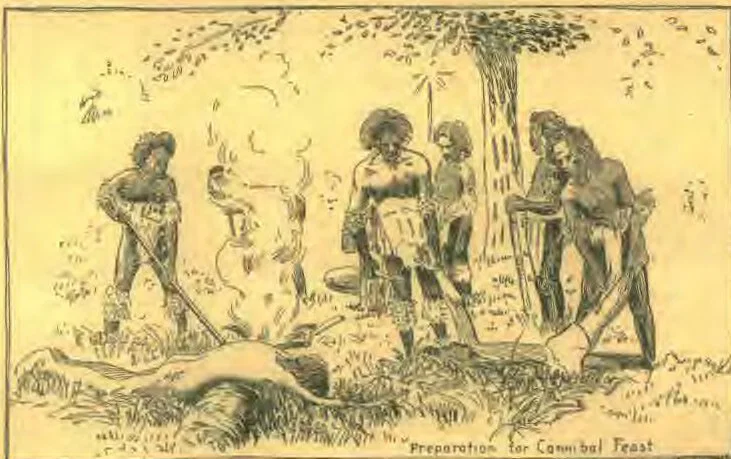
Preparation for Cannibal Feast
The vegetable world is the great storehouse of nature, from which animal, man, and beast receive energy and nutritive power. The thought that we can not have the ruddy glow to our cheeks, or be able to produce gems of thought from the brain, without first taking the life of some poor, innocent animal, and devouring his carcass, is a belief resting on ignorance.
The dumb animal goes to the vegetable storehouse for his energy; we can do the same. Vegetable fibrin and animal fibrin are identical, vegetable albumen is identical with animal albumen. There are grains, fruits, and nuts that far exceed roasts, steaks, and chops in albuminoids. Nuts furnish from 8 to 25 per cent. albumen, besides 50 per cent. of fat; grains, 7 to 15 per cent.; beans, 22 to 35 per cent.; peas, 22 per cent.; lentils, 25 per cent.; while pork contains on an average of 16 per cent.; fish, 13 per cent.; beef, 17½ per cent.
It has been demonstrated over and again that persons who live on fruits, grains, and nuts have more strength and power of endurance than those living on flesh diet. How could it be otherwise? The animal took the best, or "the cream," from the vegetable or grain when he ate and digested it, in order that his life might be sustained. And if we insist on eating the animal, we use the grain and vegetable in a second-hand manner; the first and best wear has been taken from them when they were first eaten by the other fellow; first, wear gives the best satisfaction.
Proteids, fats, carbohydrates, and minerals are the elements required for the perfect nutrition of the body. Proteids are found in abundance in beans, peas, and lentils, and are represented by gluten, albumen, fibrin, casein found in the wheat, milk, and eggs; nuts contain fully fifty per cent. of their weight in fats, also a large amount of proteids or albumen. Fats are also found in limited quantities in grains. Starch and sugar in various forms are carbohydrates. Rice and potatoes consist chiefly of starch; the heat and energy of the body are maintained by fats and carbohydrates, and as there is perhaps not a single article of food containing all of the elements necessary to keep the body in a perfectly healthy condition, it is highly important that a careful selection of food be made in order to combine one food that is deficient in suitable elements with others that have a surplus.
Dr. De Neville says: "Four classes of substances are necessary for the maintenance of life,—the albuminoids, the carbohydrates, the fats, and the minerals. Now meat contains but three of these, while the vegetables contain all four. Vegetable food is also necessary for our intellectual life; the phosphorus contained in vegetable food is almost double the amount contained in animal food. . . . Those who believe that meat gives the rose color to the cheeks and lips are in error. As Professor Musso has shown, the amount of iron oxide contained in vegetable food is much greater than that found in meat."
Dr. Lamb says: "The use of animal food hurries on life with an unnatural and unhealthy rapidity. We arrive at puberty too soon; the passions are developed too early, in the male acquire an impetuosity approaching to madness; females become mothers too early and too frequently; and, finally, the system becomes prematurely exhausted and destroyed, and we become diseased and old, when we ought to be in middle life."
In the words of another we say:— "Murdering is the business of the people; Beasts, birds, fish, all are murdered. The pelted ox is in the car; he is crazy at the rush. How wild and big his eyes! He snuffs murder ahead. A man knocks him down and stabs him. Dead so quick? His carcass is 'decently' cut in slices, And eaten by civilized cannibals. "Is there no other way to live? Angels, are there any slaughter-houses in your country? O chemists, phycologists, ethnologists, Try your skill at extracting pabulum from all things. With the destruction of life! Save us the universal crime of murdering And devouring the innocent." B. F. RICHARDS.