WHEN we speak of China’s having 426,000,000 people, we think it is a large number; but really we get no conception of what 426,000,000 means until we divide it into the provinces, as it is divided in this great empire. Let us look at some of these provinces, and make some comparisons. Take Szechuen; it has over 68,000,000 people, nearly as many as in the entire United States, and no representative of the third angel’s message there. Shangtung, a comparatively small province, has a population of 38,000,000, one-half the population of the United States, and no representative of the message. Chili, the seat of this country’s government, with its 20,000,000 souls, also has no worker. Then there are Hupeh, with 35,000,000; Nganhwei, with 23,000,000; Kiang-su, with 26,000,000; and the eight other provinces which have a population of anywhere from 5,000,000 to 13,000,000. These we have noticed have no representative of the message. Is it not a solemn thing to think that over 295,107,000 persons have never even heard of this message? This is the population living in the unentered provinces. Now let us view the situation in the provinces that have been entered, and you will see that it is much the same.
Entered Provinces.
Kuan-Tungin, in the south, has a population of over 31,000,000 people, and we have ten workers; Fukien has a population of over 22,000,000, and we have four workers there; Hunan also has a population of over 22,000,000, and we have but two workers there; in our own province of Honan, we have a population of over 35,000,000. Seven times the population of Australia and only nine workers! How would Australia get along with only one worker to 5,000,000, which would be in nearly the same proportion? How would the workers in the homeland feel if each one were held responsible for the carrying of the last warning message to nearly 4,000,000 persons? Can you imagine how difficult it has been for us who have been in China a little over a year to wait all thru this time with these millions all around us, and yet not be able to tell them of the Saviour’s love? These are some of the experiences that make the life of the missionary for the first year or two extremely hard. He sees the great need all around him, and is unable to do anything, owing to his inability to speak the native tongue. Our prayer is that as this letter is read, God will lay the burden on some that they, too, may join us in carrying the truth to this people. Think of the mighty problem that faces the workers already in the field. We now have twenty-five workers, and the population of the provinces already entered is 112,228,000—twenty-five workers to over 100,000,000 persons! Are we able to go up and possess this land? Human reason would say emphatically, “No.” But we, in the strength of an almighty God, whose the battle is, say more emphatically, “We are able.”
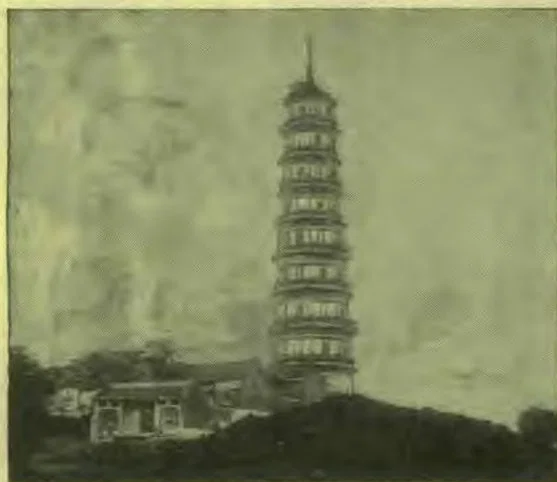
Pagnols, Monastery and Temple, China.
China Helping Another Mission Field.
An interesting resolution of the late Shanghai conference was that the donations from the Sabbath-school department in China for this year be given to the work in New Guinea. It does seem rather strange for a heathen land like China to be sending money to another mission field. But we all felt that it would do the native Christians good to know that their donations were going to help a people who are in a somewhat worse condition than are the people of China, if such a thing be possible; and I know that you will be interested to hear how the Chinese have taken up this idea. I will speak of our station. Previously to the Shanghai conference, we at Sin Yang Cheo had not organized any Sabbath-school, as we had been there but a short time; but just before Dr. Miller left for America, the committee on nominations recommended me for superintendent, and our evangelist for secretary.
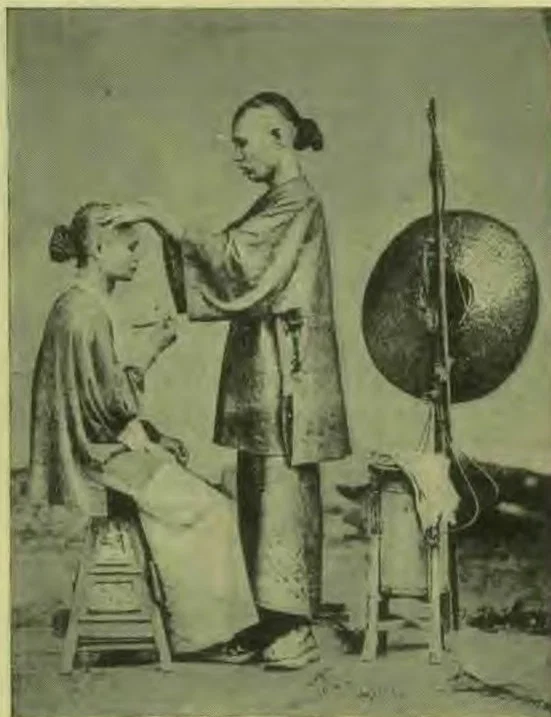
Itinerant Barber, China.
We also planned the next Sabbath to place before our Chinese brethren present the idea of giving to the work in New Guinea. Dr. Miller was not there that Sabbath, and I can assure you I found it very difficult to give them a very lengthy missionary talk on New Guinea. However, I obtained a Chinese map, and pointed out the position of the island, then proceeded to tell them that these people have no church, and that at the present time they are man-eaters. They were greatly interested in this fact, for they were horrified to learn that there is a portion of the globe where men eat one another, and they with us concluded that this would be the best place for our donations to go. This is proving a blessing to our Sabbath-schools here in Honan; and I believe that when we get the whole donation from the entire field, it will prove to be a valuable one. Brother Westrup from the Shang Tsai station, in speaking to me of this matter, told of the interest the Chinese Christians at his station are taking in this matter. Their donations for the last quarter amounted to five dollars gold. Our donations for the same time amounted to six dollars gold. These may not seem large amounts to you in the home churches; but if you take into account the poverty of the native Christians in this part of China, and also the other demands that call so largely for help in this empire, I am sure you will say that it is a good beginning in this work. On an average, in this part of China, many live on less than fifty cash a day. Many do not earn over 120 cash a day, and then they have to support a family on this, and so do not have much to give. (Twenty cash equal one cent.)