[The last two articles have been considering arguments for and against the Restoration of the Temporal Power to the Papacy. Among contributions to the subject a bishop has advocated absolute separation of church and state, as given in our last. This article continues the subject.]
THE question that naturally interests us most is what attitude the Vatican has taken in light of these principles. Many of the ranks of the church at first received this discourse with enthusiasm, and it seemed for a while to strike a friendly chord in the hearts of the people. But it must never be forgotten that the opinion of the people in the Catholic Church counts for very little, and it is soon smothered under the overwhelming authority of the hierarchy. Therefore after the people have expressed themselves, they quietly resign themselves to hear the verdict of the powers in the Vatican, and when that word has been uttered the question generally stops there. The matter caused such a stir, however, that Cardinal Ferrari, one of the most energetic prelates of the Catholic Church, took up the question in the provincial council of the bishops at Milan and they formulated a letter addressed to the pope, asking for a word from him on the subject. I quote from the cardinal’s letter as follows:
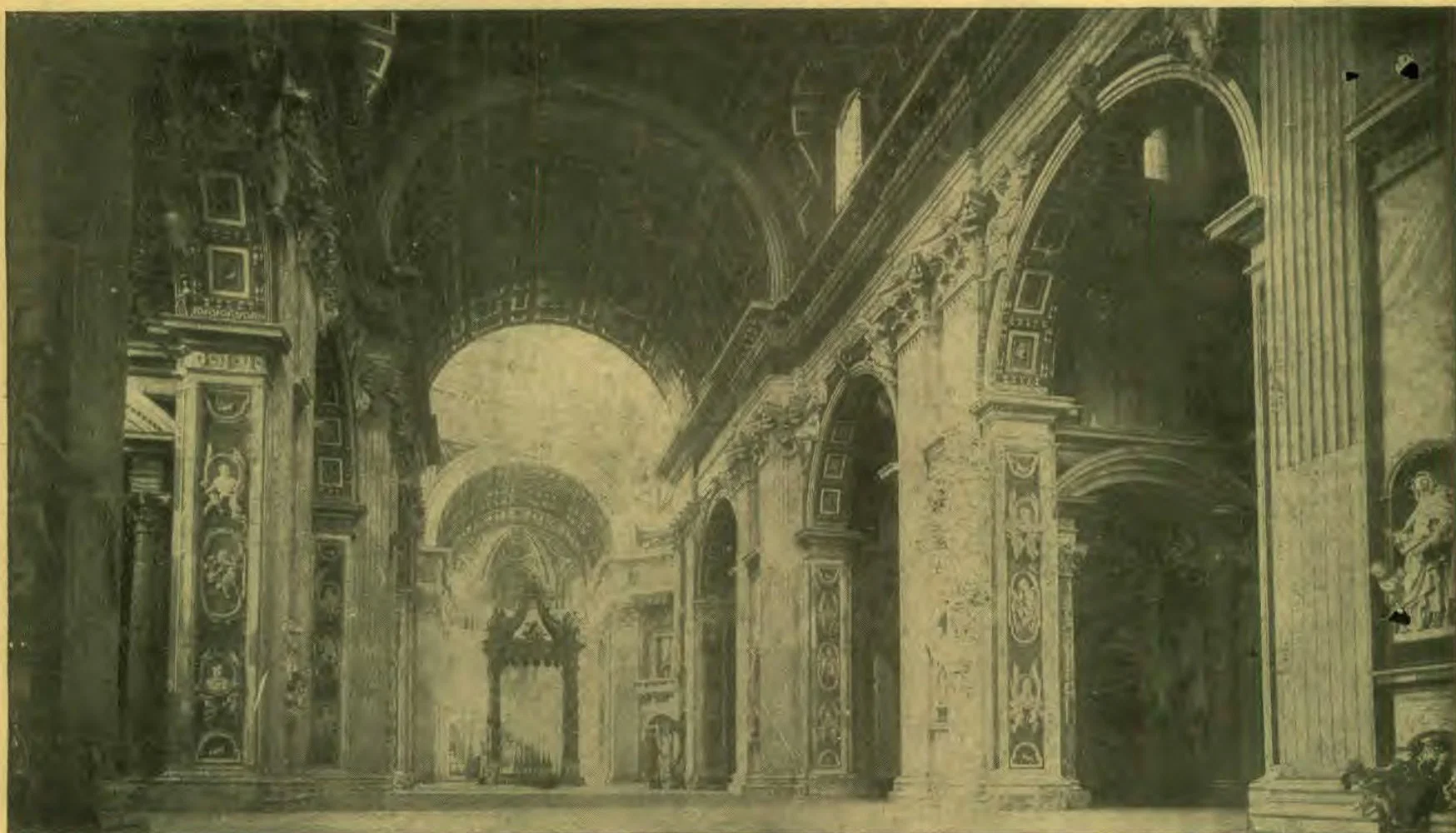
Interior of the Vatican Church.
We, the undersigned, gathered for the preparation of the acts of the provincial council, fully comprehend the profound impression that your word produces upon the children of the Catholic Church when you deplore the evils inflicted upon the church in France, and the proof of paternal benevolence that your holiness desires to extend to that noble nation. And our emotion is so much greater in that we are constrained to see with our own eyes, right around us, that is, in our own diocese, a voice [that of the bishop before referred to] which makes itself heard that is entirely out of harmony with yours, and one from which the liberal press takes the greatest advantage, to the detriment of the right doctrine and ecclesiastical discipline. And therefore, O holy father, we can not keep silent; for we greatly desire to comfort your soul which because of it is profoundly pained, and to show you that we adhere fully to your teachings and partake of your sorrows.
The pope, after consulting the cardinals of Rome, responded to the cardinal of Milan as follows:
I am grateful, sir cardinal, for the sentiments expressed in the letter which you, together with the bishops of the provincial council of Milan, have sent me. In the midst of our great grief for the ills that threaten the church of France, we feel comforted by the thought that our apostolic voice finds a response in the souls of the pastors and that they unite themselves to us in such a manner that not being able to accompany personally those generous faithful ones who are disposed to such great sacrifices, we have at any rate given a proof of our special affection, invoking upon these bishops the divine blessing.
We are furthermore very grateful to you, sir cardinal, and to the other venerable brethren, for your participation in the bitter grief of which our soul is full on account of the recent publications about the relation of the church and the state; a report truly deplorable in itself and for the unfortunate circumstances under which it was given, and more deplorable on account of its sorrowful consequences, as you and your colleagues, with profound regret, have lamented in the cited letter, as have also not a few other Italian bishops; that is to say for the most terrible damage which it causes in the minds of the great number of those who draw from the opinions of modern liberalism, and unaware of the distinction of subtilities, looking only at the source, believed as authoritative, whence emanate certain writings, and drink afterwards with the concurrence of a perverse press the deadly poison of certain teachings which will never be accepted by the church. For the rest, that we are watching with great solicitude that which regards the right doctrine and discipline you and your venerable pastors may be very sure, and that also in this case the care of the apostolic providence will not be lacking.
We can plainly see from what we have quoted above that the church has met the issue in no uncertain terms, and has defined its position with vehemence. And that which is but a just statement of the principles of religious liberty has been regarded and defined as a thing in itself deplorable by the head of the church, and the discourse of the bishop has been made out to be a document worthy of the severest reproof. It is evident, therefore, that the church of Rome has in nowise changed its position on the subject of the separation of church and state, but has again reiterated her former position with vehemence even in the face of a declaration of one of its own bishops to the contrary.
9
In fact, if we will note with some care the letter of the pope, we shall find that instead of discountenancing the fight against the government as it is at present carried on in France by the Catholics, he sanctions it. We have all read of the fierce fight that the Catholics are waging in France in their endeavor to defeat the law of the separation of the church from the state. Speaking of this conflict the pope says in his letter that while he may not be permitted to go in person to help the bishops of France, he can still send them his benediction in their struggle. So that the outbreaks in France have rather the sanction than the frown of the pope. The Catholic Church in France has never consented to the separation, but has fought it at every turn, and that with the approval of the Vatican. It is clear, therefore, that the Papacy has not changed its position one iota on the question of church and state, but rather insists, as one prelate has lately expressed it, that “it is absurd to think that one can divide the church altogether from the state, and that one can call the latter entirely secular.” This prelate was asked what disposition would be made of the case of Bishop Bonomelli, to which he replied that he thought he would be compelled to retract as he has had to do on another occasion when he uttered teachings that did not conform with the church.
The bishop who preached the discourse that has caused such a sensation came to Rome with the special purpose of explaining his position to the pope, after seeing how the Vatican viewed his utterance. But the pope did not wish to hear any explanation from him and would not even grant him an audience, altho the pope and the bishop have been intimate friends for many years. So that the bishop had to return home without even having seen the pope. The Vatican has, therefore, we see, taken a very decided position in the question, and has left no room for doubt as to its belief on the point in controversy.